

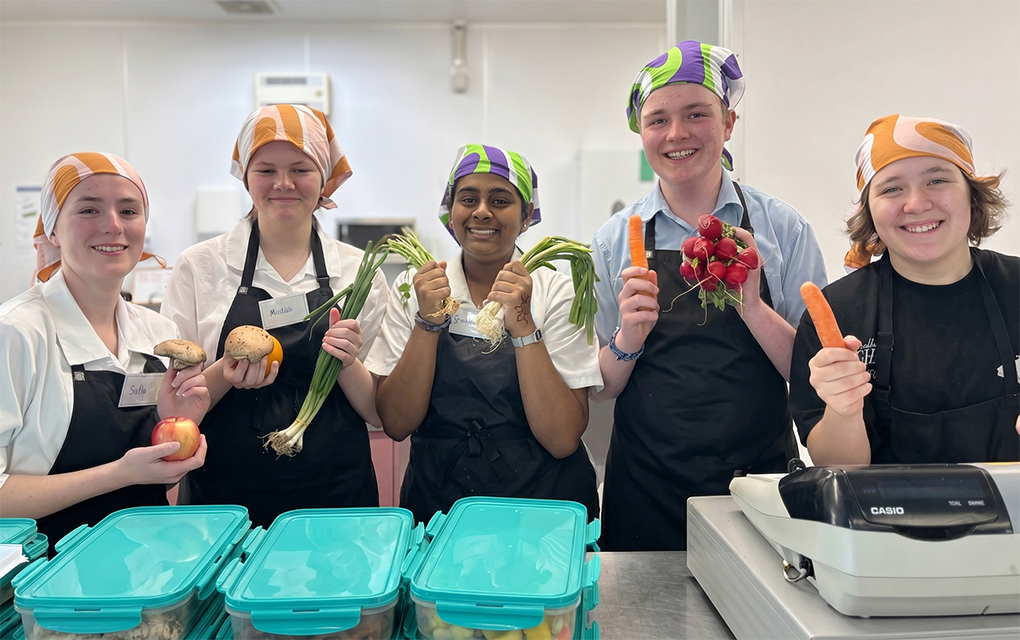

When Dr Luke Wilson first stepped into a bustling Ceres Community Project kitchen in Northern California, he felt something he hadn’t experienced in years of clinical practice: a sense of inevitability. Here, teenagers chopped vegetables beside retirees; medically tailored meals simmered on the stove; and the air carried the unmistakable hum of purpose.
“It was obvious,” he recalls. “This wasn’t just a meal service. It was a community health intervention disguised as dinner.”
Nineteen years after Ceres began its now-renowned model — one that delivered more than 226,000 meals in 2025 alone and trained hundreds of teen chefs and gardeners — Wilson, educator Jen Neill, and their friend and cook-extraordinaire-by-necessity Andrew Duncan have brought the first fully plant-based affiliate to Aotearoa.
They call it Rourou Kai Ora, “the healthy food basket,” and it is quietly transforming lives from a repurposed school cafeteria in Newlands, Wellington.
But although a registered charity is involved here, this is not a story about charity. It is a story about what happens when you give people — young and old — the tools to nourish themselves and each other.
A seed planted in California
Ceres Community Project began in Sonoma County with a simple premise: if people facing serious illness receive beautiful, organic, medically tailored meals — and if those meals are prepared by trained teenagers — everyone benefits. Clients heal. Teens gain skills, confidence, and purpose. Communities reconnect. Health systems save money. And food becomes medicine in the most literal sense.
The model has since expanded to multiple US affiliates and a Danish partner. But until now, no one had attempted it in New Zealand — and no one, anywhere, had attempted it inside a school.
“We’re the first to do it this way,” Wilson says. “Ceres was really interested. Even their US affiliates don’t run out of schools. But the opportunity was perfect.”
That opportunity came when the school’s cafeteria provider collapsed, leaving a fully equipped kitchen sitting idle. The school offered the space. Rourou Kai Ora brought the vision.
Three founders, one mission
The founding trio each arrived with a different piece of the puzzle.
- Dr Luke Wilson — medical doctor, lifestyle medicine advocate, and the project’s clinical anchor.
- Jen Neill — educator, youth mentor, and the architect of the teen volunteer programme.
- Andrew Duncan — the “not-a-chef-but-a-damn-good-cook” who could lead a kitchen full of teenagers with calm and competence.
Andrew’s path into the project began long before the first meal was plated. Twelve years ago, he and his wife went fully plant-based, inspired by his brother and surprised by the health improvements that followed. Cooking became a passion — but finding a meaningful outlet for it was harder.
“Hospitality is a tough industry,” he says. “Opening a café with young kids wasn’t realistic. I didn’t know where my skills fit.”
Then, at a birthday party, he met Luke and Jen — the only other vegans in the room. A conversation turned into weekly coffees. Weekly coffees turned into a shared vision. And that vision became Rourou Kai Ora.
“It felt like something I’d been looking into for years,” Andrew says. “A way to use what I’d learned for something bigger than myself.”
Big energy, humble start
Rourou Kai Ora’s first meals went out on October 6 last year, just before the end of the school year. The team ran a careful pilot: two weeks of teen training, followed by eight weeks of meal delivery.
“We wanted the teens to build capacity before we started sending meals out,” Jen explains. “We needed them to feel confident — not rushed.”
The teens came from a simple school assembly pitch. Jen expected a handful of interested students. Instead, 75 teenagers put their hands up.
“We had to narrow it down to 16,” she says. “And this year, after another assembly, we had another huge influx.”
There is now a waitlist.
More than cooking
The teens arrive after school, voluntarily, with no credits, no incentives, and no external rewards. They come because they want to help. Some have never turned on an oven.
“One of the first teens panicked because they accidentally turned the oven off,” Jen laughs. “They came to me terrified. I said, ‘Well… just turn it back on.’”
These moments are the heart of the programme. Confidence grows. Skills grow. And something deeper grows, too.
Andrew sees it every week.
“They design playlists, they laugh, they stay late if we’re behind. They’ve made the space their own,” he says. “Their commitment blows me away.”
One afternoon, a participant sent a handwritten card describing how the meals had changed their wellbeing. A teen volunteer read it and burst into tears.
“They realised, maybe for the first time, that they were helping someone,” Jen says. “It was beautiful.”
Food as treatment
Rourou Kai Ora partners with local GPs and the local marae, Ngā Hau e Whā o Papararangi. Participants are referred for chronic conditions — diabetes, heart disease, metabolic issues, and more.
“Many doctors don’t really understand what medically tailored meals are,” Wilson says. “Some think it’s a food security programme. It’s partially that, but it’s also a therapy.”
Meals are 100% whole-food, plant-based, low in salt, oil, and sugar — aligned with evidence-based dietary patterns known to improve chronic disease outcomes.
Participants receive seven meals a week for 12 weeks, with the option to extend to 24.
The results are promising. Some participants report profound shifts in how they think about food. Others simply feel better — so much better that they visit their GP less often.
Plant point power
One of the most effective educational tools has been the introduction of plant points — a simple count of how many different plant foods appear in each meal.
“It’s a great bridge into nutrition education,” Jen says. “The teens would say, ‘This meal has nine plant points — I probably eat that in a week.’”
From there, conversations flow naturally into gut microbiome health, diversity of plant intake, and why whole foods matter.
It’s nutrition education without the lecture — and without the resistance.
Inside the kitchen
Andrew leads the weekly menu cycle — four weeks of rotating meals, constantly tweaked for seasonality and plant diversity.
“We’re trying to give people as many plant points as we can,” he says. “But also meals that are hearty and satisfying.”
Recent dishes include:
- pineapple “fried” rice with pickled veg and baked tofu
- lentil loaf with tomato chutney, mashed potatoes, gravy, and coleslaw
- spaghetti with butternut squash sauce, a muffin, and broccoli
- leek and potato soup
- vegetable stew with polenta
Seven full meals per participant, every week. A main and two sides. Cooked by teens. Guided by adults. Delivered with intention.
The Rourou Kai Ora model
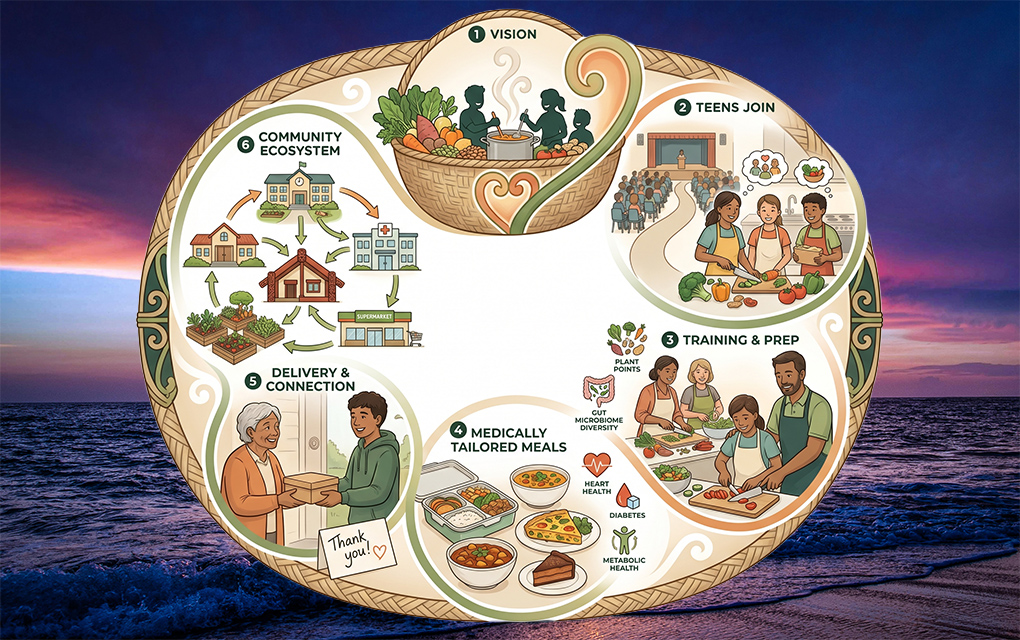
A community ecosystem
Adult volunteers prep ingredients from 1–3 pm. Teens arrive after school to cook. Meals go out to participants who often send back gratitude, stories, and sometimes tears.
The school is supportive. The marae is engaged. Local supermarkets and community centres are exploring partnerships. Demand is growing.
“We don’t want to overpromise and underdeliver,” Wilson says. “Right now, we’re focusing on high impact with smaller numbers.”
So far, around 25 teens and 25 participants have been involved.
The bigger picture
Wilson is clear: the teen component is not an add-on. It is central.
“When you give young people an opportunity to contribute, they rise to it,” he says.
The programme gives them:
- practical cooking skills
- nutrition literacy
- confidence
- community connection
- a sense of purpose
- and, for some, a pathway into future study or work
It also gives them something harder to quantify: pride.
National potential
Could Rourou Kai Ora expand across New Zealand?
“Definitely,” Wilson says. But the questions are big: Who should run it? Should government support it? Should it be community-led?
For now, the founders are simply doing the work. But the long-term vision is larger — a network of kitchens, gardens, and youth-led food-as-medicine hubs across the country.
New Zealand’s health system is ripe for such innovation.
Cafeteria becomes a beacon
The irony is not lost on anyone: the school cafeteria that once served deep-fried, ultraprocessed food is now home to a programme teaching teens how to cook whole-food, plant-based meals for people with chronic illness.
“It’s a win for the students too,” Jen says. “That food isn’t available anymore.”
The kitchen has become a sanctuary — a place where the noise of the world quiets and the work of healing begins.
Peering over the fence
Ceres affiliates in the US run garden programmes alongside their kitchens. Rourou Kai Ora hopes to do the same.
“There’s a community garden right next to the school,” Dr Wilson says. “We could partner with them. It would double our capacity for teen volunteers.”
The long-term dream is a standalone site — a hub for cooking, gardening, education, and community connection.
But for now, the school kitchen is enough. More than enough.
The broader view
New Zealand’s rates of childhood obesity, type 2 diabetes, and metabolic disease are among the highest in the OECD. Ultraprocessed food marketing saturates children’s lives. Many teens leave home unable to cook even basic meals.
Rourou Kai Ora is not a silver bullet. But it is a blueprint.
It shows what happens when:
- Food is treated as medicine
- Teens are treated as capable
- Communities are treated as interconnected
- And health is treated as something we build together
It is small. It is local. It is early. And it is working.
Final thoughts
“We know what this food can do,” Wilson says. “We’ve seen it. The teens see it. The participants feel it. And the community feels it too.”
Jen nods. “It’s mind, body, and soul. For everyone involved.”
In a modest school kitchen in Newlands, a movement is taking shape — one meal, one teen, one family at a time.
Rourou Kai Ora isn’t just feeding people.
It is nourishing a future.