

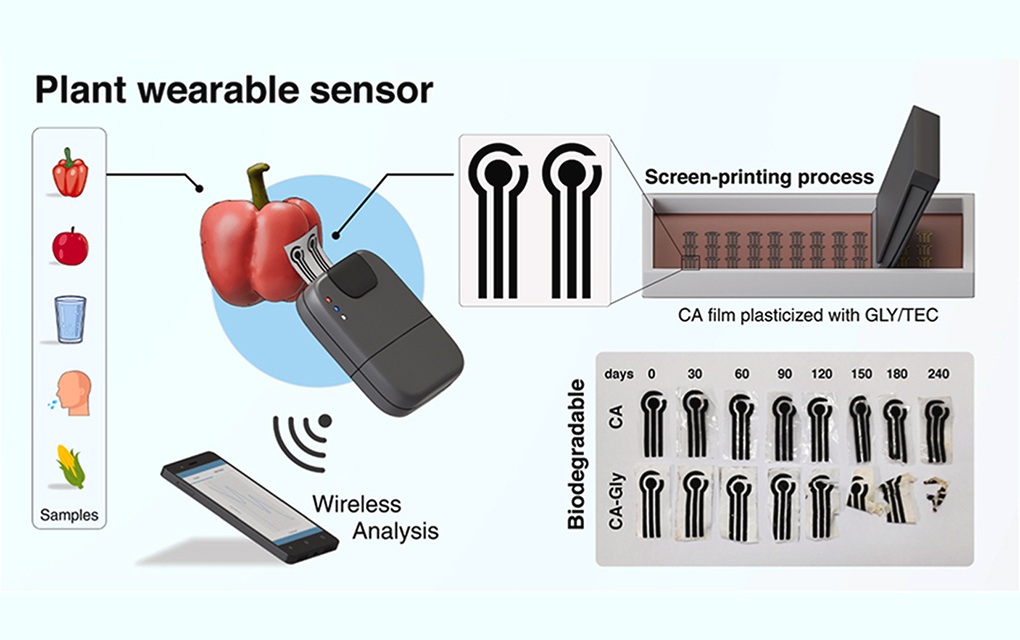

A team of Brazilian researchers has unveiled a breakthrough that could reshape how farmers, food producers, and even households monitor pesticide residues. Scientists at the São Carlos Institute of Physics at the University of São Paulo have developed ultra-thin, plant‑friendly “wearable” sensors made from biodegradable cellulose acetate — a plant‑based material that can be sourced from agricultural waste streams.
The tiny devices can detect multiple pesticides directly on the surface of fruits, vegetables, and living plants in just over three minutes.
A greener alternative
Most current wearable sensors rely on petroleum-derived plastics that struggle to adhere to curved or uneven surfaces and contribute to long-term waste. The new sensors, however, are screen‑printed onto flexible cellulose acetate bioplastic, offering a fully biodegradable, non‑toxic, and low‑cost alternative.
As lead researcher Paulo Augusto Raymundo‑Pereira explains, cellulose is the most abundant natural polysaccharide on Earth and brings “exceptional biocompatibility, high thermal stability, and flexibility” to the design.
Each disposable sensor costs just 0.077 cents to produce and can be burned under controlled conditions to recover carbon ink for new devices — a circular approach that further reduces environmental impact.
How they work
The platform integrates two analytical techniques — square‑wave voltammetry and differential pulse voltammetry — enabling the detection of three common pesticide classes (diquat, carbendazim, and diphenylamine) in a single test.
To take a reading, users simply place a droplet of water on the plant surface — such as the natural depression on a tomato stem or the grooves of a bell pepper — position the sensor over it, and let the device perform its analysis. The full process takes three minutes and twenty‑eight seconds.
A portable wireless potentiostat transmits results via Bluetooth to a smartphone, offering real‑time, on‑site monitoring without damaging the plant or fruit.
Tested on real foods
To simulate real‑world conditions, the team sprayed apples and bell peppers with agrochemicals, allowed them to dry, and then applied the sensors directly to the fruit surface. The devices successfully detected pesticide residues using only a small amount of buffer solution.
But the potential applications extend far beyond agriculture. The researchers demonstrated that the same sensors can detect pesticide traces in human saliva and tap water, and could eventually be adapted to monitor biomarkers in sweat and urine — opening doors to low‑cost, biodegradable health diagnostics.
Global relevance
Wearable sensors were named one of the World Economic Forum’s top emerging technologies in 2023 for their potential to boost agricultural productivity and plant health monitoring. Yet until now, most devices have relied on non‑renewable plastics and were designed primarily for human use.
Raymundo‑Pereira’s team is the first to create biodegradable versions suitable for both plants and people, with patent applications already filed in Brazil.
Given the growing global scrutiny of pesticide residues — and the increasing consumer demand for transparency — this innovation could offer farmers, regulators, and households a fast, affordable, and environmentally responsible tool for monitoring food safety.
For communities advocating cleaner food systems, reduced chemical exposure, and regenerative agriculture, this technology represents a meaningful step forward. It aligns with the push for low‑impact tools that empower growers and consumers alike to understand what’s really on their food — without adding more plastic to the planet.