


by Peter Barclay
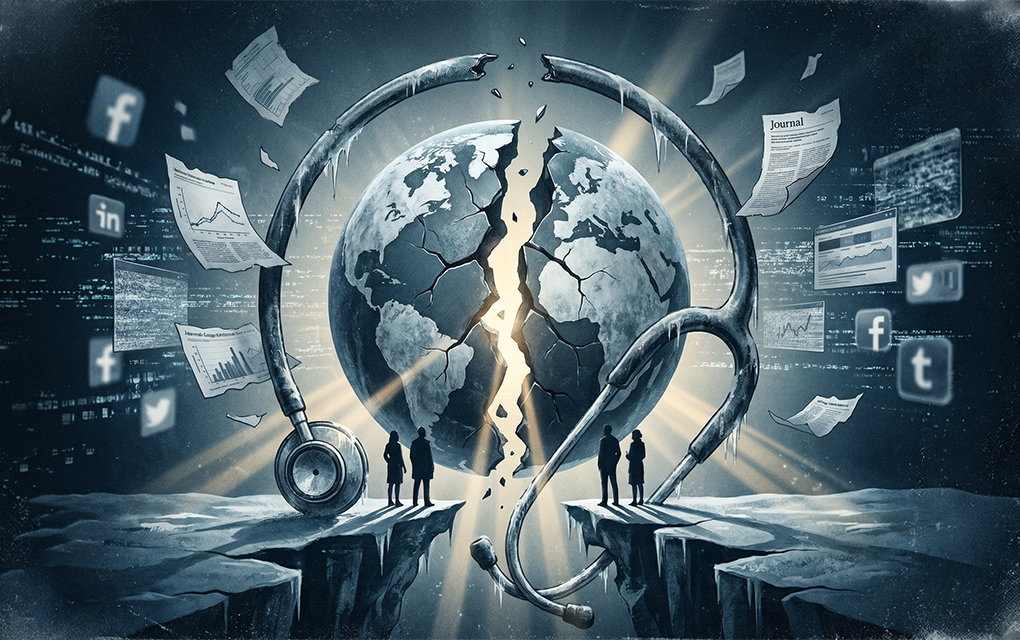
Something fundamental is shifting around us. You can feel it in GP waiting rooms, in supermarket aisles, and in almost every online debate about food, vaccines, or chronic disease. It’s not just political distrust or economic frustration anymore. It’s a deeper rupture: a global unravelling of trust in almost everything, from health systems and scientific institutions to political systems, global alignments, and the very idea of shared truth.
New Zealand is experiencing this fracture acutely, but the pattern is global. And when you place these developments alongside the generational‑cycle theory as explained in The Fourth Turning, the alignment is hard to ignore.
Authors Strauss and Howe argue that societies move through recurring 80–100‑year cycles, each ending in a crisis or a “Fourth Turning”, marked by institutional breakdown and a struggle to rebuild collective trust.
If they’re right, health and science have become central battlegrounds of this crisis era.
The problem in health
Let’s consider health care to begin with. Across New Zealand, people report longer wait times, fewer available GPs, and a sense that the system is stretched beyond capacity. The same story is unfolding worldwide:
- The UK’s NHS faces record waitlists.
- The US system is overwhelmed by cost barriers, declining life expectancy, and insurance battles.
- Australia, New Zealand, the US and Europe all struggle with workforce shortages and chronic disease burdens.
- Asia faces demographic collapse and rising healthcare demand.
Everywhere, demand is rising while capacity falls. Trust erodes. And in Fourth Turning terms, this is exactly how crisis eras manifest: institutions that once felt solid begin to wobble under demographic pressure, political short‑termism, and public disillusionment.
The degradation of science
For me, the most alarming trend has been the global decline of trust in science. The pandemic briefly elevated scientific authority, but shifting guidance, political interference, and misinformation created a backlash.
Today:
- US trust in scientists has fallen dramatically since 2019.
- Europe reports declining confidence among younger adults.
- New Zealand’s broader institutional distrust inevitably sweeps science into its wake.
- In Asia and Latin America, scientific legitimacy is increasingly politicised.
What’s happening is far from a communications failure. It is a structural crisis of authority. Until now, science has relied on a simple social contract: we trust scientists to tell us the truth; they trust us to act on it. That contract is now frayed, and a large set of inverted commas can be placed around the word ‘trust’.
But in Fourth Turning logic, this is predictable. Crisis eras are marked by the collapse of inherited authority. Institutions lose their aura. People seek alternative sources of truth: tribal, conspiratorial, or algorithmically amplified.
Fake news and misinformation
When trust collapses, misinformation fills the void.
- Anti‑vaccine movements surge.
- Miracle cures and wellness influencers replace evidence‑based guidance.
- Nutrition debates become ideological battlegrounds.
- Online communities reward outrage over nuance.
This isn’t because people are “stupid”. It’s because they’re deeply anxious and searching for certainty in a chaotic world. In Fourth Turning terms, it’s the “epistemic fragmentation” that precedes institutional rebuilding. Australia’s current effort to ban under-16s from social media is an attempt to rebuild the commercial giants running that world.
Economic stressors
A recent article published by NZ media outlet Stuff made a crucial point: economic pressure erodes trust. When people struggle to afford food, housing, healthcare, electricity or petrol, they become more suspicious of institutions and more vulnerable to polarisation and populism.
Chronic stress worsens health outcomes. Food insecurity drives reliance on ultra‑processed diets. Inequality widens health gaps. And as outcomes worsen, trust declines further.
This is the “winter” of the generational cycle where accumulated pressures force a reckoning.
Tribalism in health
One of the most disturbing trends is the rise of identity‑based health beliefs.
- Vaccination becomes political identity.
- Diet becomes tribal allegiance.
- Public health measures become culture‑war symbols.
Social media accelerates this shift. Heavy users of platforms like X and Reddit show the lowest levels of institutional trust. Algorithms reward extremity, not nuance.
In Fourth Turning terms, tribalism is a defining feature of crisis eras. When institutions lose legitimacy, people retreat into smaller, emotionally resonant identities. Health becomes a proxy for belonging.
The global pattern
If you zoom out, the parallels across nations are unmistakable:
- The US faces collapsing trust in public health agencies.
- Europe sees protests over mandates and widening health inequalities.
- Asia grapples with demographic stress and scientific scepticism.
- Latin America and Africa struggle with health infrastructure and distrust in global health bodies.
The pattern is global. The timing is synchronous. The themes are consistent.
What comes next?
The Fourth Turning is not a prophecy of doom. It describes cycles: breakdown followed by renewal. But after crisis comes reconstruction. At this point, some of the following might still look like a distant dream, but let’s look on the bright side.
A post‑crisis renewal could include:
- Transparent, accountable public health systems
- Honest scientific communication and new political alliances
- Investment in prevention and lifestyle medicine
- Improved understanding of climate science
- More equitable food systems
- Community‑based health models
- Re‑established shared truth through education and media reform
- A shift from individualism to collective wellbeing
This will be the work of the next generation.
A shared responsibility
Right now, I see a hunger for clarity, honesty, and trustworthy health information. Whole Food Living has always stood for evidence‑based health, food as medicine, the environment and community. But at this moment, at this generational hinge, I think all of us who understand where ill-health is coming from share a deeper responsibility.
We must help rebuild trust.
We must translate science into something human.
We must help people navigate uncertainty.
We must reconnect health to meaning, community, and agency.
If The Fourth Turning is right, we are living through the storm before the rebuild. What we choose to do now, how we communicate, how we listen, how we lead, will reshape our health and environmental landscape for decades to come.