

by Catherine Barclay
Language is one of the most powerful tools we have in the health and wellness world. It shapes how we think, how we act, and how we build movements that genuinely improve people’s lives.
Lately, however, I’ve found myself wrestling with a growing discomfort: the words we rely on most—the ones meant to sharpen our focus and strengthen our advocacy—are becoming so broad, so overused, and so commercially repurposed that their meaning is slipping through our fingers.
This isn’t just a linguistic irritation. It’s a real problem for anyone trying to communicate clearly, ethically, and with integrity in a sector that already struggles with misinformation and trend‑driven noise.
And I’ll be honest: I think we’re losing control of our vocabulary.
All or nothing
When every word means everything, they end up meaning nothing.
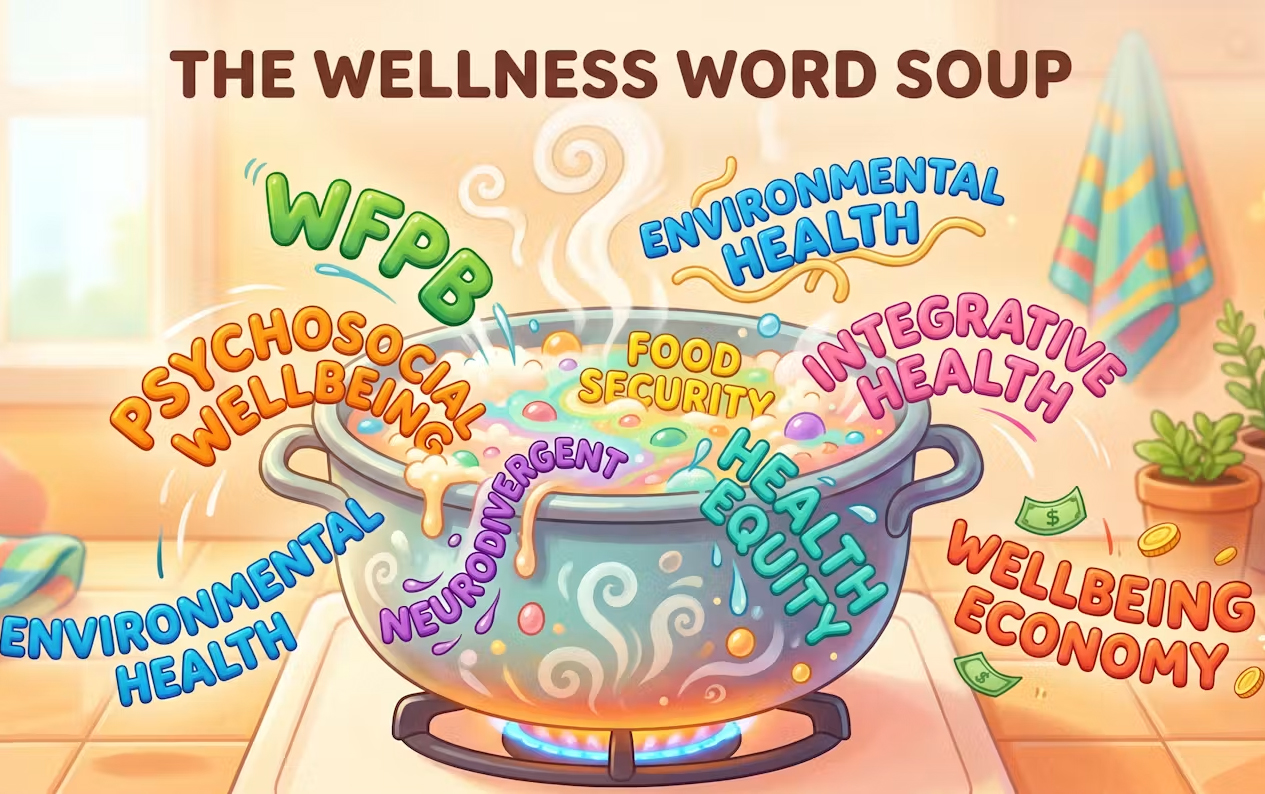
Terms like food security, neurodivergent, health equity, integrative health, wellbeing economy, and lifestyle medicine were created with precision. They emerged from research, advocacy, lived experience, and policy work. They were designed to describe specific realities and specific needs.
But as the wellness industry expands—and as commercial interests increasingly enter the conversation—these words are being stretched to fit marketing narratives, brand identities, and social media trends. What once carried weight now risks becoming vague, feel‑good language that can be applied to almost anything.
This is where intentional obfuscation creeps in. When a term becomes fashionable, it becomes profitable. And when it becomes profitable, it becomes tempting for brands to use it in ways that blur its meaning just enough to be convenient.
The result? A slow erosion of clarity.
Food security
The term ‘food security’, for instance, is one of the most important concepts in public health. It’s about reliable access to safe, nutritious, culturally appropriate food. It’s about affordability, stability, dignity, and community resilience.
But I’ve watched the term get flattened into a simplistic idea: “people having food.”
That reduction strips away the cultural, economic, and systemic layers that matter most. It also makes it easier for organisations to claim they “support food security” without addressing the deeper issues—like supply chain fragility, poverty, land access, or the nutritional quality of available food.
When commercial interests get involved, the term becomes more of a marketing asset rather than a call to action.
Neurodivergent divergence
The term neurodivergent was born from disability advocacy. It honours cognitive diversity and challenges the idea of a single “normal” brain. It carries history, identity, and community.
But as wellness brands adopt it, I’ve seen it drift into personality shorthand—used to describe creativity, sensitivity, or “thinking differently.” That shift may seem harmless, but it erases the lived realities of people who rely on the term for access, understanding, and support.
When language meant to empower becomes trendy, it risks becoming trivialised.
Health equity rebranded
Health equity is not a vibe. It’s not a brand value. It’s not a marketing angle.
It is a measurable goal: ensuring everyone has a fair opportunity to achieve their highest level of health, regardless of socioeconomic status, race, gender, disability, or geography.
But as the term spreads across wellness marketing, it’s often used symbolically rather than structurally. A company might claim to “support health equity” because it offers diverse imagery or flexible pricing. These gestures matter, but they are not the full picture.
Health equity requires policy reform, community investment, and systemic accountability. When the term is diluted, the urgency behind it dissolves.
Integrative health and LM
Integrative health and lifestyle medicine are grounded in clinical evidence. They involve multidisciplinary care, nutrition, movement, sleep, stress management, social connection, and reducing harmful substances.
But in the broader wellness world, these terms are increasingly used to describe anything that feels “holistic”—from journaling to cold plunges to “manifesting wellbeing.”
When evidence-based disciplines become catch-all phrases, their credibility suffers. And when commercial interests latch onto them, the science often gets overshadowed by the aesthetics.
The wellbeing economy
For me, this term is an excellent example of a systemic idea that’s shrinking into a marketing buzzword
The wellbeing economy is a radical concept. It’s about redesigning economic systems to prioritise human and planetary wellbeing over GDP growth. It’s about governance, policy, and societal values.
But as wellness brands adopt the term, it’s often used to describe internal culture, product lines, or brand ethos. The systemic meaning gets replaced with a personal one.
This shift matters because it changes the scale of the conversation. A term meant to challenge global economic structures becomes a slogan for consumer behaviour.
Why dilution happens
Several forces drive this broadening of language:
- Cross-sector adoption
- Social media’s preference for broad, relatable language
- Marketing pressure to appear socially conscious
- The commercial value of “inclusive” terminology
- The speed at which wellness trends spread
None of this is inherently malicious. But it does create a landscape where clarity becomes harder to maintain—and where intentional obfuscation becomes an easy way to appear progressive without doing the work. Or worse still, to make absolutely minor changes to make it seem like you’re doing the work.
Why it bugs me
As someone who works in health communication, branding, and community storytelling, I rely on language to build trust. Whole Food Living relies on language to educate, empower, and advocate for meaningful change.
When our industry’s most important words lose their meaning, our messages lose their impact.
If we want to advocate for food security, we need the term to retain its full definition. If we want to support neurodivergent communities, we need the term to be used respectfully. If we want to advance health equity, we need the term to stay tied to structural change. If we want to promote integrative health and lifestyle medicine, we need those terms to remain evidence-based. If we want to discuss the wellbeing economy, we need to keep its systemic roots intact.
In this sense, precision is not elitist; it’s ethical.
Keeping it simple
In a world where wellness language is becoming increasingly complex—and increasingly co-opted—there is enormous power in keeping things simple. Not simplistic. Not watered down. Just clear.
Clear language reaches more people. Clear language builds trust. Clear language resists intentional obfuscation. Clear language protects the integrity of the movements we care about.
When we strip away jargon and trend-driven vocabulary, we make space for real understanding—and real change.
Calling it out
My call to the wellness community is to resist the use of buzzwords.
We need more honesty. We need more clarity. We need more respect for the origins of the terms we use. We need more commitment to keeping our language grounded in reality, evidence, and community.
Words matter. And when we protect their meaning, we protect the people, systems, and futures they were created to serve.