


by Peter Barclay
For as long as I recall, every new patient form at a GP clinic I’ve signed up to has asked the same predictable questions: Do you smoke? How much alcohol do you drink? Are you allergic to anything? These questions are treated as essential—baseline information without which a doctor cannot safely or accurately interpret your health.
But there is one question that is almost never asked, despite being just as fundamental, and arguably far more influential on your day‑to‑day biology: What do you eat?
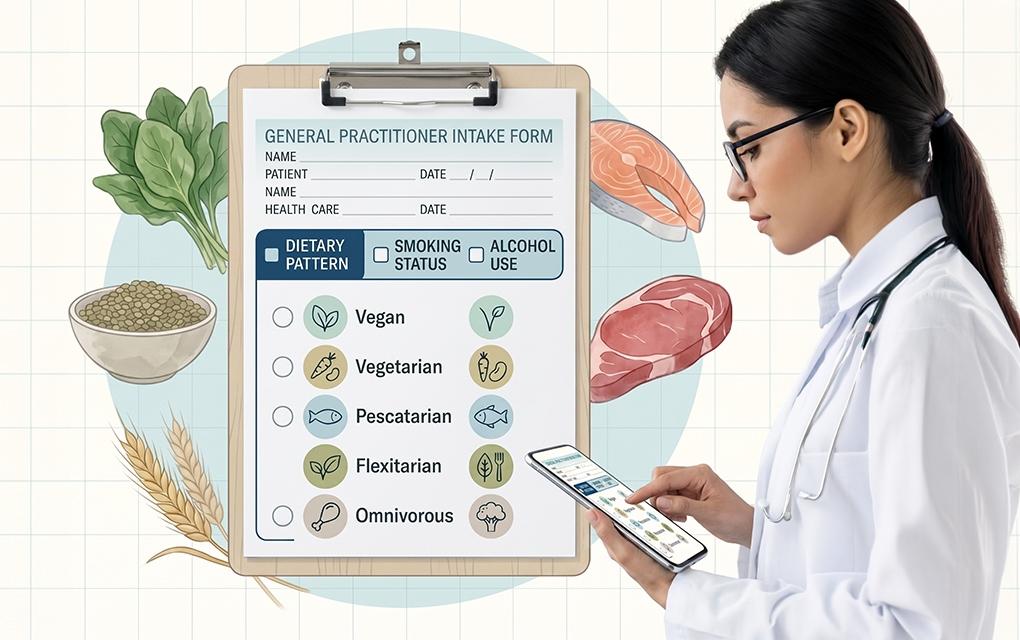
Not in vague terms. Not “Do you eat healthy?” Not “How many servings of fruit and vegetables do you get?” I mean a simple, factual, categorical question: Are you vegan, vegetarian, flexitarian, pescatarian, or omnivorous?
Obviously, we might debate diet categories, but for me, it seems almost too obvious. Yet the medical system still behaves as if diet is a lifestyle choice floating somewhere outside the realm of clinical relevance—important for long‑term health, yes, but not something that affects the interpretation of today’s blood test or tomorrow’s urine sample.
A new study I recently wrote about shows just how wrong that assumption is. And it raises a much bigger question: If diet can distort something as basic as creatinine, what else in our medical system is being misread, misinterpreted, or misdiagnosed simply because no one bothered to ask what we eat?
When normal isn’t normal
The study in question, published in the International Journal of Hygiene and Environmental Health, examined how creatinine—long used to “correct” urine samples—behaves in vegans versus omnivores. The findings were startling.
When researchers compared 24‑hour urine samples from vegans and omnivores, the two groups excreted identical amounts of a biomarker called DHPMA. But once the samples were adjusted using creatinine, vegans suddenly appeared to have lower levels—despite no biological difference at all.
Why? Because creatinine isn’t just a reflection of muscle mass, as scientists have assumed for decades. It also spikes for up to 10–12 hours after eating cooked meat or fish. That means an omnivore who ate a steak the night before a test will show an artificially elevated creatinine level the next morning. A vegan will not. The adjustment method itself creates a false difference.
This isn’t a minor technicality. Creatinine adjustment is used everywhere: environmental exposure studies, toxicology, nutritional epidemiology, and occupational health. And yet almost none of these studies record what participants ate the day before.
If diet can distort research at this scale, what does it mean for everyday clinical practice?
My own creatinine ‘problem’
Since adopting a whole‑food, plant‑based diet, my creatinine levels have consistently fallen below the standard reference range of 60–105. Every year, my lab report comes with the same warning: “Low serum creatinine; consider low muscle mass, weight loss, muscle wasting, or hyperthyroidism.”
None of these apply to me. I’m healthy, active, and certainly not wasting away. The only thing “wrong” with me is that I don’t eat meat.
But the reference range was built on populations that do.
This is the quiet scandal hiding in plain sight. If the “normal” range is based on people who eat animal muscle tissue, then vegans (by definition) will appear abnormal. Not because we are unhealthy, but because the yardstick is wrong.
And if creatinine is skewed, what else might be?
Other biomarkers
Creatinine is just one example. But it forces us to confront a bigger, more uncomfortable possibility: many of the reference ranges used in modern medicine may be subtly biased toward omnivorous physiology. Consider these few possibilities:
- HDL and LDL cholesterol: Vegans typically have lower LDL and often lower HDL. But if the “healthy” range was built on omnivores, are we misclassifying plant‑based patients as abnormal simply because their lipid metabolism differs?
- Vitamin B12: Vegans are routinely flagged for low B12, but omnivores can have artificially high serum B12 due to supplementation in animal feed. Are we comparing apples with fortified oranges?
- Inflammatory markers: Diet profoundly affects CRP, IL‑6, and other markers. Should a whole‑food plant‑based eater be judged by the same thresholds as someone consuming a high‑fat, high‑animal‑protein diet?
- Kidney function tests: Higher creatinine in omnivores can mimic reduced kidney function. Lower creatinine in vegans can mimic muscle wasting. Both interpretations can be wrong.
None of this means reference ranges are useless. But it does mean they are not neutral. They are shaped by the populations used to create them—and those populations have historically been overwhelmingly omnivorous.
If we want medicine to be accurate, fair, and personalised, we must stop pretending that diet is irrelevant.
A formal requirement
GPs need to ask about diet—formally, not casually. Most GPs will ask about diet only when a problem arises: high cholesterol, high blood pressure, or diabetes. But by then, the damage is already done. And even then, the question is often vague: “How’s your diet?” or “Are you eating well?” This is not enough.
Diet should be recorded the same way as smoking status: clearly, consistently, and at the very first appointment. Here’s why:
1. It improves interpretation of lab tests
If a GP knows you are vegan, they will interpret creatinine differently. They will understand that lower levels are normal for you, not a sign of muscle wasting. They may choose specific gravity instead of creatinine for urine correction. They may avoid unnecessary referrals or investigations.
2. It helps identify risks and strengths unique to your eating pattern
A vegan patient may need periodic B12 monitoring. An omnivore with high red‑meat intake may need more frequent lipid checks. A pescatarian may need mercury screening. A high‑fat keto eater may need cardiovascular monitoring.
Without knowing the diet, these decisions are guesswork.
3. It supports more personalised, effective health advice
Imagine two patients with identical cholesterol numbers. One eats a whole‑food plant‑based diet; the other eats processed meats and fried foods. The same numbers mean very different things. One may need reassurance; the other may need urgent intervention.
4. It acknowledges diet as a central determinant of health
We treat smoking as a vital sign. We treat alcohol intake as a vital sign. Yet diet—arguably the most powerful modifiable factor in chronic disease—is treated as an afterthought. This is a category error.
Population-level insights
There is another reason—one that extends far beyond individual test interpretation—why primary care should routinely record dietary patterns: the data itself would finally allow us to see patterns we have been blind to for decades.
Right now, we have no systematic way of understanding how disease prevalence differs between vegans, vegetarians, pescatarians, flexitarians, and omnivores within real‑world clinical settings. Researchers can run cohort studies, yes, but everyday primary‑care data—the richest, most immediate health dataset we have—is effectively diet‑blind.
It might seem like wishful thinking, but imagine if every GP practice in New Zealand, Australia, the UK, and the US collected a simple dietary‑pattern field. A single practice might not reveal much; the numbers would be small. But aggregated across regions, health networks, or national systems, the picture could be transformative.
We could finally examine questions such as:
- Are vegans genuinely less likely to present with hypertension or type 2 diabetes in primary care?
- Do omnivores show higher rates of gout, kidney stones, or inflammatory conditions?
- Are pescatarians more likely to show elevated mercury levels or specific neurological symptoms?
- Do flexitarians transition into healthier biomarker profiles over time?
- Are certain cancers more or less common in particular dietary groups?
Right now, we simply cannot answer these questions with confidence because the foundational data is missing. Diet is treated as anecdote, not as a structured variable.
And this matters. If creatinine reference ranges are skewed because they were built on omnivorous populations, then our understanding of disease prevalence may be skewed for the same reason. Without dietary‑pattern data, we risk mistaking population norms for biological norms.
A national or international dataset linking diet to disease patterns would allow researchers and clinicians to see associations that have been invisible until now. It would help refine reference ranges, improve diagnostic accuracy, and guide preventive care strategies tailored to real-world dietary diversity.
In other words, a simple dietary‑pattern question could become one of the most powerful epidemiological tools we have.
A simple fix
The solution is not complicated. Every GP intake form should include a mandatory dietary‑pattern question such as this:
Which of the following best describes your diet?
- Omnivore – consume animal, fish, plant and dairy products
- Vegan – never consume meat, fish or dairy
- Vegetarian – consume dairy but not meat or fish
- Pescatarian – consume fish but not animal meat
- Keto – follow a ketogenic diet
- Other – please specify
This one question would immediately improve the accuracy of lab interpretation, the relevance of clinical advice, and the quality of preventive care.
It would also help correct the subtle but pervasive bias built into medical reference ranges—bias that disadvantages plant‑based eaters by making their normal physiology appear abnormal.
Seeing the whole person
We need a healthcare system that sees the whole person. As plant‑based eating becomes more common, the medical system must evolve. The creatinine study is a wake‑up call: even the most basic biomarkers can be distorted when diet is ignored. And if that’s true for creatinine, it may be true for many others.
Diet is not a footnote. It is not a lifestyle detail. It is a biological context—one that shapes everything from kidney function to cholesterol to inflammation to toxicant exposure.
If we want healthcare that is accurate, equitable, and genuinely personalised, we must start with the simplest question of all: What do you eat?