


For years, nutrition science has told us that plant‑forward diets deliver more fibre, more micronutrients, and more protective phytochemicals. But until recently, we’ve known surprisingly little about how different plant‑based dietary patterns—vegan, vegetarian, pesco‑vegetarian, pro‑vegetarian, and omnivorous—actually compare when it comes to one of the most powerful families of bioactive compounds: polyphenols.
A major new study from Spain, the OMIVECA Study, offers the most detailed picture yet. By analysing both dietary intake and urinary biomarkers, researchers have mapped how polyphenol exposure differs across dietary patterns, which foods contribute most, and which compounds best reflect what people truly eat.
The findings are striking—and they carry important implications for public health, disease prevention, and how we think about the future of food.
Why polyphenols matter
Polyphenols are a vast group of plant‑derived compounds found in fruits, vegetables, legumes, whole grains, nuts, seeds, cocoa, coffee, tea, herbs, spices, and plant‑based beverages. They include flavonoids, phenolic acids, lignans, stilbenes, and other subclasses, each with unique biological effects.
They are widely recognised for their antioxidant and anti‑inflammatory properties, and have been linked to reduced risk of cardiovascular disease, neurodegenerative conditions, and some cancers . More than 10,000 polyphenols have been identified, though around 500 are commonly studied in nutrition research.
Yet measuring polyphenol intake is notoriously difficult. Food frequency questionnaires (FFQs) often miss key foods, and absorption varies widely depending on chemical structure and gut microbiota. That’s why the OMIVECA study’s dual approach—combining detailed dietary data with urinary biomarkers—is so valuable.
Inside OMIVECA
The study included 792 adults across Spain, most of them young (median age 22) and predominantly female (73%). Participants self‑identified as omnivores, vegans, ovo‑lacto‑vegetarians, pesco‑vegetarians, or pro‑vegetarians (omnivores with high adherence to a healthy plant‑based index).
A subset of 200 participants provided first‑morning urine samples, enabling researchers to quantify 28 individual polyphenols using advanced LC‑MS/MS analysis.
The study’s strength lies in its breadth: a 175‑item FFQ enriched with modern plant‑based foods—whole grains, berries, teas, plant‑based beverages, and meat alternatives—captured a contemporary picture of plant‑based eating patterns.
Big on delivery
Across the board, plant‑based diets (PBDs) delivered substantially higher total polyphenol intake than omnivorous diets. Median intake among omnivores was 739 mg/day, compared with 1120 mg/day in vegans, with other PBD groups falling in between.
This pattern held across most polyphenol subclasses:
- Flavonoids: higher in all PBD groups, especially vegans (653 mg/day) vs omnivores (396 mg/day)
- Phenolic acids: significantly higher in PBDs, driven by vegetables, fruits, and coffee/tea
- Lignans: nearly double in vegans compared with omnivores (74.7 vs 40.8 mg/day)
- Isoflavonoids: the most dramatic difference—vegans consumed ~100× more than omnivores (94.8 vs 0.1 mg/day) due to soy and legume intake
These differences reflect the foods that dominate each dietary pattern. Vegans consumed the most vegetables, legumes, nuts, spices, whole grains, and plant‑based alternatives, while pro‑vegetarians consumed the most fruit, chocolate, coffee, and tea
Biggest contributors
Across all participants, the top polyphenol contributors were:
- Fresh fruits (18.2%)
- Vegetables (14.6%)
- Coffee and tea (12%)
- Sugary items (10.6%)—mostly bottled fruit juices
- Berries (7.9%)
- Dark chocolate (6.9%)
- Nuts (5%)
But the pattern shifts dramatically by diet type.
Vegans
- Vegetables (20.8%) and fruits (10.4%) dominate
- Higher contributions from nuts, legumes, plant‑based beverages, and protein alternatives
Pro‑vegetarians
- Coffee and tea contribute the most (14.7%)
- Higher intake of whole grains and dark chocolate
Omnivores
- Higher contributions from bakery products, potatoes, and refined cereals
- Sugary items contribute more than twice the amount seen in PBD groups (13.4%)
These differences matter because different polyphenol subclasses have different biological effects. For example, flavonols from onions and brassicas, anthocyanins from berries, and isoflavones from soy each have distinct metabolic pathways and health impacts.
Urinary biomarker confirmation
Urinary polyphenols provide an objective measure of intake and metabolism. Here too, PBDs outperformed omnivores.
Total urinary polyphenols were significantly higher in all PBD groups, with vegans showing the highest concentrations (215 mg GAE/g creatinine vs 132 mg GAE/g creatinine in omnivores).
Isoflavones: The clearest signal
Urinary genistein and daidzein—the hallmark isoflavones of soy—were dramatically higher in vegans:
- Genistein: 469 ng/mL in vegans vs 4.6 ng/mL in omnivores
- Daidzein: 746.9 ng/mL in vegans vs 3.9 ng/mL in omnivores
These compounds showed the strongest correlations between intake and excretion (rho ~0.6), making them robust biomarkers of soy and legume consumption.
Other notable biomarkers
- Naringenin and hesperetin (from citrus) were higher in PBDs, especially vegans and pro‑vegetarians
- Enterolactone and enterodiol (microbiota‑derived lignans) were higher in PBDs, reflecting whole grain and seed intake
- Phenolic acids such as ferulic, caffeic, and p‑coumaric acids were consistently higher in PBDs, mirroring vegetable and whole‑grain consumption
A principal component analysis revealed three distinct urinary clusters:
- High‑isoflavone cluster—almost exclusively vegans
- High‑tyrosol/phenolic acid cluster—mostly PBDs
- Low‑polyphenol cluster—predominantly omnivores
The polyphenol‑rich diet score
The study also applied a Polyphenol‑Rich Diet Score (PPS). PBD groups scored significantly higher than omnivores, and the PPS correlated strongly with both dietary and urinary polyphenols (rho = 0.55 and 0.37, respectively).
This suggests the PPS could be a practical tool for assessing polyphenol exposure in population studies—something Whole Food Living readers may see more of in future research.
The study’s findings reinforce a growing body of evidence: plant‑based diets naturally deliver higher levels of protective polyphenols, and the diversity of these compounds increases with the diversity of plant foods consumed.
Key implications:
1. Polyphenols may help explain the health advantages of plant‑based diets.
Higher intakes of flavonoids, phenolic acids, lignans, and isoflavones have been linked to lower risk of chronic diseases, including cardiovascular disease, diabetes, and some cancers. The OMIVECA data strengthens the case that PBDs deliver these compounds in meaningful quantities.
2. Soy intake stands out.
The dramatic differences in isoflavone intake and excretion highlight soy’s unique role in vegan and vegetarian diets. Isoflavones have been associated with reduced all‑cause and cardiovascular mortality at intakes similar to those observed in the vegan group.
3. Coffee and tea matter—but not as much as we think.
In some cohorts, coffee accounts for up to 65% of total polyphenol intake. In OMIVECA, it contributed only 12%—though this rose to ~30% when larger portion sizes were modelled. This suggests cultural eating patterns strongly influence polyphenol profiles.
4. Biomarkers are essential for accurate assessment
The strong correlations for genistein and daidzein validate their use as objective markers of soy intake. Other biomarkers showed weaker correlations, reflecting the complexity of polyphenol metabolism.
Boiling it down
For WFPB followers, the message is clear: polyphenols thrive where plants thrive. So, to maximise your polyphenol intake:
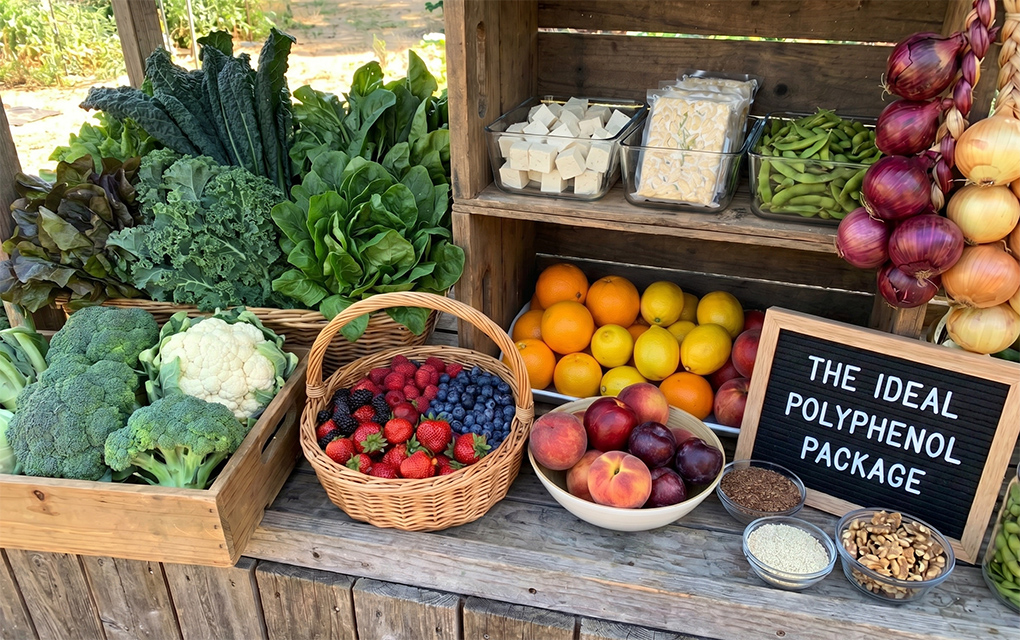
- Eat the rainbow—berries, leafy greens, brassicas, onions, citrus, stone fruit
- Include legumes daily—especially soy foods like tofu, tempeh, edamame
- Choose whole grains—rye, oats, barley, whole wheat
- Use herbs and spices liberally—turmeric, cinnamon, oregano, thyme
- Enjoy nuts and seeds—flaxseed, sesame, walnuts
- Drink polyphenol‑rich beverages—tea, coffee, kombucha
- Choose minimally processed plant‑based alternatives where possible
These foods don’t just add colour and flavour—they deliver measurable, biologically active compounds that support long‑term health.
A new lens
The OMIVECA study offers a powerful new lens for understanding how dietary patterns shape our biochemical landscape. It confirms what many Whole Food Living readers intuitively know: a diverse, whole‑food, plant‑based diet is rich not only in nutrients, but in protective phytochemicals that leave a measurable imprint on the body.
As plant‑based eating continues to evolve—with new foods, new cultural influences, and new scientific tools—polyphenols may become one of the most important markers of dietary quality. And as this study shows, they tell a compelling story.