

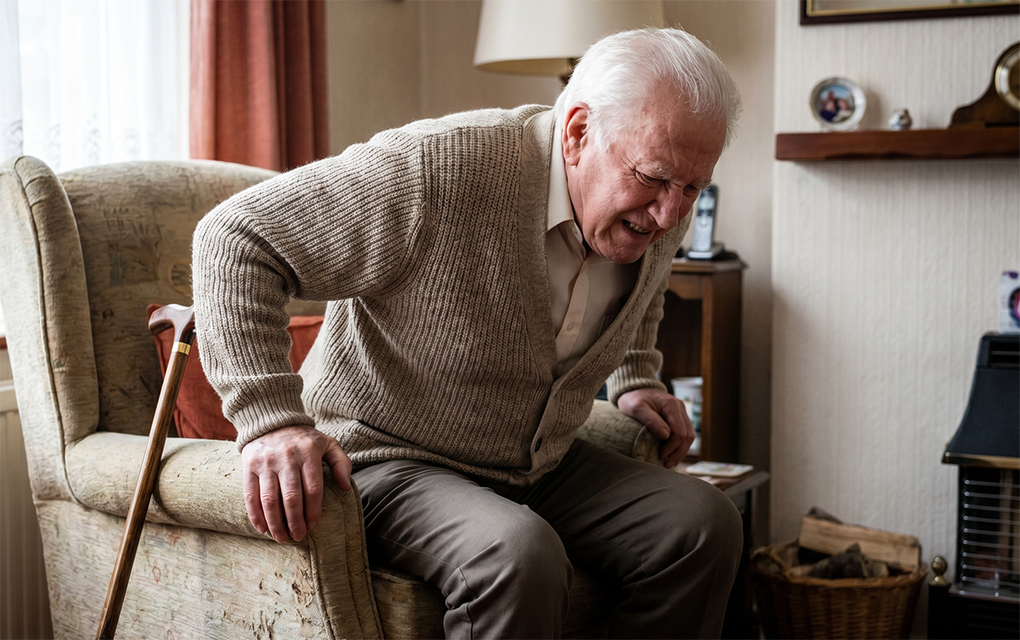

Older adults who struggle to rise from a chair may be signalling far more than tired legs. A major new study spanning 15 European countries suggests that this simple, everyday movement can predict future mental health, joint problems, and overall quality of life — long before more serious symptoms appear.
For Whole Food Living readers, the message is clear: mobility is medicine, and early signs of decline deserve attention, not resignation.
Researchers from the University of Sharjah in the UAE analysed data from more than 50,000 adults aged 50+ over nearly a decade. At the start, participants were asked one deceptively simple question: Do you have difficulty standing up from a chair after sitting for a long time? Nearly one in five said yes.
That single answer turned out to be a powerful predictor.
Older adults who reported difficulty rising from a chair were significantly more likely to experience:
- Lower quality of life in the years that followed
- Symptoms of depression and emotional distress
- Osteoarthritis and joint problems that limited daily movement
As senior researcher Khalid Saeed put it, this difficulty “is not just about the legs — it reflects a broader decline that can affect independence, confidence, and mental well-being”.
Implications for ageing well
Standing up from a chair requires a coordinated blend of strength, balance, and neuromuscular control. When this movement becomes difficult, people often begin to avoid activities — social outings, errands, even short walks — which can accelerate isolation and low mood.
The study’s authors emphasise that this early sign is clinically actionable. It requires no equipment, no testing, and no cost — yet it can help identify people at risk of psychosocial decline and musculoskeletal disease long before more serious conditions develop.
Interestingly, difficulty rising from a chair did not consistently predict heart disease or diabetes once age, weight, and existing conditions were accounted for — a reminder that chronic diseases have complex pathways.
Three key lessons
Prof. M. Azhar Hussain, who led the study, highlights three takeaways that resonate strongly with Whole Food Living’s focus on prevention and lifestyle medicine:
1. Early mobility challenges deserve attention, not dismissal. Difficulty rising from a chair is an early sign of functional decline — and a prompt for clinicians and families to intervene sooner rather than later.
2. Mental health and joint health are deeply intertwined. The strongest associations were with depression and osteoarthritis, not metabolic disease. Movement, mood, and mobility form a feedback loop that can spiral downward if ignored.
3. As populations age, simple screening tools matter
A single self-reported question can help health systems identify at‑risk individuals and support more independent ageing for longer.
This research reinforces a core principle WFL returns to often: small signals matter.
Just as dietary shifts, sleep patterns, and stress levels offer early clues about health, so too does the body’s ability to perform everyday movements.
Four practical steps
For older adults — and those supporting them — this study suggests practical steps:
- Check in regularly: If rising from a chair becomes harder, treat it as meaningful information.
- Prioritise strength and balance: Resistance training, tai chi, yoga, and daily functional movements can help maintain independence.
- Stay socially connected: Avoiding outings due to mobility challenges can accelerate emotional decline.
- Seek early assessment: A GP, physiotherapist, or geriatric specialist can help identify reversible causes and create a plan.
This is not about fear — it’s about empowerment. The earlier we notice changes, the more effectively we can respond.
The study concludes that self-reported difficulty rising from a chair is “a simple yet powerful predictor” of chronic disease risk and psychosocial decline in older adults, and a valuable low-cost screening tool for public health and clinical practice.
The bottom line here is that health is not defined by dramatic events, but by the quiet, everyday signals our bodies send us. Listening early — and responding with compassion, movement, and support — can change the trajectory of ageing.