

There are moments when a single flavour can pull you through time.
A spoonful of lentil soup that tastes exactly like your grandmother’s. The bright snap of summer tomatoes that returns you to a childhood garden. The smell of onions softening in a pan that signals home, even if you’re thousands of kilometres away. These experiences feel emotional, even spiritual, because they are.
Flavour is one of the brain’s most powerful storytellers, and food is one of the oldest ways humans have ever made sense of who we are.
In a world that often treats food as fuel, it’s easy to forget that eating is also remembering. Every bite carries a history—biological, cultural, and deeply personal. And when we choose whole, natural foods, we’re not just nourishing our bodies; we’re reconnecting with the sensory cues that shaped us long before we had language for belonging.
This is the quiet magic of food as memory.

This is the sixth in our fortnightly Healthy Food Series. The series consists of 12 features exploring the science, culture and shared joy of natural eating … The previous article in this series covered ‘Slow food rituals‘ – Energising the body from within.
Taste and time
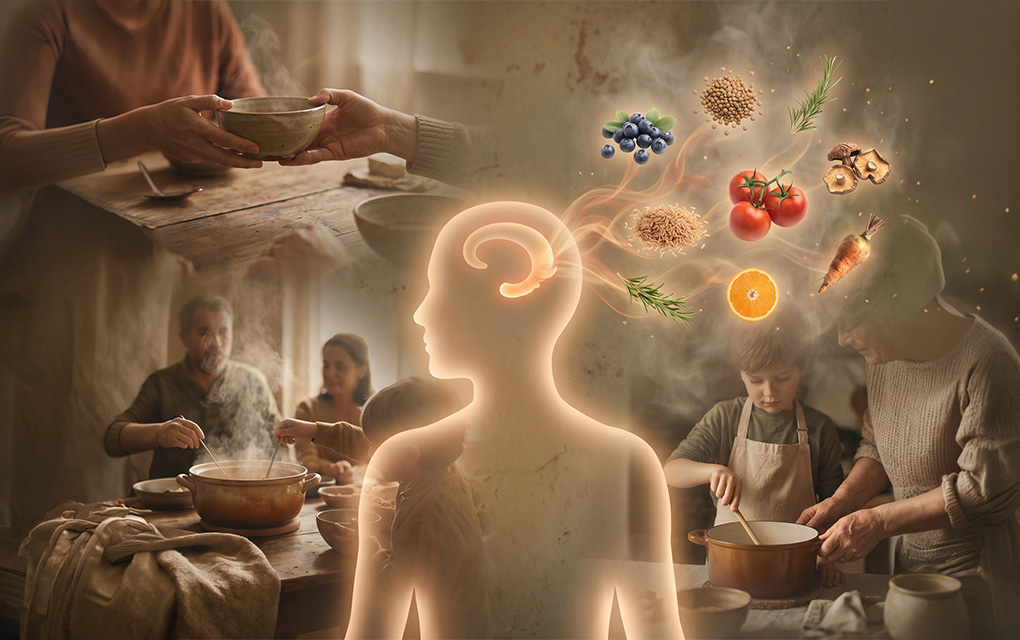
Taste is the only sense that has a direct, unfiltered line to the brain’s emotional and memory centres. When you eat, signals from your tongue travel straight to the hippocampus (the region responsible for memory formation) and the amygdala (the seat of emotion). No other sensory pathway is wired quite this intimately.
This is why flavour can unlock memories with a vividness that sight or sound rarely matches. Neuroscientists call this autobiographical recall—the brain’s ability to retrieve a memory with sensory detail, emotional tone, and contextual richness. In other words, flavour doesn’t just remind you of a moment; it lets you re‑experience it.
But the hippocampus does more than store memories. It also helps us form a sense of identity. It’s the part of the brain that answers the question: Who am I, and where do I belong? When flavours activate this region, they reinforce the stories we tell about ourselves—our families, our cultures, our childhoods, our rituals.
This is why the foods we grow up with become emotional anchors. They’re not just tastes; they’re neural pathways.
Meals and emotional anchors
If flavour connects us to our personal past, shared meals connect us to our collective one.
Humans have been gathering around food for more than 100,000 years. Long before we built cities or wrote stories, we cooked together. Anthropologists argue that communal eating is one of the earliest forms of social bonding—a behaviour that helped humans survive by strengthening trust, cooperation, and group identity.
Modern neuroscience backs this up. When people eat together, their nervous systems synchronise. Heart rates align. Breathing patterns soften. The brain releases oxytocin, the hormone associated with bonding and safety. Even chewing in rhythm with others increases feelings of connection.
This is why shared meals become emotional anchors. They’re not just social events; they’re biological rituals. They teach us who our people are. They teach us what “home” feels like.
And when those meals are built around whole, natural foods—foods that have existed across generations—they carry a deeper resonance. They become part of a lineage.
Intergenerational meaning
Every culture has flavours that act as memory keepers.
For some, it’s the earthy comfort of legumes simmered slowly with aromatics. For others, it’s the bright acidity of citrus, the grounding warmth of root vegetables, or the smoky depth of roasted peppers. These flavours endure because they’re tied to landscapes, seasons, and survival. They’re tied to the foods that nourished our ancestors long before industrial processing existed.
Whole foods—grains, beans, fruits, vegetables, herbs—are inherently intergenerational. They’re grown, harvested, shared, and passed down. They carry stories in their fibres.
A bowl of brown rice isn’t just a carbohydrate source; it’s a crop that sustained entire civilisations. A handful of berries isn’t just an antioxidant boost; it’s a seasonal marker that signals abundance or scarcity. A pot of lentils isn’t just protein; it’s a symbol of resourcefulness, hospitality, and care.
When we eat these foods today, we’re participating in a continuity that stretches back centuries. We’re tasting history.
And for many people, these foods are the last remaining thread to a culture they may no longer live in. A flavour can be a homeland.
Belonging through flavour
Belonging isn’t just a social feeling; it’s a psychological need. Humans are wired to seek connection—to people, to place, to story. Food is one of the most accessible ways we meet that need.
Psychologists describe food memories as identity markers. They help us understand:
- Where do we come from
- Who raised us
- What traditions shaped us
- What values do we inherit
- What comfort feels like
This is why people often crave the foods of their childhood during stressful times. The brain uses flavour as a shortcut to safety. A familiar taste can regulate the nervous system faster than a mindfulness exercise.
But belonging isn’t only backwards-looking. It’s also something we create. When we cook for others, we’re building new emotional associations. When we share meals, we’re forming new memories. When we introduce our children to the flavours we grew up with, we’re passing on identity.
Food becomes a bridge—between generations, between cultures, between versions of ourselves.
Your own food stories
Every reader has a flavour that shaped them.
Maybe it’s the smell of garlic hitting the pan, signalling that dinner was about to become something special. Maybe it’s the sweetness of stone fruit eaten over the sink in summer. Maybe it’s the earthy aroma of mushrooms after rain, or the tang of fermented foods that mark celebrations.
These stories matter. They’re not trivial or sentimental. They’re part of your neural architecture.
Think about the foods that formed you:
- What was the first dish that made you feel cared for?
- What flavour instantly brings you home?
- What meal taught you something about your culture?
- What food connects you to someone you’ve lost?
- What natural ingredients feel like part of your identity?
These aren’t just memories; they’re maps. They show you where you’ve been and what you value. And they can guide how you nourish yourself today.
Reclaiming memories
In a fast‑paced, convenience‑driven world, many people feel disconnected from the foods that once grounded them. Ultra‑processed products are engineered for intensity, not meaning. They stimulate the brain, but they don’t speak to it.
Whole foods, on the other hand, invite slowness. They require chopping, simmering, kneading, and tasting. They ask you to participate. They ask you to remember.
Cooking with natural ingredients is a form of memory work. It reconnects you to sensory cues that industrial food has flattened. It brings back the textures, aromas, and rhythms that shaped your early experiences of nourishment.
When you cook whole foods, you’re not just preparing a meal. You’re re‑entering a lineage of people who cooked before you. You’re honouring the flavours that built you. You’re creating new memories for the people who will come after you.
This is how food becomes identity in motion.
Food and reconnection
As people search for grounding in an increasingly fragmented world, many are returning to the foods that feel real, familiar, and meaningful. Not out of nostalgia, but out of a desire for connection.
Whole foods offer that connection. They’re sensory, emotional, cultural, and communal. They remind us that nourishment is not just biochemical—it’s relational.
When we choose foods that carry memory, we’re choosing to live in alignment with our own story. We’re choosing to honour the people who fed us, the places that shaped us, and the traditions that held us.
And we’re choosing to create new memories that future generations will taste and recognise.
A return to self
Food is one of the most intimate ways we experience the world. It’s how we celebrate, how we grieve, how we gather, how we heal. It’s how we remember.
Flavour is a language older than words. It tells us who we are.
And when we return to whole, natural foods—foods with history, foods with lineage, foods with meaning—we return to ourselves.