


by Peter Barclay
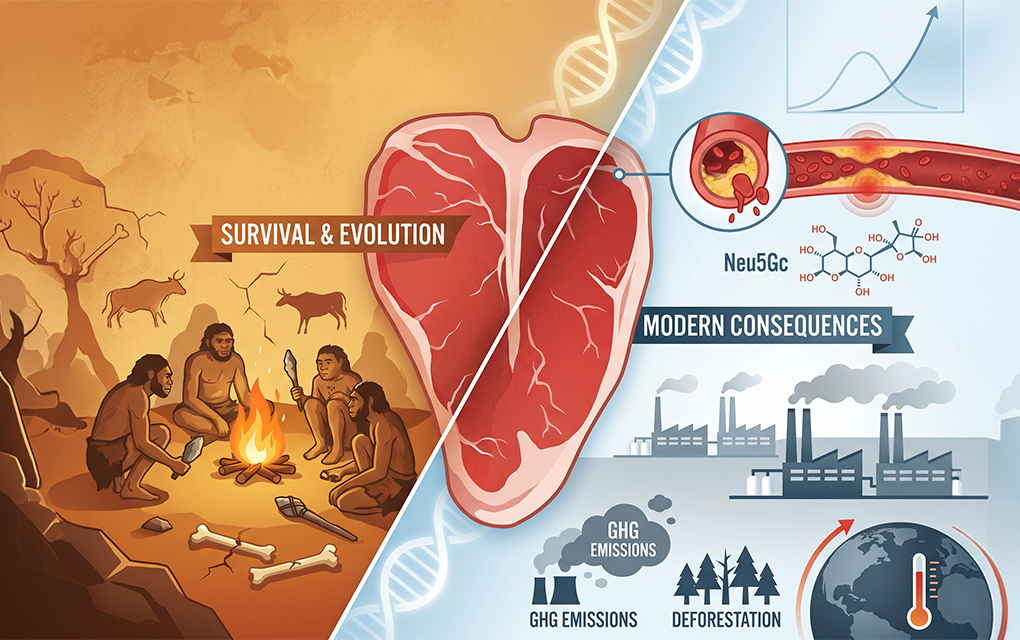
For most of human history, red meat was not a luxury, a cultural symbol, or a political flashpoint. It was a survival tool. A new interdisciplinary review published in The Quarterly Review of Biology traces this three‑million‑year relationship and argues that the very food that once fuelled our evolution has, in its industrialised modern form, become a driver of chronic disease and ecological instability.
The authors — Juston Jaco, Kalyan Banda, Ajit Varki, and Pascal Gagneux — weave together archaeology, anthropology, molecular biology, and epidemiology to show how red meat shifted from evolutionary advantage to modern liability.
Their central message is not anti‑meat; rather, it is a call to understand how profoundly the context of meat consumption has changed.
Scavenged fat to cultural icon
Archaeological evidence suggests that early hominins were incorporating animal‑derived foods long before the emergence of the genus Homo. But the review challenges the popular image of our ancestors as hunters chasing lean cuts of muscle.
Instead, fatty tissues, bone marrow, organs, and even brain matter were likely the most prized components — dense in calories and essential lipids needed to support the energy‑hungry developing brain.
The authors note that today’s Euro‑American cultural emphasis on steaks and roasts has shaped assumptions about what early humans valued. This modern lens obscures the reality that protein alone is a poor fuel for the brain; it was dietary flexibility — not meat alone — that supported human evolutionary success.
The turning point
The transition to agriculture 10,000–12,000 years ago brought stability but reduced dietary diversity. Ironically, iron deficiency — rare among hunter‑gatherers — became more common as cereal‑heavy diets limited iron absorption. This shift set the stage for the nutritional vulnerabilities we still grapple with today.
Fast‑forward to the 21st century: the global meat industry is now valued at US$1.3 trillion and continues to expand, particularly in low and middle‑income countries. But this growth comes with well‑documented health consequences.
Large epidemiological studies consistently link red and processed meat consumption to higher risks of cardiovascular disease, type 2 diabetes, colorectal cancer, and all‑cause mortality.
The International Agency for Research on Cancer (IARC) classifies processed meat as a Group 1 carcinogen and unprocessed red meat as probably carcinogenic — a distinction that underscores the strength of the evidence.
The xenosialitis difference
One of the most striking elements of the review is its discussion of “xenosialitis,” a diet‑mediated inflammatory process unique to humans. Roughly two million years ago, humans lost the ability to produce a sugar molecule called Neu5Gc. Yet this molecule remains abundant in red meat.
When consumed, Neu5Gc becomes incorporated into human tissues, where it interacts with antibodies the immune system produces against it — generating chronic, low‑grade inflammation.
This inflammatory cycle may contribute to atherosclerosis, colorectal cancer progression, and possibly cognitive decline.
For WFL followers, this mechanism adds a compelling biological layer to the epidemiological evidence: it suggests not just correlation, but a plausible pathway linking red meat to chronic disease.
Environmental fallout
Industrial livestock production is responsible for roughly 15% of global greenhouse gas emissions, while also driving deforestation, water contamination, and antibiotic resistance. These impacts are not evolutionary inevitabilities; they are products of modern scale, technology, and consumption patterns.
The review emphasises that the nature and scale of today’s meat consumption bear little resemblance to the small‑scale, opportunistic, and diverse diets of early humans.
The authors do not argue that humans must abandon red meat entirely. Instead, they situate modern consumption within a deep historical and biological context, showing how a once‑adaptive food source has, in its industrialised form, become a contributor to chronic disease and ecological degradation.
But their conclusion is clear: the flexibility that allowed our ancestors to thrive should guide us again. We are not locked into the dietary patterns of the past — but we must understand them to make better choices today.
Some central themes
This review reinforces several themes central to Whole Food Living’s mission:
- Dietary diversity matters. Our ancestors thrived on varied plant‑ and animal‑based foods, not meat‑heavy diets.
- Context is everything. The health impacts of red meat today cannot be separated from industrial production, processing, and scale.
- Inflammation is a key pathway. Mechanisms like xenosialitis highlight why red meat affects humans differently than other species.
- Environmental and health outcomes are intertwined. What harms the planet often harms the human body — and vice versa.
For readers navigating the modern food landscape, there’s a valuable and educational lesson in awareness here. Understanding the evolutionary story of red meat helps us see today’s choices with clearer eyes.