
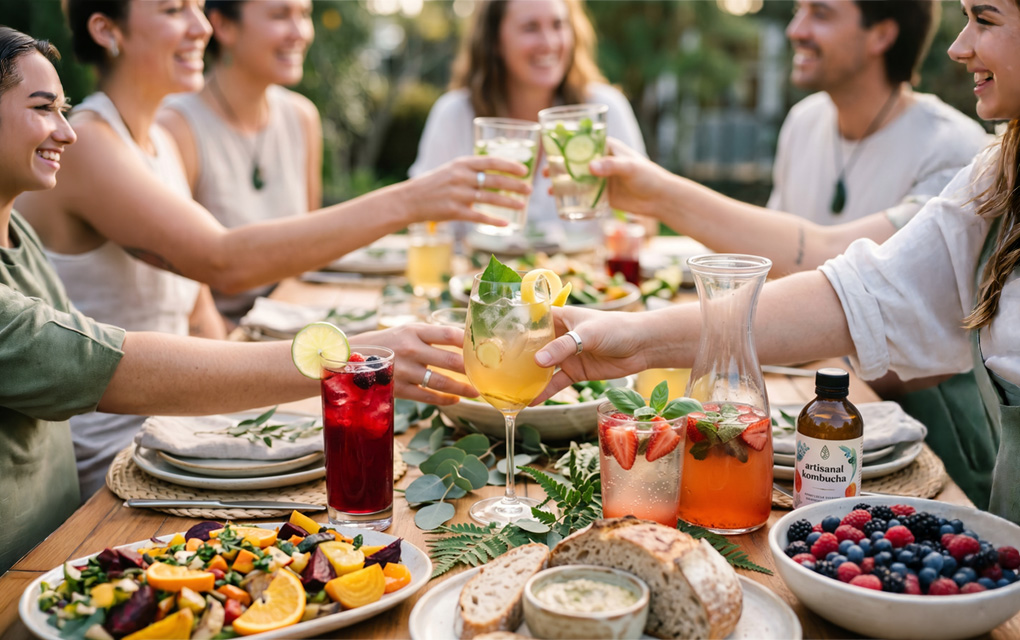

Why the future of socialising is flavour‑rich, gut‑friendly, and deeply connected.
For decades, social life in many cultures has orbited around alcohol. Friday drinks, dinner parties, weddings, work functions—every gathering seemed to come with a glass in hand. But something remarkable is happening around the globe: people are choosing to connect without the haze. Alcohol‑free gatherings aren’t just a trend; they’re a cultural shift toward clarity, well-being, and more meaningful connections.
This movement isn’t about deprivation. It’s about intention. It’s about discovering that celebration can be vibrant, sensory, and soulful without the after‑effects of alcohol. And it’s being fuelled by a growing understanding of what alcohol actually does to the body—especially sleep, mood, and gut health—paired with a renaissance of botanical drinks, kombucha, shrubs, and infused waters that bring complexity and pleasure to the glass.
Welcome to the new era of socialising: alcohol‑free, but full of life.
This is the seventh in our fortnightly Healthy Food Series. The series consists of 12 features exploring the science, culture and shared joy of natural eating … The previous article in this series covered ‘Food as Memory‘ – Energising the body from within.
Reviewing the science
Alcohol is often framed as a shortcut to relaxation, but physiologically, it does the opposite.
Even small amounts of alcohol:
- Suppress REM sleep, the phase essential for memory, emotional processing, and creativity
- Fragmented sleep cycles, causing micro‑awakenings
- Increase overnight heart rate and core temperature
- Reduce next‑day cognitive clarity
Many people report falling asleep faster after a drink, but the sleep they get is shallow and unrestorative. Wearable data from millions of nights confirms this: alcohol is one of the strongest disruptors of sleep quality.
When people remove alcohol—even for a week—they often describe waking with a clearer mind, steadier energy, and a sense of emotional resilience they didn’t realise they were missing.
The cortisol rollercoaster
Alcohol temporarily boosts GABA (a calming neurotransmitter) and dopamine (the reward chemical), which is why the first drink can feel relaxing. But the brain quickly compensates by increasing excitatory chemicals.
The result:
- Higher baseline anxiety the next day
- Mood volatility
- Reduced stress tolerance
- A “dip” in motivation and emotional steadiness
This rebound effect is so common it has a name: hangxiety.
Removing alcohol allows the nervous system to stabilise. People often describe feeling more grounded, more present, and more emotionally available in social settings.
A gut disruptor
Alcohol is a gut irritant. It:
- Increases intestinal permeability (“leaky gut”)
- Reduces beneficial bacteria
- Increases inflammation
- Impairs nutrient absorption
For people working to support gut health—through fibre, fermented foods, and whole‑food eating—alcohol can quietly undermine progress.
When alcohol is removed, the gut microbiome often rebounds quickly. Many people notice improved digestion, clearer skin, and more stable energy within weeks.
Rise in botanical drinks
As people step back from alcohol, they’re not settling for plain soda water. A new world of flavour has emerged—complex, adult, and deeply satisfying.
Botanical Drinks
These blends use herbs, spices, florals, and citrus to create layered, aromatic profiles. Think:
- Rosemary + grapefruit
- Ginger + kawakawa
- Hibiscus + lime
- Cucumber + mint + black pepper
Botanical drinks offer the sensory pleasure of a cocktail without the physiological cost.
Kombucha
Kombucha has become a staple at modern gatherings because it:
- Offers natural effervescence
- Contains organic acids that support digestion
- Provides a gentle probiotic effect
- Comes in sophisticated flavours like yuzu, ginger‑lemon, or berry‑hibiscus
It feels festive without being sugary or juvenile.
Shrubs
Shrubs—vinegar‑based fruit syrups—are making a comeback from their 18th‑century origins. They’re bright, tangy, and incredibly refreshing.
A splash of shrub with sparkling water creates a drink that feels intentional and grown‑up.
Infused Waters
Infused waters are the quiet achievers of alcohol‑free hosting. They’re beautiful, hydrating, and endlessly customisable:
- Orange + cinnamon
- Strawberry + basil
- Lemon + thyme
- Blueberry + lavender
They turn hydration into an experience.
Redefining celebration
Across cultures, alcohol has long been tied to ritual—weddings, toasts, milestones, grief, reunions. But communities are now re‑examining what celebration actually means.
Today, more and more people are craving presence. They want conversations they remember, laughter that isn’t fuelled by inhibition loss, and gatherings where everyone feels included—pregnant guests, sober‑curious friends, athletes, those on medication, and those simply choosing clarity.
Removing alcohol doesn’t remove ritual. It transforms it.
New rituals are emerging:
- Pouring kombucha into stemmed glasses
- Passing around a tray of botanical spritzes
- Opening a bottle of sparkling water with the same ceremony as champagne
- Sharing homemade shrubs or infused waters as gifts
The ritual remains; only the substance changes.
Alcohol‑free gatherings naturally include teenagers, elders, and those who prefer not to drink. They create a space where everyone participates equally, without pressure or explanation.
From sober‑curious communities to alcohol‑free bars in major cities, the world is reimagining what it means to gather. The shift isn’t about moralising; it’s about wellbeing, connection, and creativity.
Hosting with soul
Hosting without alcohol isn’t about removing something—it’s about elevating everything else. Start with a signature drink. Offer one or two crafted beverages that feel special. Create a drinks station.
Include:
- Sparkling water
- Kombucha varieties
- Fresh herbs
- Citrus slices
- Ice with frozen berries or edible flowers
- A shrub or botanical syrup
Let guests build their own combinations, and focus on texture and colour.
Use:
- Tall glasses
- Stemware
- Garnishes
- Clear ice
- Beautiful pitchers
Presentation is half the pleasure and can be a heap of fun.
Don’t forget the food
Offer nourishing, abundant food, some of it in small portions. Alcohol‑free gatherings shine when the food is vibrant:
- Roasted vegetable platters
- Fresh salads
- Dips and crudités
- Whole‑grain flatbreads
- Seasonal fruit
Food becomes the centrepiece rather than an afterthought.
The communal element
People bond through shared activity:
- Making dumplings
- Rolling sushi
- Building tacos
- Decorating fruit tarts
- Preparing a big salad together
This taps into the same communal energy as our recent slow‑food rituals article—connection through shared preparation.
Connection, clarity and care
Alcohol‑free gatherings aren’t about restriction—they’re about expansion. They expand our capacity to connect, to feel, to rest deeply, and to show up fully. They invite us to celebrate with intention rather than habit.
In a world that often pushes us toward numbing, choosing clarity is an act of self‑respect. Choosing connection without alcohol is an act of community care.
And choosing to gather around beautiful, nourishing drinks and food—botanicals, kombucha, shrubs, infused waters—is a way of saying: We can celebrate richly, joyfully, and wholeheartedly, without compromising our wellbeing.
This is socialising with soul.
It is the future of gathering.