
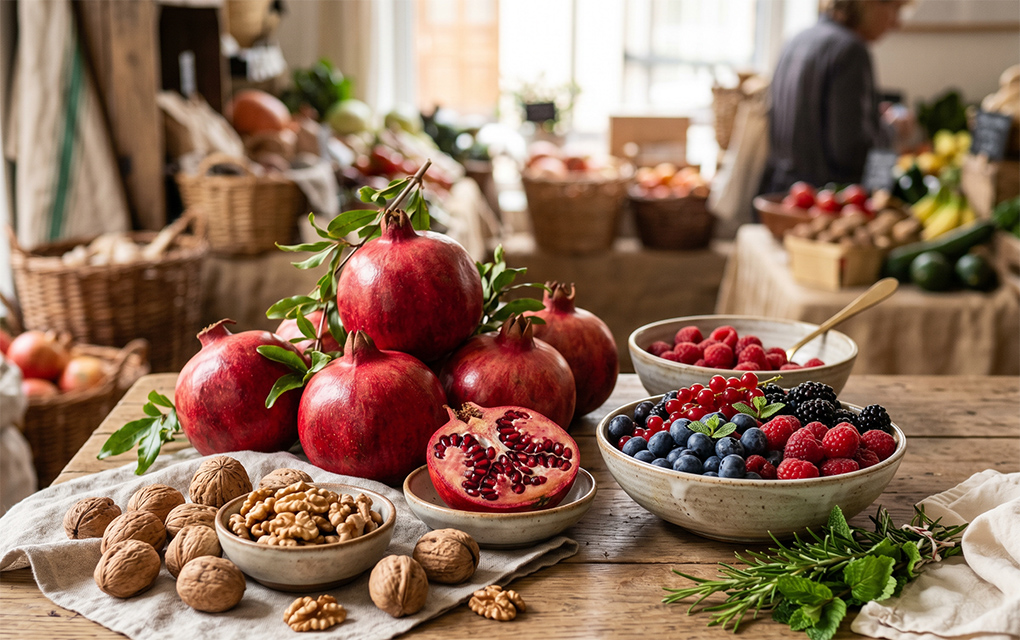

A recent study from the University of Louisville offers one of the clearest explanations yet of how certain plant foods — especially pomegranates, walnuts and berries — work with gut microbes to strengthen the intestinal barrier and support healing in inflammatory bowel disease (IBD). For anyone following Whole Food Living’s ongoing coverage of fibre-forward nutrition and gut health, this research is a milestone worth paying attention to.
The research team, led by Associate Professor Venkatakrishna Rao Jala, focused on urolithin A (UroA) — a microbial metabolite produced when gut bacteria break down polyphenols found in pomegranates, walnuts and berries. Their findings show that UroA activates a protective pathway in the gut that helps maintain barrier integrity and supports tissue repair.
IBD, which includes Crohn’s disease and ulcerative colitis, is marked by chronic inflammation and a weakened intestinal lining. When this barrier breaks down, harmful bacteria can leak into the body, triggering pain, inflammation and long-term complications.
The Louisville team discovered that UroA selectively activates the aryl hydrocarbon receptor (AHR) in intestinal epithelial cells — the cells that line and protect the gut.
A protective role
This targeted activation triggers a chain reaction that activates the NLRP6 inflammasome, a cellular defence system. While inflammasomes are often associated with harmful inflammation, this study shows that under the right conditions, they can play a protective role.
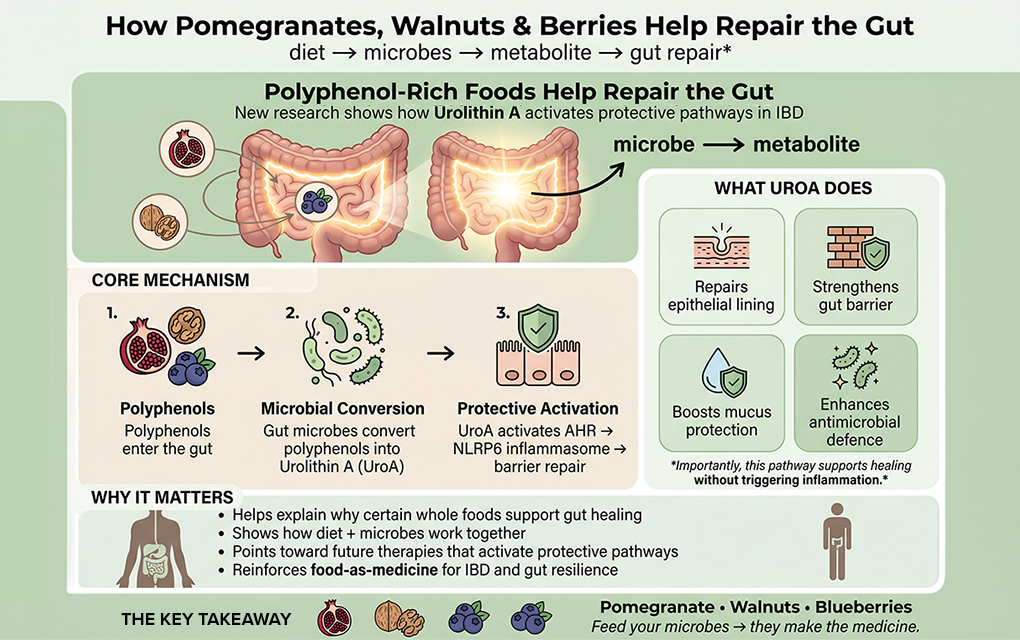
When UroA activates the NLRP6 inflammasome in epithelial cells, it triggers the release of molecules that help:
- Repair the gut lining
- Strengthen the intestinal barrier
- Increase protective mucus production
- Enhance antimicrobial defences
Crucially, this happens without promoting inflammation.
This is the first study to show how a natural microbial product works with the body’s own systems to coordinate complex molecular processes during intestinal injury.
As lead investigator Sweta Ghosh explains, “Not all inflammatory pathways are harmful… under the right conditions and in the right cells, these pathways can play an essential role in maintaining gut health and supporting tissue repair.”
Future treatment strategies
The team validated their findings using cell studies, organoids and intestinal tissue samples from patients with IBD — showing that UroA activates the same protective pathway in human tissue.
This opens the door to new therapeutic approaches that target specific protective pathways rather than broadly suppressing the immune system, which is the basis of many current IBD treatments.
Jala notes that understanding how natural compounds produced through interactions between diet, microbes and the body influence disease processes could lead to more precise therapies that restore intestinal balance.
The body system
This study reinforces a core message Whole Food Living has championed for years: the gut is a dynamic ecosystem, and healing depends on the interplay between diet, microbes and the body’s own repair systems.
The key implications:
- Polyphenol-rich foods matter — pomegranates, walnuts and berries aren’t just nutrient-dense; they feed gut microbes that produce beneficial metabolites like UroA.
- Microbial diversity is essential — without the right microbes, the body can’t generate UroA.
- Future therapies may be diet-driven — rather than suppressing inflammation, treatments may aim to activate protective pathways.
- Food-as-medicine continues to gain scientific traction — this study adds mechanistic clarity to what many Whole Food Living readers already experience firsthand, and strict WFPB followers have known well before our time.
For individuals living with IBD or chronic gut issues, this research offers hope: the path to healing may lie not only in pharmaceuticals but in supporting the gut ecosystem through whole foods and microbial balance.