


by Peter Barclay
When filmmaker Ryan Wirick created Farmacy of Light, he didn’t simply make a documentary about food. He made a film about energy — the energy that animates plants, the energy that fuels human metabolism, and the energy that connects biology and physics in ways we’re only beginning to understand.
It’s a film that asks us to look hard at the everyday miracle of nourishment and to consider what happens when our food system drifts too far from the source of life itself: light.
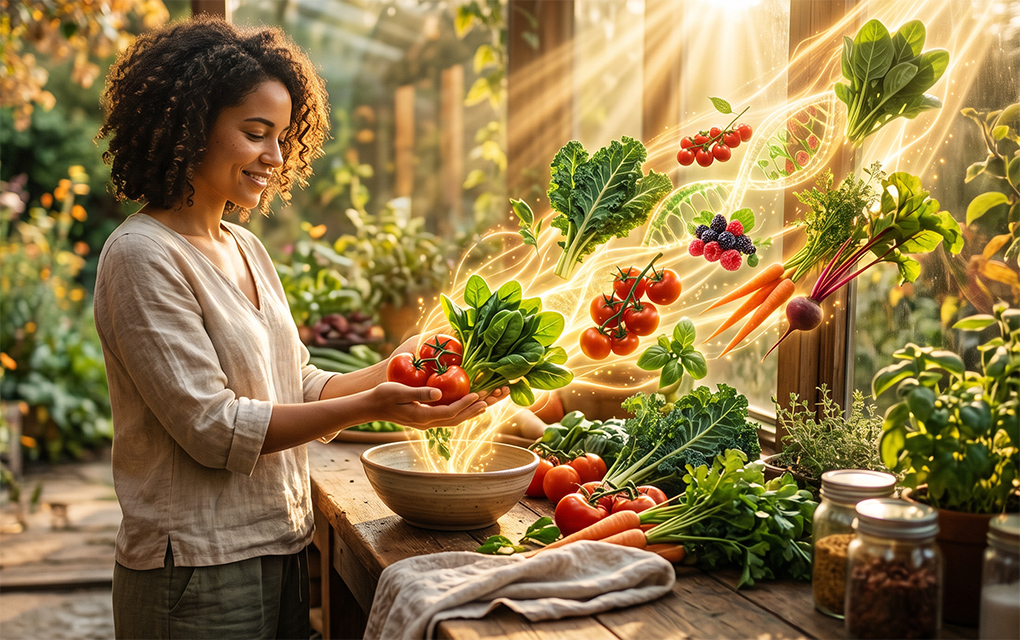
Wirick’s work is grounded in a simple but profound idea: Every bite of whole, fresh food is a biochemical echo of sunlight. And when we eat food that has lost its connection to that light — through distance, delay, or processing — we lose something essential too.
The film’s title is not a poetic flourish. It’s literal science, and something we covered in an article published nearly two years ago now.
The physics of food
At the heart of Farmacy of Light is the concept of photonic energy — the energy carried by photons, the particles of light. In physics, this is not metaphor. It’s measurable, quantifiable, and foundational.
Plants absorb photons through chlorophyll. That photonic energy excites electrons, drives photosynthesis, and becomes:
- polyphenols
- carotenoids
- flavonoids
- antioxidants
- vitamins
- fibre
- living cellular structures
Such compounds are the nutritional backbone of whole foods. They are the molecular signatures of sunlight, and Wirick’s film makes this connection explicit: Fresh food is the closest thing humans have to eating light.
This is where biology and physics merge — not in mysticism, but in mechanism. The film shows that the health benefits of whole foods are not abstract. They are the direct result of photonic energy transformed into biochemistry.
When food travels too far
One of the film’s most sobering facts is this: The average bite of “fresh” food in the United States travels 1,500 miles before it reaches a plate. By the time those miles accumulate, something else has been lost: Between harvest and market, vegetables can lose up to 45% of their nutritional value.
That’s kind of sobering for people like me here in New Zealand. Here, a trip of 1500 miles would cover more than the length of the entire country.
But there’s more than just spoilage at issue here. It’s the degradation of the very compounds created by photonic energy — antioxidants, vitamins, polyphenols, and other delicate molecules that break down with time, temperature, and handling.
The film argues that long‑distance food systems don’t just disconnect us from farms. They disconnect us from the physics of nourishment.
The living signature of fresh food
Farmacy of Light also touches on the emerging science of biophoton emission — the ultra‑weak light naturally emitted by living cells. While still a developing field, biophoton research suggests that:
- Living cells emit measurable light
- Stressed or damaged cells emit more
- Fresh, intact plant cells behave differently from processed ones
The film doesn’t overstate the science. It simply shows that life has a luminosity — faint, real, and detectable — and that fresh foods carry more of this living signature than foods that have been refined, milled, heated, or ultra‑processed.
It’s a reminder that “fresh” is not a marketing term. It’s a biological condition.
A cinematic language of light
Wirick uses light not just as a scientific theme but as a visual grammar. Gardens shimmer. Kitchens glow. Faces soften as people work together. The film’s aesthetic reinforces its thesis: whole foods are carriers of vitality, memory, and meaning.
This resonates deeply with food cultures around the world — including Māori and Pasifika traditions — where kai is understood as a living force, not a commodity. In Aotearoa, the idea that food grown in cared‑for soil carries a different kind of energy is not new. The film simply translates that wisdom into the language of physics.
Where LM meets quantum curiosity
What makes Farmacy of Light particularly relevant to Whole Food Living readers is how seamlessly it bridges lifestyle medicine with emerging scientific frontiers.
Without preaching, the film illustrates:
- How whole‑food diets reduce metabolic dysfunction
- How shared meals strengthen mental wellbeing
- How fresh foods support cellular resilience
- How ultra‑processed foods disrupt the body’s natural energy systems
- How biology and physics are converging to explain why whole foods heal
It’s a cinematic demonstration of what research increasingly shows: Health is not just biochemical. It is energetic.
A global message with local urgency
Although the film travels across cultures, its themes land squarely in New Zealand’s health landscape — rising obesity rates, widening income‑related disparities, and a food system increasingly dominated by ultra‑processed products.
Farmacy of Light doesn’t claim food alone can solve systemic inequity. But it does show how food can be a starting point — an empowering, immediate, human‑scale intervention.
For communities in Aotearoa, this message matters, and it reinforces what many already know: When we reclaim fresh, whole, local food, we reclaim our connection to the energy that sustains life.
The mystery of nourishment
There’s a mystery at the heart of nourishment, and the film captures it with a well-chosen quote from Albert Einstein: “The most beautiful experience we can have is the mysterious. It is the fundamental emotion that stands at the cradle of true art and true science.”
Farmacy of Light is built on that mystery. The mystery of how light becomes food. How food becomes health. How health becomes the capacity to live fully.
It’s a film that illuminates rather than instructs, inspires rather than lectures, and reminds us that the simplest acts — growing, cooking, sharing — are rooted in the deepest physics of life.