


by Whole Food Living
Longevity used to be framed as a numbers game — how many years we could add to the end of life. But the science has shifted. Today, researchers talk less about lifespan and more about healthspan: the years we spend mobile, mentally sharp, and free from chronic disease. Increasingly, the evidence points to one powerful lever we can control every day — what we eat.
Across global studies, four dietary patterns consistently emerge as longevity boosters: polyphenol‑rich foods, resistant starch, fermented foods, and plant diversity. Not supplements, superfood powders, or exotic imports.
They’re everyday foods that reshape the microbiome, reduce inflammation, and strengthen the metabolic pathways that keep us thriving well into older age.
Here’s what the latest science reveals — and how you can bring these longevity foods into your kitchen.
Our cellular shield
Polyphenols are the colourful compounds in plants that act like microscopic bodyguards. They neutralise oxidative stress, reduce inflammation, and support vascular health — three pillars of healthy ageing.
Large cohort studies from Europe, Japan, and the US show that people with the highest polyphenol intake have lower rates of cardiovascular disease, cognitive decline, and all‑cause mortality. But the magic isn’t just in the compounds themselves. Polyphenols also feed beneficial gut microbes, which transform them into even more potent metabolites. But where do we find them?
Think colour, bitterness, and variety:
- Berries, cherries, plums
- Red cabbage, purple kūmara, beetroot
- Herbs and spices (oregano, turmeric, cinnamon)
- Green tea, black tea, coffee
- Dark leafy greens
- Cocoa and dark chocolate
How to use them daily
- Add a handful of berries to porridge or overnight oats.
- Swap one coffee for a green tea.
- Build meals around colourful vegetables — the deeper the colour, the higher the polyphenols.
- Use herbs and spices liberally; they’re tiny longevity bombs.
Resistant starch bonus
Resistant starch is a type of carbohydrate that resists digestion in the small intestine and becomes food for the microbiome. When gut bacteria ferment resistant starch, they produce butyrate, a short‑chain fatty acid linked to reduced inflammation, improved insulin sensitivity, and protection against colon cancer.
Emerging research shows that diets high in resistant starch can improve metabolic health, reduce visceral fat, and support healthy ageing — even without weight loss.
Where to find it
- Cooked‑and‑cooled potatoes, rice, and pasta
- Green bananas and plantains
- Lentils, chickpeas, and beans
- Whole grains like barley and oats
How to use it daily
- Make a big batch of potato salad or rice salad and keep it in the fridge.
- Add lentils to soups, curries, and pasta sauces.
- Blend a green banana into a smoothie for a fibre‑rich base.
- Choose whole grains over refined ones — barley risotto, steel‑cut oats, wholegrain sourdough.
30 plants a week
One of the most influential findings in microbiome science comes from the American Gut Project: people who eat 30 different plant foods per week have significantly more diverse gut microbiomes than those who eat fewer than 10.
Microbial diversity is strongly associated with resilience — lower inflammation, better metabolic health, and reduced risk of chronic disease. Diversity matters more than perfection. It’s not about eating kale every day; it’s about eating lots of different plants across the week.
What counts as a plant?
More than most people think:
- Vegetables
- Fruits
- Whole grains
- Legumes
- Nuts and seeds
- Herbs and spices
A sprinkle of sesame seeds, a handful of spinach, a spoonful of lentils — they all count.
How to use it daily
- Build a “diversity bowl” with 8–12 plant ingredients.
- Rotate your grains: oats one day, barley the next, brown rice after that.
- Keep mixed nuts and seeds on the bench for easy sprinkling.
- Use frozen vegetables to add quick variety.
The microbial multiplier
Fermented foods are having a renaissance — and for good reason. A landmark Stanford study found that eating two to four servings of fermented foods per day increased microbial diversity and reduced 19 inflammatory markers, including IL‑6, a key driver of chronic disease.
Unlike fibre, which feeds the microbes you already have, fermented foods introduce new microbes and microbial metabolites. They act like a biodiversity injection for the gut ecosystem.
Where to find them
- Sauerkraut, kimchi
- Kombucha
- Miso, tempeh, natto
- Yoghurt (plant‑based or dairy)
- Sourdough bread
- Fermented vegetables of any kind
How to use them daily
- Add a spoonful of sauerkraut to lunch or dinner.
- Stir miso into soups or dressings.
- Choose kombucha instead of soft drinks.
- Use tempeh in stir‑fries, tacos, or salads.
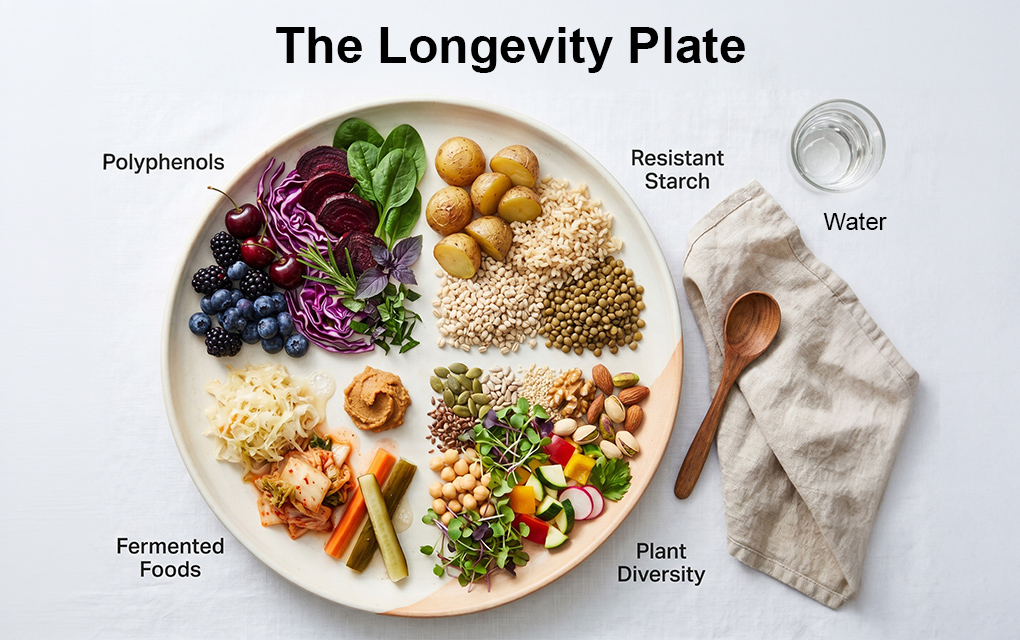
The Longevity Plate
A longevity‑focused plate isn’t restrictive. It’s abundant, colourful, and deeply satisfying. Here’s what it looks like in practice:
- Half the plate: colourful vegetables (polyphenols + fibre)
- A quarter: whole grains or cooled starches (resistant starch)
- A quarter: legumes, tofu, or tempeh (protein + fibre)
- On top: nuts, seeds, herbs, spices (polyphenols + diversity)
- On the side: a fermented food (microbial diversity)
This isn’t a diet. It’s a pattern — one that aligns with Blue Zones, Mediterranean traditions, cultural identity, and the most robust longevity research worldwide.
Globally, we’re facing rising rates of metabolic disease, gut‑related disorders, and lifestyle‑driven chronic illness. Yet, generally speaking, we also have extraordinary access to fresh produce, whole grains, legumes, and traditional fermentation practices.
Longevity isn’t about chasing youth. It’s about building a body and mind that stay strong, adaptable, and connected to community. And the foods that support that future are already in our kitchens — berries, beans, kūmara, sauerkraut, barley, herbs, spices, and the humble cooled potato.
The science is clear: eat more plants, eat more variety, feed your microbes, and let fermentation do some of the work. The result is a longer, stronger life — not just in years, but in vitality.