


by Peter Barclay
Ever since we started, Whole Food Living has consistently pushed the idea that food is much more than fuel — it’s an essential lever for transforming health, of course, but it also impacts our personal identity, and the community we immediately associate with.
Something we’ve particularly noticed is that even with a rise in interest in plant-based eating over the years, many people still struggle to turn intention into sustained action. A new peer‑reviewed study published in Cureus offers one of the clearest windows yet into why that gap persists — and what might help close it.
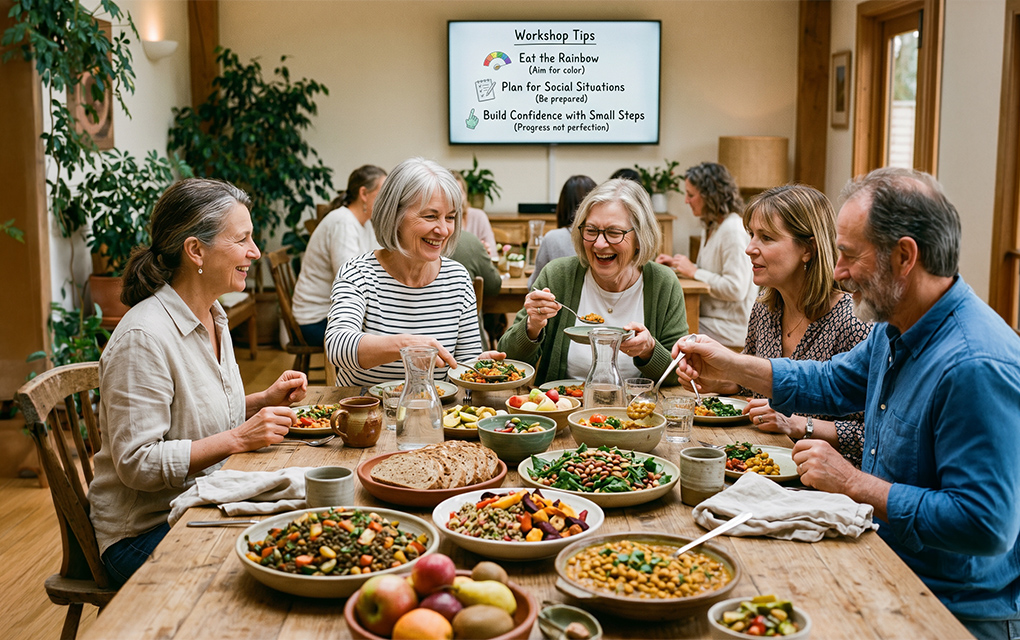
Drawing on survey data from attendees of a Plant Strong residential retreat in North Carolina in April this year, the research maps out the psychosocial landscape of people actively seeking lifestyle change.
These residential retreats are WFPB-grounded, so it’s not surprising the findings reveal a highly motivated population often well on the way to full plant-based adoption. Despite this, they still navigate persistent barriers that mirror what we regularly hear from readers.
Motivated but not uniform
The retreat attracted 92 adults, with 73 completing the survey (79.3% response rate). Participants were predominantly women, older (mean age 63), and highly educated — a demographic profile common in immersive lifestyle programs.
What stands out is how ready this group already was for change. Nearly half (47.9%) were in the maintenance stage of the transtheoretical model (TTM), meaning they had adhered to a whole‑food, plant‑based (WFPB) diet for more than six months. Another quarter was in preparation, actively gearing up for full adoption.
This aligns with what we (WFL) often observe, and of course, immersive programs tend to attract people who are already leaning into change. But the study also identified a smaller pre‑action subgroup — just eight participants — whose psychosocial profile differed sharply from the rest.
Self-efficacy: the quiet predictor
The most striking finding is the strong relationship between self‑efficacy (i.e. confidence in one’s ability to maintain a WFPB diet) and stage of change.
Self‑efficacy scores climbed steadily from pre‑action (mean 2.62) to maintenance (mean 4.11) on a five‑point scale. Statistical analysis confirmed a large effect size (η² = 0.242) and significant differences between early‑stage participants and those in the action or maintenance stages.
In other words: confidence isn’t just a companion to change — it’s a driver of it.
This mirrors broader behavioural research showing that self‑efficacy predicts dietary adherence across contexts, from fruit and vegetable intake to plant‑based transitions. The retreat data reinforce that even highly motivated individuals arrive with varied levels of confidence, and those in early stages may need targeted support to bridge the gap.
The ‘eating out’ barrier
Despite strong motivation, participants reported several persistent barriers to maintaining a WFPB diet:
- Food availability when eating out (84.9%) was the most common barrier, with 41.1% rating it significant.
- Time for meal preparation (73.9%) was also a major challenge.
- Social pressure from friends or family affected 58.9% of respondents.
These findings echo what Whole Food Living readers often share: the home environment may be supportive, but restaurants, travel, and social gatherings remain high‑risk contexts.
Interestingly, cost was the least reported barrier (20.5%) — a reminder that for motivated individuals, affordability may not be the primary obstacle.
Health motivation remains key
If barriers reveal friction points, facilitators illuminate what keeps people moving forward. The strongest motivator by far was:
- Desire to improve long‑term health was rated “very helpful” by 93.2% of participants.
Other powerful facilitators included:
- Physical energy gains (82.2%)
- Access to recipes or meal plans (74.0%)
One finding, however, deserves special attention: household support was split down the middle — 43.8% found it very helpful, while the same proportion said it wasn’t a factor at all. This bimodal pattern reflects the “support and sabotage” dynamic documented in other research, where partners or family members can either accelerate or undermine dietary change.
Taste, knowledge & time
The study also explored whether dietary pattern (omnivorous, plant‑forward, vegetarian, or plant‑based) influenced perceived barriers.
Three associations reached nominal significance:
- Taste/texture concerns were far more common among omnivores than plant‑based eaters.
- Meal‑prep knowledge was a significant barrier for 38.5% of omnivores but none of the fully plant‑based participants.
- Preparation time was a major barrier for plant‑forward and omnivorous respondents but less so for plant‑based ones.
While these associations did not survive multiple‑comparison correction, they align with a familiar pattern: the further along someone is in their plant‑based journey, the fewer practical barriers they perceive.
Interesting insights
I was fascinated by this study because it offers several insights relevant to what Catherine and I see as Whole Food Living’s mission:
1. Immersive programs attract people already primed for change.
But they also include a small group who need foundational support — especially in building confidence.
2. Self‑efficacy is a critical early‑stage target.
Retreats and coaching programs may benefit from explicitly strengthening coping skills for high‑risk contexts like social events and eating out.
3. Environmental barriers persist even among motivated individuals.
Post‑retreat support — recipe access, community groups, accountability check‑ins — may be essential for sustaining change.
4. Household dynamics matter.
Helping participants navigate their home food environment could be as important as teaching them to cook.
Limitations worth noting
The study’s sample was predominantly older, White, female, and highly educated, limiting generalizability. The cross‑sectional design cannot determine causality, and the timing of the survey during the retreat may have influenced responses. The self‑efficacy measure was brief and not formally validated.
Still, the findings offer valuable insight into a population actively pursuing plant‑based change — and the psychosocial levers that shape their success.
The WFL takeaway
If you’re early in your plant‑based journey, confidence may feel fragile — and that’s normal. The research suggests that self‑efficacy grows with experience, exposure, and supportive environments. Barriers like eating out, social pressure, and time constraints are common, but they’re also navigable with the right tools and community.
If you’re further along, your lived experience is a resource. Sharing strategies, recipes, and coping techniques can help others build the confidence you’ve earned.
And for everyone, health motivation remains the strongest and most universal driver of change. When the “why” is clear, the “how” becomes easier to learn.