

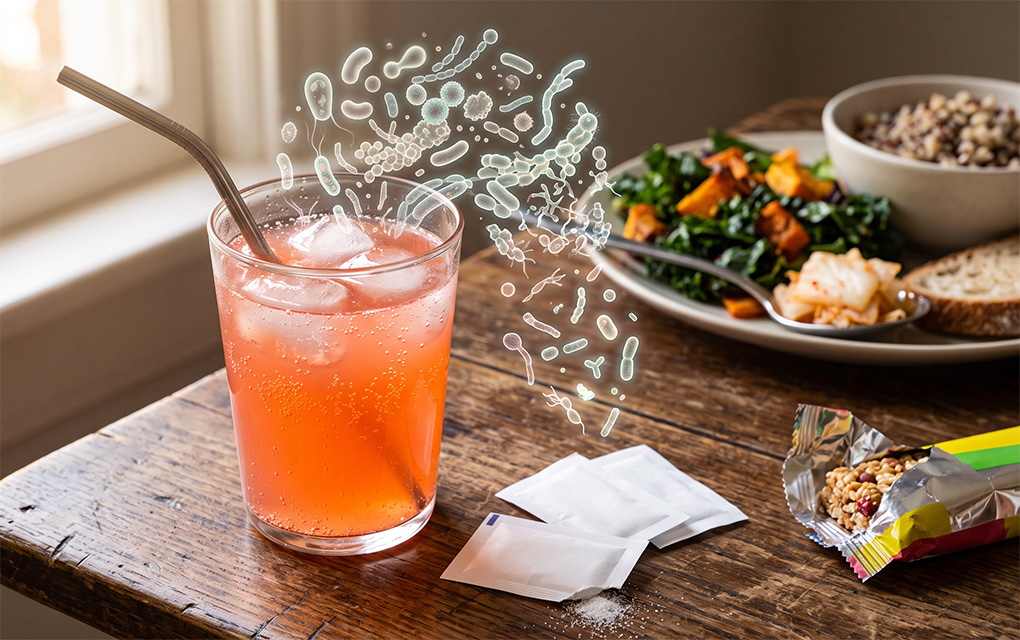

For many health-conscious consumers, swapping sugar for low-calorie sweeteners has seemed like a simple step toward better wellness. But emerging research suggests the story may be more complex, particularly when it comes to the health of our gut microbiome.
A new study from researchers at the University of Cambridge has found that many common sweeteners can directly affect gut bacteria, with some effects becoming even stronger when combined with certain medications.
The gut microbiome is home to trillions of microorganisms that play essential roles in digestion, immune function, metabolism, and overall health. A diverse and balanced microbial community is generally considered a cornerstone of wellness.
Scientists have long suspected that artificial sweeteners may influence the microbiome, but much of the existing evidence has come from animal studies or large population analyses. The Cambridge team wanted to examine whether sweeteners interact directly with gut bacteria and whether those effects change when sweeteners are consumed alongside other common compounds.
Largest lab investigation
Researchers tested 39 commercially available sweeteners against 25 different species of gut bacteria. The results were surprising: approximately three-quarters of the sweeteners altered the growth of at least one bacterial species. Some slowed bacterial growth, while others stopped it altogether. Several of the affected microorganisms are associated with maintaining digestive health and supporting a healthy gut environment.
Importantly, not all sweeteners behaved the same way. Different sweeteners affected different bacterial species, highlighting that sweeteners should not be treated as a single category when evaluating their potential impacts on health.
The hidden impact
One of the most interesting findings was that sweeteners did not act alone. Researchers examined how sweeteners behaved when combined with substances commonly found in foods, beverages, and medications, including caffeine, vanilla extract, and several prescription drugs.
The team identified more than 100 instances where the effects of a sweetener changed when another substance was present. Some combinations intensified the impact on gut bacteria, while others reduced it. This suggests that the health effects of sweeteners may depend as much on what they are consumed with as on the sweeteners themselves.
New questions raised
Among all the combinations tested, one stood out. Researchers found that isosteviol, a sweetener used in the food and beverage industry, had a particularly strong effect when combined with the antidepressant duloxetine.
Together, the compounds significantly reduced the growth of two beneficial bacterial species associated with digestive wellness and blood sugar regulation. When tested in a simulated gut microbiome, the combination also lowered microbial diversity and altered the overall balance of the bacterial community.
The researchers also observed laboratory changes linked to inflammation and immune activity. However, they emphasize that these findings occurred in controlled laboratory settings and do not prove that the same effects occur in people.
The dietary pattern lens
Whole Food Living often encourages readers to focus on minimally processed foods and to view health through the lens of dietary patterns rather than individual ingredients. This new research reinforces that perspective.
The study does not suggest that all sweeteners are harmful, nor does it show that people should immediately stop using sugar alternatives. Instead, it highlights how little we still know about the interactions between food additives, medications, and the microbial world inside our digestive system.
A whole-foods approach naturally reduces reliance on highly processed products that often contain multiple sweeteners, additives, and other compounds. Choosing naturally sweet foods such as fruit, enjoying a varied plant-rich diet, and focusing on fibre-rich foods remain evidence-based ways to support a healthy microbiome.
The big challenge
The University of Cambridge study challenges the notion that low-calorie sweeteners are completely biologically inactive. Researchers found that many sweeteners can directly influence gut bacteria and that their effects may change significantly when combined with medications or other food ingredients.
While further human research is needed before drawing firm conclusions, the findings serve as an important reminder: what we eat rarely acts in isolation. The complex interactions between foods, additives, medications, and the microbiome may play a much larger role in our health than previously understood.
Source: University of Cambridge research published in Molecular Systems Biology, 2026; 22 (9): 1453 DOI: 10.1038/s44320-026-00225-6