
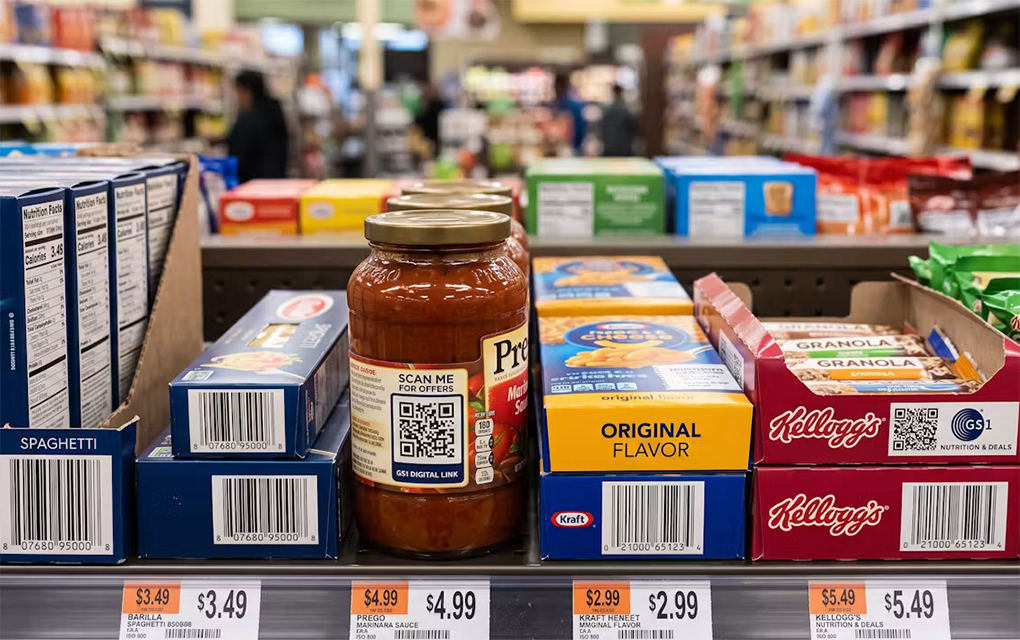

For more than half a century, the humble barcode has been the silent workhorse of modern retail — a simple black‑and‑white pattern that tells a checkout computer what you’re buying.
But as food safety challenges grow more complex, and as consumers demand clearer, healthier, more trustworthy information, that familiar striped label is finally getting a long‑overdue upgrade.
And it could transform the way we protect our health.
The first barcode scan (a pack of Juicy Fruit gum in 1974) ushered supermarkets into the digital age. Yet despite enormous leaps in technology, the basic barcode has barely changed. Today’s one‑dimensional UPC codes still do just one thing: identify a product at checkout. That simplicity is no longer good enough.
Food systems have become global, fast-moving, and vulnerable. Outbreaks like this summer’s deadly Cyclospora event in the US, which claimed two lives, highlight how slow, manual tracing can leave consumers exposed and retailers scrambling.
Quick identification
Healthy living isn’t just about what we choose to eat. It’s also about how quickly we can identify what’s unsafe.
Next year, retailers will begin rolling out a new generation of two‑dimensional barcodes — QR‑style labels capable of holding thousands of characters instead of just a handful. This shift, part of GS1’s “Sunrise 2027” initiative, is designed to modernise food safety and empower consumers with real-time information.
These smarter barcodes can:
- Show where and when a product was packaged — crucial for tracing contamination quickly
- Reveal allergens, ingredients, and recyclability — supporting healthier, more sustainable choices
- Help stores automatically block expired or recalled items — preventing dangerous foods from ever reaching your basket
- Allow consumers to check safety at home — a simple scan to confirm whether your product is part of a recall
In other words, the barcode becomes a health tool.
It’s all about trust
Healthy living isn’t only about fibre-forward meals, plant-based recipes, or mindful eating. It’s also about trust — knowing that the food you bring home is safe, traceable, and transparent.
Today, lot numbers and batch codes are printed separately from barcodes, often in tiny, cryptic strings that require human interpretation. With tens of thousands of products on shelves, mistakes are inevitable. And mistakes cost lives.
By embedding these identifiers directly into the barcode, recalls become precise, not broad. That means:
- Less food waste — millions of dollars in perfectly safe food are currently discarded because stores can’t easily distinguish good batches from bad ones
- Faster outbreak response — investigators can trace contamination back to specific farms or factories in minutes, not days
- More confidence for families — especially those managing allergies, chronic illness, or vulnerable immune systems
This is implementation science at the supermarket checkout.
Progressive adoption
The transition won’t be instant. Printing unique, data-rich labels on every package requires new hardware and new workflows, and some manufacturers are sceptical about the cost and complexity. Others argue that without regulation, adoption may be slow.
But food safety experts like Frank Yiannas — former FDA deputy commissioner — say the investment is small compared to the catastrophic losses companies face during major recalls. And early adopters like Procter & Gamble and Topo Chico are already printing 2D codes on their products.
The momentum is building.
Imagine walking through your local supermarket and scanning a product to instantly see:
- Where it came from
- Whether it’s part of a recall
- How fresh it is
- Whether it fits your dietary needs
- How to recycle the packaging
Food waste reduction
Imagine a world where outbreaks are contained before they spread, where food waste drops dramatically, and where consumers have the power to make safer, healthier choices with a single tap.
That world is closer than it seems.
The barcode, a tiny symbol we’ve ignored for decades, is about to become one of the most important tools in the future of healthy living. And as Whole Food Living readers know well, healthier systems create healthier people.