


by Peter Barclay
For a decade, Australia and New Zealand looked poised to ride the global plant‑based wave. New eateries opened, supermarket shelves expanded, and Australia’s CSIRO projected a $13 billion alternative-protein sector by 2030. Six in ten Australians had tried or were open to trying plant-based products. The momentum felt unstoppable.
Then came COVID, relentless price rises, and not long after, the brakes went on.
Restaurants closed, supermarket ranges shrank, and the cultural buzz around meat‑free eating softened. Now, new research from Canada and Finland shows that shoppers’ behaviour around plant-based proteins is more complex than we assumed — and that the future of plant-forward eating won’t be built on premium meat substitutes alone.
This is the moment for a reset, and New Zealand and Australia are uniquely positioned to lead it.
A cultural cool change
From a commercial perspective at least, plant-based seems to have lost some of its cultural cool.
Across Australia, more than ten up‑market plant-based restaurants have shut in Sydney alone over the past three years. Ovolo Hotels, once proudly plant‑based, has substantially wound back its commitment in 2024. Woolworths delisted several plant-based lines after “poor and declining” sales. In New Zealand, hospitality outlets have done a deep dive, with more than 400 closures over 12 months.
Of course, purely plant-based restaurants are a small segment of the restaurant industry, but given the broader picture and concerns about climate change, why the retreat? General economic decline has been real, but the current situation more likely speaks of a cultural shift. For example, trends and changes like:
- Protein-maxxing and gym-centric eating have re‑centred animal protein as the “serious” choice for strength and weight management.
- GLP‑1 medications have increased demand for high-protein foods, often interpreted as animal-based by default.
- Masculinity narratives continue to link meat with identity and status, making plant-based feel like a cultural mismatch for some consumers.
In NZ and Australia — where BBQ culture, farming identity, and rural pride run deep — these forces land even harder.
Shifting health perceptions
Consumers increasingly question whether plant-based products are actually healthy, and this is coupled with the narrative that vegan eating “is not always healthy”. Many meat and dairy alternatives contain high sodium and additives, undermining the original promise of “better for you”.
I clearly recall a personal experience at the Auckland Food Show several years ago, when an ardent vegan offered me, Catherine, and Dr Mark Craig a vegan sausage being promoted on the Vegan stand. We all refused, of course, and I can only assume that the offer was made from a complete lack of understanding of what it meant to be a WFPB vegan. I made a mental note at the time that that was a perception I really wanted to change.
Meanwhile, the grocery-cart study shows:
- Whole-food plant proteins (beans, lentils, peas, tofu) are cheaper and nutritionally superior to both meat and processed analogues.
- One-to-one swaps (plant-based cheese for dairy cheese) often increase grocery bills.
- Legumes remain the most cost-effective protein source across all income groups.
This is a crucial pivot point for NZ and Australia, where cost-of-living pressures are reshaping our food choices.
Price versus variety
The real pivot point here is that while price matters, variety matters more. The study of 87,000 grocery carts found:
- When prices rise, shoppers buy less of everything — meat and plant-based alike.
- Meat purchases are more price-sensitive than plant-based ones.
- Lower-income shoppers are more price-sensitive overall, but the gap is smaller for plant-based products.
The real barrier? Lack of variety.
Meat offers a ladder of price points (steak → mince → cheap and processed). Plant-based shelves often offer only two or three options. When prices rise, plant-based consumers can’t “trade down”. For NZ and Australia — where supermarket duopolies already limit choice — this is a structural challenge.
Repacking the narrative
The meat and dairy sectors have successfully reframed themselves as:
- Essential for food security
- Central to rural economies
- Less harmful to the climate than previously thought
This narrative shift is influencing consumers and policymakers alike, as this press release explains.
Meanwhile, CSIRO’s cuts to food science and precision fermentation research signal a retreat from alternative-protein innovation in Australia.
NZ faces similar pressures: a strong livestock sector, political sensitivity around rural livelihoods, and slow policy movement on dietary emissions. Yet the climate case for shifting some protein intake toward plants is stronger than ever.
A new WHOLE narrative
New Zealand and Australia have a chance to do things differently. Options I see are:
1. Reframe plant-based as normal, not niche
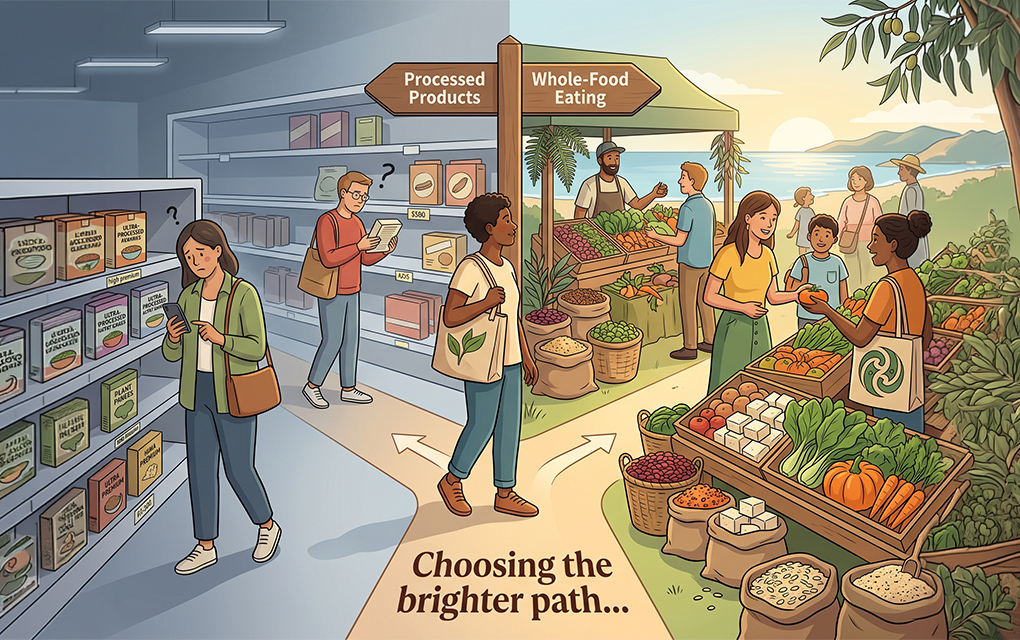
Move away from premium, ultra-processed mimicry and toward everyday whole foods.
2. Build cultural relevance
Plant-forward eating must feel local, not imported — think legumes in curries, tofu in stir-fries, lentils in cottage pie, beans in tacos.
3. Support price parity
Subsidies, discounts, and supermarket commitments could make plant-based staples as affordable as dairy milk or mince.
4. Expand variety
More tofu formats, more legumes, more local plant-based innovations — not just burgers and nuggets.
5. Tell a different story
Strength, care, whānau wellbeing, climate resilience — these are powerful narratives in both NZ and Australia.
Plant-based ideas for this week
Here are a few options to try this week
Swap mince for lentils once
A single lentil-based meal (spag bol, shepherd’s pie, nachos) can cut the cost of that dinner by 50–70%.
Buy tofu as your “protein anchor”
In NZ and Australia, tofu is one of the few plant proteins consistently cheaper than meat — and it’s versatile across cuisines.
Use legumes as your lunch base
Chickpeas, black beans, and red lentils turn soups, salads, and wraps into high-protein, low-cost meals.
Skip the one-to-one substitutes
Plant-based cheese, yoghurt, and meat analogues are where grocery bills spike. Use them sparingly, not as staples.
Build a “three-staple rotation”
Choose three cheap, reliable plant proteins for the week — e.g., tofu + red lentils + chickpeas — and plan meals around them.
The path forward
The plant-based slowdown isn’t a rejection — it’s a recalibration.
Consumers in NZ and Australia aren’t turning away from plant-based eating; they’re turning away from expensive, ultra-processed, culturally mismatched versions of it.
The future belongs to whole foods, affordability, cultural fit, and climate sense.
If the first wave of plant-based was about novelty, the next is about making it normal. This is where the real transformation begins, and whole food living becomes reality.