


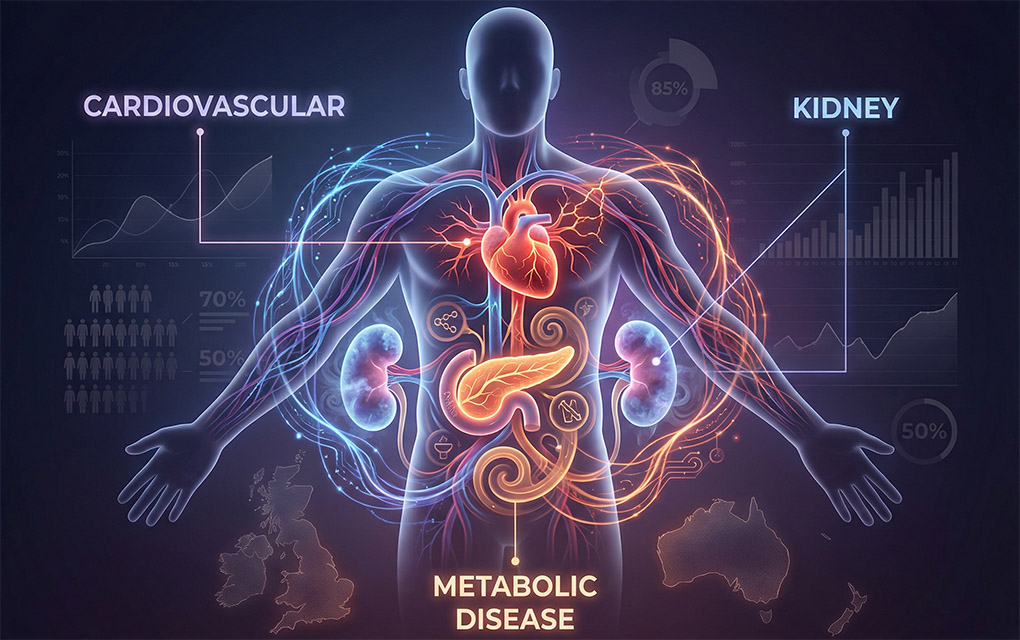

For years, health systems have treated heart disease, diabetes, and kidney disease as separate problems—three parallel epidemics, each with its own specialists, medications, and public‑awareness campaigns.
But science has been telling a different story. These conditions are not parallel at all; they are deeply intertwined, feeding off one another in ways that quietly accelerate risk long before symptoms appear.
The American Heart Association (AHA) has now given this interconnected web a name: cardiovascular‑kidney‑metabolic syndrome, or CKM syndrome. And according to their 2026 statistics update, CKM syndrome is far more widespread—and far more dangerous—than most people realise.
A hidden epidemic
The AHA’s new data paints a stark picture. In the United States:
- Almost 1 in 4 adults with diabetes don’t know they have it.
- Up to 9 in 10 adults with chronic kidney disease (CKD) are undiagnosed.
But these numbers are not unique to the U.S. They reflect a global pattern of under-screening and under-recognition.
United Kingdom
- Diabetes UK estimates over 850,000 people in the UK have diabetes but remain undiagnosed.
- Kidney Research UK reports that around 7 million people have CKD, but only a fraction know it.
Australia
- Diabetes Australia estimates up to 500,000 Australians have undiagnosed type 2 diabetes or prediabetes.
- Kidney Health Australia reports that 1 in 3 adults is at risk of kidney disease, and 90% of those with early CKD are unaware.
New Zealand
- The Ministry of Health estimates up to 100,000 New Zealanders have diabetes but are undiagnosed.
- Kidney Health NZ reports 1 in 10 adults has CKD, but most don’t know until the disease is advanced.
Across all three countries, the pattern is identical: metabolic and kidney disorders develop slowly, quietly, and often without symptoms—until they suddenly become life‑altering.
What Exactly Is CKM Syndrome?
CKM syndrome is the medical term for the interconnected relationship between cardiovascular disease, kidney disease, and metabolic disorders such as diabetes and obesity. Think of it as a three‑way feedback loop:
1. Cardiovascular disease (C)
- Heart attacks
- Stroke
- Heart failure
2. Kidney disease (K)
- Reduced kidney function
- Chronic kidney disease
- End‑stage renal disease
3. Metabolic disorders (M)
- Type 2 diabetes
- Prediabetes
- Insulin resistance
- Obesity
Each condition worsens the others. High blood pressure damages the kidneys. Damaged kidneys raise blood pressure. Diabetes accelerates both. Excess weight drives insulin resistance, inflammation, and vascular damage. And once the heart is involved, the risk of disability and early death rises sharply.
The AHA highlights that the greatest dangers of CKM syndrome are heart disease and stroke, which remain the leading causes of death worldwide.
Cases go undetected
CKM syndrome thrives in the shadows because its early stages are almost always silent. High blood pressure, high cholesterol, early kidney damage, and rising blood sugar rarely cause symptoms. The AHA notes that:
- Two‑thirds of people with high blood pressure or diabetes are not screened for kidney disease.
- The uACR urine test, which detects early kidney damage, is dramatically underused.
- The eGFR blood test, which measures kidney filtration, is often not ordered until symptoms appear—by which time significant damage may already be present.
Dr Stacey E. Rosen, volunteer president of the AHA, puts it plainly: “Understanding the connection helps you better prevent complications through lifestyle changes and appropriate treatment.”
Scale of the problem
The AHA’s 2026 report shows:
- Half of all U.S. adults have high blood pressure.
- 1 in 3 has high cholesterol.
- More than half have prediabetes or diabetes.
- Over half have a high waist circumference.
- 1 in 7 has kidney disease.
These numbers are mirrored across the UK, Australia, and New Zealand, where obesity, hypertension, and type 2 diabetes have risen steadily over the past two decades.
In New Zealand, for example:
- 34% of adults live with obesity.
- 1 in 4 adults has high blood pressure.
- Māori and Pasifika communities experience significantly higher rates of CKD and diabetes, reflecting deep inequities in access to prevention and care.
CKM syndrome is not a niche medical concept—it is the dominant pattern of chronic disease in modern societies.
Lifestyle matters
The AHA emphasises that 80% of heart attacks and strokes are preventable. That’s a staggering figure, and it underscores a truth that the WFPB community knows well: lifestyle is not a side note—it is the foundation.
CKM syndrome is driven by shared risk factors:
- High blood pressure
- High cholesterol
- High blood sugar
- Excess body weight
- Chronic inflammation
- Reduced kidney function
These are profoundly influenced by daily habits, and where lifestyle medicine shines. The AHA points to Life’s Essential 8, but the principles align closely with whole‑food, plant‑based living.
1. Whole‑food, plant‑forward eating
A diet rich in vegetables, fruits, legumes, whole grains, nuts, and seeds:
- Improves insulin sensitivity
- Lowers LDL cholesterol
- Reduces blood pressure
- Supports kidney health
- Reduces inflammation
Plant‑based diets have been shown to reduce the progression of CKD and improve metabolic markers even in high‑risk populations.
2. Regular physical activity
Movement improves every component of CKM syndrome:
- Lowers blood pressure
- Improves glucose control
- Reduces visceral fat
- Enhances kidney perfusion
- Strengthens the heart
Even 30 minutes of brisk walking daily can reduce cardiovascular risk by up to 30%.
3. Healthy weight management
Waist circumference is one of the strongest predictors of CKM risk. Reducing visceral fat improves:
- Blood sugar
- Blood pressure
- Kidney filtration
- Cholesterol levels
4. Avoiding tobacco and limiting alcohol
Smoking accelerates vascular damage and kidney decline. Alcohol contributes to hypertension and metabolic dysfunction.
5. Prioritising sleep and stress reduction
Chronic stress and poor sleep disrupt hormones that regulate appetite, blood pressure, and glucose metabolism.
6. Regular screening
This is the piece most people overlook.
For anyone with diabetes, high blood pressure, obesity, or a family history of kidney or heart disease, the AHA recommends:
- Blood pressure check
- Cholesterol panel
- Fasting glucose or A1C
- BMI and waist circumference
- uACR urine test
- eGFR blood test
These simple tests can detect CKM syndrome years before symptoms appear.
Global wake-up call
CKM syndrome is not a new disease—it is a new way of understanding the diseases that already dominate global health. By naming the syndrome, the AHA is urging clinicians, policymakers, and the public to stop treating heart disease, diabetes, and kidney disease as isolated problems.
For Whole Food Living readers, the message is both urgent and empowering:
- The risks are real, widespread, and often invisible.
- But the tools to prevent and reverse much of this burden are already in our hands.
Lifestyle change is not a soft option—it is a powerful, evidence-based intervention that can transform the trajectory of CKM syndrome at both individual and population levels.
As Dr Rosen notes, “Everyone could benefit from being screened this way.” But beyond screening, everyone can benefit from the daily choices that support metabolic, cardiovascular, and kidney health.
In a world where chronic disease is rising faster than health systems can keep up, CKM syndrome is a reminder that prevention is not just possible—it is essential.