



by Peter Barclay
Food is everywhere. It fills our shops, schools, workplaces, leisure centres, and homes. Even when we’re not buying it, we’re surrounded by it — on billboards, bus shelters, television screens, and in social feeds. It’s easy to accept this constant presence as a normal part of modern life. But the latest Broken Plate 2026 report reveals a deeper truth: the food surrounding us is not neutral. It is shaping our choices, our health, and our future in ways that are increasingly hard to ignore.
The report, produced by The Food Foundation, offers a comprehensive look at the UK’s food system and the environments in which people make daily food decisions. It shows a system out of balance, where the foods most aligned with good health and environmental sustainability are often the hardest to access, while cheaper, less nutritious options dominate high streets, supermarket shelves, and advertising budgets. The result is a widening gap between what people should be eating and what the food environment makes easy, affordable, and appealing.
For Whole Food Living readers in New Zealand, Australia, and across the globe, the findings feel familiar. The pressures described — rising food prices, the dominance of fast food, the marketing of sugary products to children, and the growing burden of diet-related disease — echo global trends. The Broken Plate 2026 is not just a snapshot of the UK; it is a mirror reflecting challenges faced across many countries.
When healthy slips out of reach
One of the most striking insights from the report is the widening cost gap between healthier and less healthy foods. Healthier foods — including fruit, vegetables, and many protein sources — are now nearly twice as expensive per calorie as foods high in fat, salt, and sugar. This gap has grown steadily over the past decade, and recent cost-of-living pressures have only intensified the divide.
For households on low incomes, the consequences are severe. The report shows that families with children in the lowest income bracket would need to spend the vast majority of their disposable income to follow the Eatwell Guide. Even child-free households in the same bracket face an unrealistic financial burden. Meanwhile, the highest-income households spend a fraction of their income on the same diet.
This is not simply a matter of personal choice. It is a structural barrier that shapes what people can realistically afford. As food inflation continues to outpace overall inflation, food insecurity has risen sharply. Millions of adults and children now struggle to access enough nutritious food, and food bank use has surged to record levels.
The report also highlights the cost of sustainable protein alternatives. While whole food plant proteins such as beans and lentils remain affordable, many pre-prepared plant-based products — the ones most visible on supermarket shelves — are significantly more expensive than their meat equivalents. This price premium makes it harder for households to shift toward healthier, lower-impact diets, even when they want to.
Citizen photo stories included in the report bring these statistics to life. One ambassador describes relying on “yellow sticker” discounts not for treats but for basic meals. Another documented mouldy surplus food offered to disadvantaged communities, raising questions about dignity and fairness. These stories underscore the emotional and practical toll of a food system that does not work for everyone.
The geography of choice
Affordability is only one part of the picture. The report also examines where food is sold and what is available when people go looking for it. Fast-food outlets continue to dominate many neighbourhoods, making up a quarter of all food outlets across England and more than a third in the most deprived areas. This concentration is not accidental; it reflects planning decisions, commercial incentives, and years of underinvestment in community infrastructure.
For young people, fast-food outlets have increasingly become social spaces, replacing youth centres that have closed over the past decade. But the health implications are clear. Easy access to energy-dense, nutrient-poor food is linked to diet-related ill health, and the clustering of fast-food outlets in deprived areas compounds existing inequalities.
Inside supermarkets, the picture is similarly concerning. Breakfast cereals marketed to children — often with colourful packaging and health claims — are frequently high in sugar and low in fibre. Only a small fraction meet low-sugar criteria, and very few provide meaningful fibre. When assessed using the government’s nutrient profiling model, a large proportion of these cereals are considered unhealthy, despite their child-friendly branding.
The report shows that planning powers can make a difference. Some local authorities have successfully blocked new fast-food outlets near schools, and early evidence suggests these measures reduce the proliferation of unhealthy options. But such actions remain the exception rather than the norm, and stronger national support is needed to ensure healthier food environments across all communities.
The marketing machine
Even when healthier food is available and affordable, it must also compete with a powerful marketing ecosystem. The report reveals a stark imbalance in how food is promoted. A significant share of all food promotions — including price reductions — is for foods high in fat, salt, and sugar. Although recent regulations have restricted certain types of multibuy promotions, retailers have shifted toward other promotional tactics that maintain the visibility of less healthy products.
Advertising spend tells an even clearer story. Traditional advertising channels — television, outdoor posters, radio, and print — overwhelmingly promote foods that should be eaten sparingly. Fruit and vegetables, which should make up a large portion of daily diets, receive only a tiny fraction of advertising investment. To align advertising with dietary guidelines, spending on fruit and vegetables would need to increase dramatically.
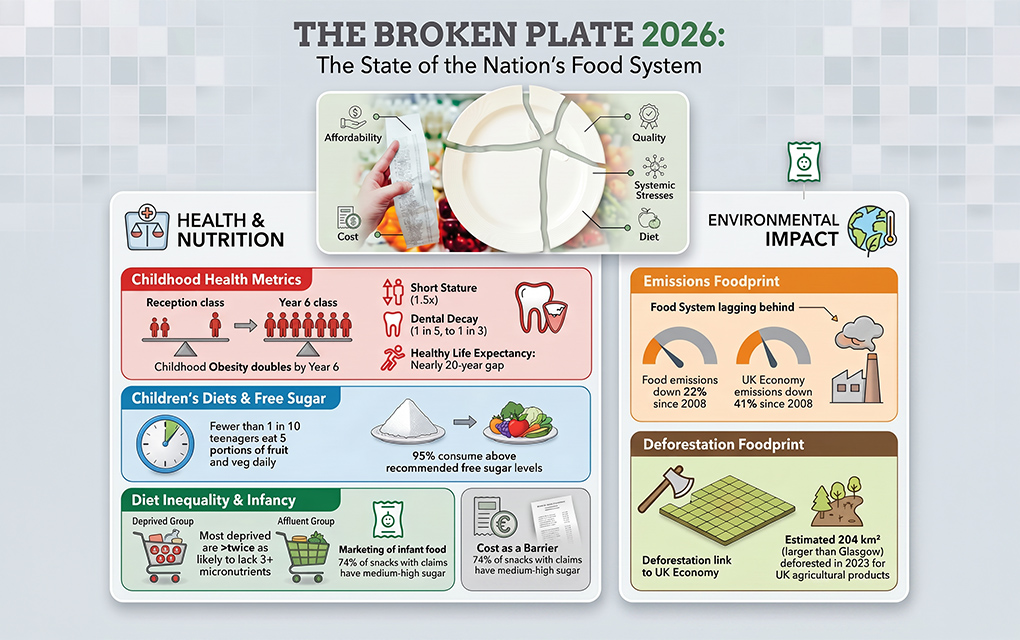
The report also highlights concerning trends in infant food marketing. Nearly all baby and toddler snacks feature front-of-pack claims, yet many contain medium or high levels of sugar. These claims can mislead parents and caregivers, making it difficult to identify genuinely healthy options for young children. Voluntary guidance introduced in 2025 has not yet produced meaningful change, and stronger regulation may be required.
Schools have become another frontier for food marketing. Evidence shows that major food companies are embedding themselves in school environments through branded canteens, sponsored materials, and fundraising activities. These tactics build brand familiarity from an early age and undermine efforts to promote healthy eating in educational settings.
Considering the consequences
The cumulative impact of affordability, availability, and appeal is visible in health outcomes. Childhood obesity remains high, with rates doubling between early primary school and Year 6. Dental decay affects a significant proportion of young children, particularly in deprived areas. Healthy life expectancy has fallen, and the gap between the most and least deprived communities has widened to nearly two decades.
Dietary inequalities are stark. Few teenagers consume enough fruit and vegetables, and most exceed recommended sugar intake. Micronutrient deficiencies are more common in deprived groups, reflecting limited access to nutritious foods.
Environmental outcomes are equally concerning. Food system emissions have declined more slowly than emissions across the wider economy, and deforestation linked to UK consumption remains significant. These trends highlight the need for dietary shifts that support both human and planetary health.
Ready for change
The Broken Plate 2026 does not simply diagnose problems; it outlines clear pathways for action. These include aligning wages and benefits with the real cost of a healthy diet, strengthening nutritional safety nets, improving planning policies, incentivising reformulation, and expanding advertising regulations. The report emphasises that meaningful change requires coordinated action across government, industry, and communities.
For Whole Food Living readers, the message is clear: the food environment is not a passive backdrop. It is an active force shaping health outcomes long before individuals make choices. But it is also a system that can be redesigned. With strong leadership, evidence-based policy, and community engagement, healthier and more sustainable food environments are possible.
The Broken Plate 2026 offers a roadmap — not just for the UK, but for any country grappling with rising diet-related disease, food insecurity, and environmental pressures. It challenges us to rethink the structures that shape our food choices and to imagine a future in which healthy, sustainable food is accessible, affordable, and appealing to everyone.