



A new preclinical study from Mass General Brigham in Boston has uncovered a strikingly fast way high-fat foods can disrupt gut health—offering fresh insight into why Western dietary patterns are so strongly linked to chronic disease.
The research, published in Immunity, reveals that even short bursts of high‑fat eating can rapidly wipe out a crucial population of immune cells that help maintain the integrity of the intestinal barrier.
The findings add to a growing body of evidence showing that the gut’s immune ecosystem is far more sensitive to dietary shifts than previously understood—and that the consequences can unfold within days, not months or years.
The study focused on group 3 innate lymphoid cells (ILC3s), a specialised immune cell population seeded early in life. These cells play a central role in protecting the gut lining, producing IL‑22—a molecule that helps maintain barrier integrity and prevent inflammation.
Researchers found that when mice were exposed to a high‑fat diet, ILC3s declined rapidly and selectively. While other immune cells, such as Th17 cells, remained stable, ILC3s appeared uniquely vulnerable to the metabolic stress triggered by dietary fat.
Immune layer collapse
This loss wasn’t subtle. Within days, the gut’s protective immune layer began to collapse, compromising the barrier that keeps microbes and inflammatory molecules from leaking into the bloodstream.
The team used a combination of mouse models, human intestinal samples, and advanced imaging techniques to understand why ILC3s were so affected. Their findings point to a two‑step mechanism:
- High dietary fat alters the gut microbiota, triggering inflammatory signals.
- These signals disrupt the ability of ILC3s to process lipids, leading to mitochondrial dysfunction and ultimately cell death.
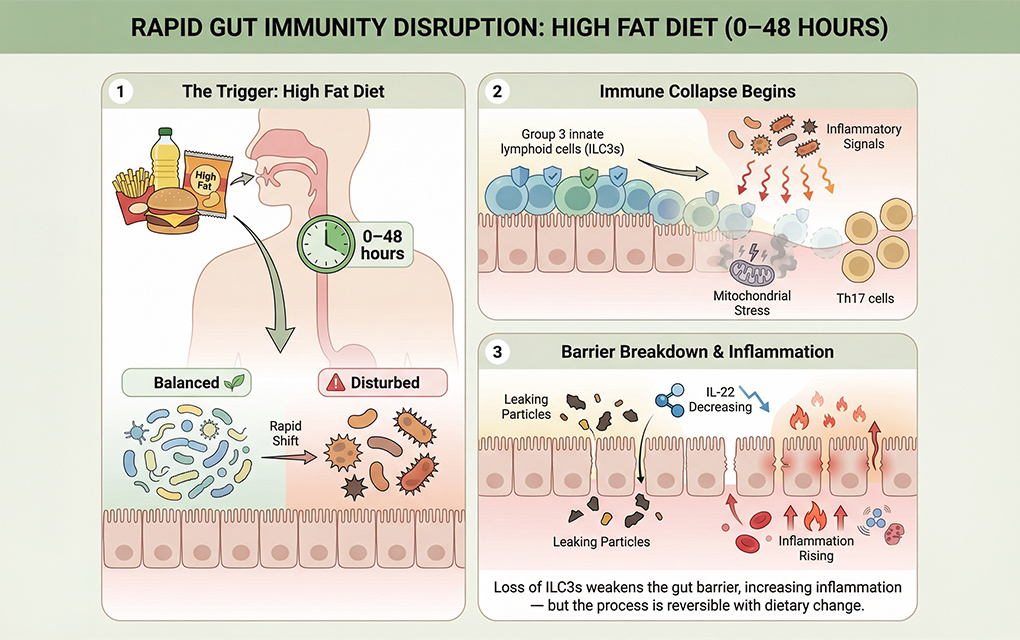
This cascade results in reduced IL‑22 production and increased intestinal permeability—often referred to as “leaky gut”—a condition associated with obesity, type 2 diabetes, inflammatory bowel disease, and even neuroinflammatory disorders.
Most research on diet and immunity focuses on long‑term patterns. But as senior author Dr Selma Boulenouar notes, people experience dietary fluctuations every day. The rapidity of the immune response observed here suggests that short-term dietary choices may have immediate consequences for gut health, especially for individuals already at risk of chronic inflammation.
The study also challenges the assumption that ILC3s are resilient once established early in life. Their sudden collapse in response to dietary fat was “unexpected,” the researchers said.
Loss not permanent
One of the most encouraging insights from the study is that the loss of ILC3s is not permanent. When dietary fat levels were reduced, the gut’s immune balance began to recover. This suggests that early dietary interventions—particularly reducing high‑fat, ultra‑processed foods—may help restore gut integrity and reduce inflammation risk.
For Whole Food Living readers, this reinforces a familiar theme: small, consistent dietary shifts can have powerful effects on health, even over short timeframes.
While the study was preclinical, the implications for human health are clear:
- The gut’s immune system is highly responsive to what we eat.
- High‑fat foods—especially those typical of Western diets—can quickly undermine gut defences.
- Supporting the microbiome through fibre‑rich, whole‑food eating patterns may help protect vulnerable immune cells.
- Early dietary changes may prevent or reverse inflammation‑driven disease pathways.
Maintaining resilience
The research adds urgency to the worldwide push for whole‑food, plant‑forward eating. It also highlights the importance of gut‑protective nutrients—particularly fibre, polyphenols, and fermented foods—in maintaining immune resilience.
Beyond lifestyle implications, the study points to immune metabolism as a promising therapeutic target. By understanding how immune cells process nutrients—and how this process goes awry—researchers may be able to design interventions that strengthen gut immunity even in the face of dietary stress.
More immediately, though, the message is clear: your gut’s immune system is listening to every meal. And it responds faster than we ever realised.