


by Peter Barclay
Just as the UN confirms that breaching the 1.5C warming limit has become ‘imminent and unavoidable’, a groundbreaking new analysis from California’s Fifth Climate Change Assessment reveals that the state’s warming climate is already costing residents billions of dollars every year.
The report, led by researchers from the University of California San Diego School of Global Policy and Strategy, confirms that climate change is now directly pressuring local food systems, healthcare costs, housing, and family budgets.
The impact is wide-ranging, researchers say, and clearly confirms years-old scientific consensus that a rapid rise in global warming (in the order of 1.5C and beyond) would have definable consequences at household level. It affects food prices, utility bills, health expenses, insurance costs, and even how many hours people can safely work outdoors.
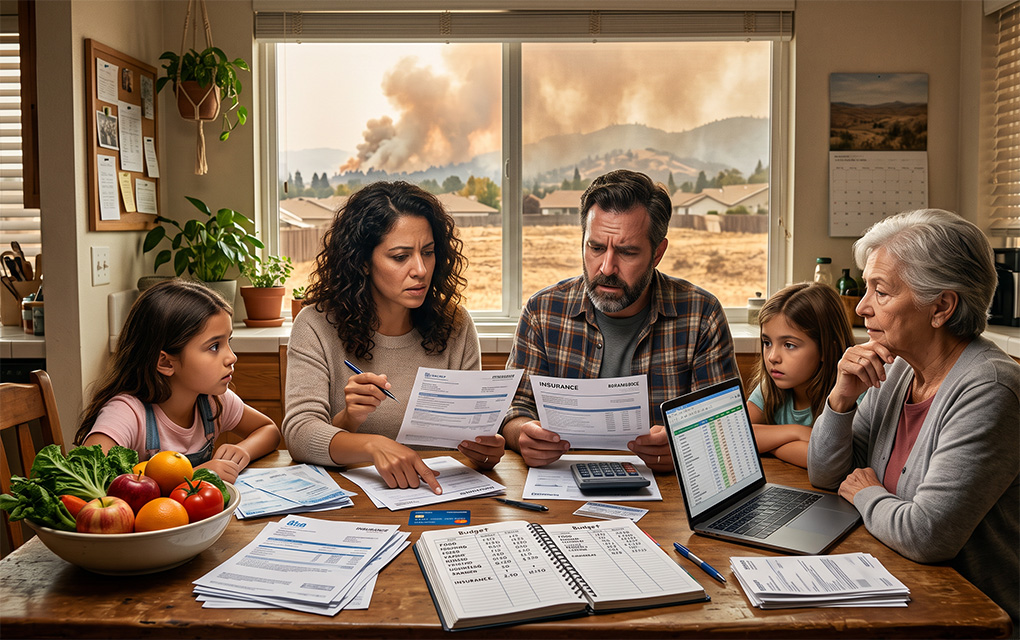
Researchers point to rising food, energy, and water costs, increasing insurance premiums, growing health care expenses, and the need for home upgrades that can withstand heat waves and wildfire risks.
According to a national estimate cited in the report, an American born in 2024 could face between $500,000 and $1 million in lifetime climate-related costs.
These expenses affect everyone, but they do not affect everyone equally. Low-income households, outdoor workers, older adults, young children, tribal communities, rural populations, and people with existing health conditions are among those most vulnerable to climate-related harms. Inland counties in California’s Central Valley, Inland Empire, and southeastern desert regions face especially high economic risks.
The human cost
One of the report’s most striking findings concerns extreme heat.
By 2050, California could experience approximately 560 additional heat-related deaths each year, carrying an estimated annual economic impact of $7.7 billion. The consequences extend beyond mortality statistics. Increased heat is linked to higher rates of illness, reduced productivity, and greater strain on health care systems.
Heat also affects workers directly. The report projects that employees in highly exposed occupations could lose several working hours each year because conditions become too dangerous for safe outdoor labour. Workers in California’s Central Valley may lose between 5 and 10 hours annually, while southeastern California could see losses of 15 to 20 hours per worker each year by 2050.
For industries that depend on outdoor labour, including agriculture, landscaping, and construction, reduced work hours translate into lower productivity and higher costs that ultimately ripple through the entire economy.
The wildfire problem
Wildfires are often measured by acres burned and structures lost, but their health effects may be even more costly.
The assessment projects that under a high-warming scenario, wildfire smoke exposure could contribute to approximately 5,060 additional deaths annually in California by 2050. Researchers estimate the economic impact at about $68.8 billion per year, making wildfire smoke one of the most expensive climate-related health threats identified in the report.
For individuals focused on healthy living, these findings underscore the importance of air quality awareness, respiratory protection during smoke events, and community resilience planning.
Pressure on food systems
The connection between climate change and food costs is particularly relevant to Whole Food Living readers.
Researchers note that climate-related disruptions in agriculture can spread throughout the economy. Drought-related water shortages alone could cause between $2.7 billion and $5.1 billion in direct agricultural losses annually by the early 2040s.
When farms face reduced water supplies and lower productivity, the consequences eventually reach grocery shelves. Higher production costs, reduced yields, and supply chain disruptions can all contribute to increased food prices for consumers. The report emphasises that impacts in one sector often generate costs in others, creating cascading economic consequences.
The housing market
Climate risks are also reshaping the housing market.
The report estimates that approximately 20 inches of sea-level rise, which could occur as early as 2050, would place about $17.9 billion worth of residential and commercial property at risk from inundation statewide.
At the same time, insurance costs continue to rise. Researchers highlight dramatic growth in the California FAIR Plan, the state’s insurer of last resort. The amount of property insured through the program increased from about $50 billion in exposure in 2018 to approximately $750 billion by March 2026.
For homeowners, this trend demonstrates how climate risks are increasingly influencing affordability, property values, and long-term financial planning.
San Diego’s climate future
A companion regional report focused on San Diego County paints a detailed picture of what many communities could face.
Climate models project average temperatures in the region will increase by roughly 4°F (2.2°C) by mid-century compared with the 30-year period ending in 2010. Warming is expected to be especially pronounced during spring and fall, effectively extending summer conditions and increasing the number of extreme-heat days. Interior areas are expected to warm more than coastal regions.
The report also projects:
- More intense rainfall concentrated in shorter storm events.
- Sea-level rise of approximately 1.0 to 1.6 feet by 2075.
- Increased pressure on electrical systems due to higher cooling demand.
- Continued wildfire threats, particularly during Santa Ana wind events.
- Growing threats to biodiversity and native ecosystems.
- Increased rates of heat-related illness, respiratory conditions, and other public health concerns.
It’s time to adapt
Despite the sobering findings, researchers emphasise that effective adaptation can reduce future costs.
The assessment points to investments in resilience measures such as microgrids, battery storage, distributed solar systems, infrastructure improvements, and community preparedness efforts. The report’s authors argue that proactive adaptation can generate benefits that far outweigh initial investments.
For individuals, adaptation may include improving home energy efficiency, protecting against wildfire risks, strengthening emergency preparedness, supporting local food systems, and staying informed about climate-related health risks.
The report clearly shows that personal wellness and environmental resilience are deeply connected. Building healthier communities, supporting sustainable food systems, and investing in preparedness are no longer simply lifestyle choices. They are increasingly essential strategies for navigating a warmer, more unpredictable future.
Sources: UN Emissions Gap Report, 2026
California’s Fifth Climate Change Assessment