



by Peter Barclay
A study published in the International Journal of Hygiene and Environmental Health has uncovered a surprisingly simple—but far‑reaching—problem in nutrition and environmental health research: the way scientists adjust spot urine samples may be systematically skewing results, especially in studies comparing vegans, vegetarians, and omnivores.
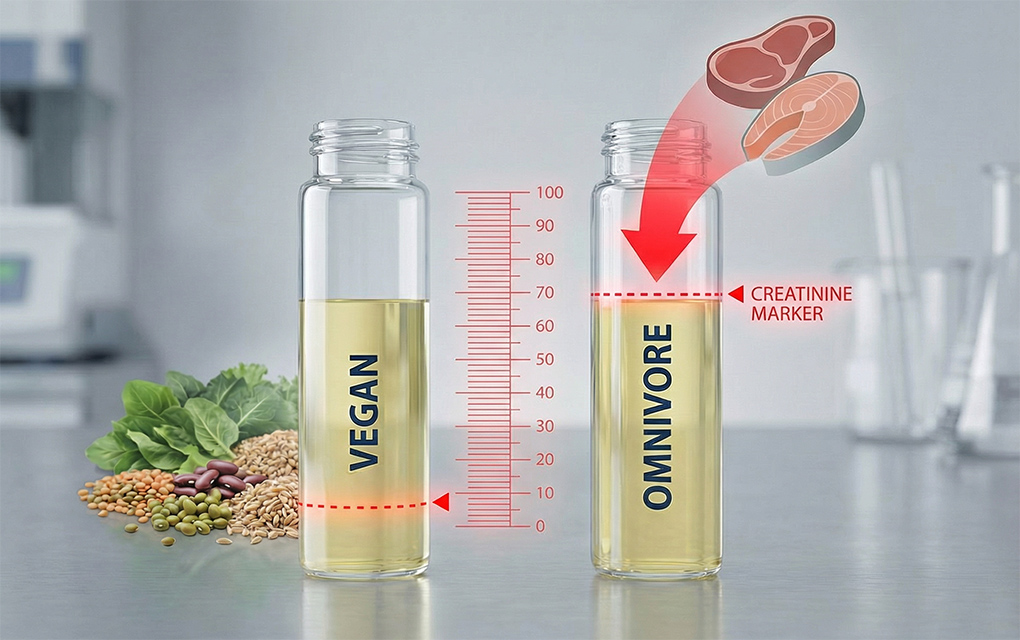
At the centre of the issue is creatinine, a compound long used to “correct” urine samples for hydration. For decades, researchers have assumed creatinine levels are stable and primarily reflect muscle mass. But this new analysis shows that creatinine is also strongly influenced by something far more variable: whether a person has recently eaten cooked meat or fish.
This matters because creatinine‑adjusted urine biomarkers are widely used to assess exposure to contaminants, nutrients, and environmental chemicals. If creatinine itself varies dramatically by diet, then comparisons between plant‑based eaters and omnivores may be distorted from the start.
A closer look
The research team analysed data from the “Risks and Benefits of a Vegan Diet” (RBVD) study, which included 36 vegans and 36 omnivores matched by age and sex. Participants provided 24‑hour urine samples, allowing researchers to compare true daily excretion of a biomarker with the creatinine‑adjusted values typically used in large epidemiological studies.
The biomarker chosen was DHPMA, an endogenous metabolite not expected to differ between diet groups. And indeed, when measured properly—using full 24‑hour urine collection—vegans and omnivores excreted identical amounts.
But when the same samples were adjusted for creatinine, the picture changed dramatically.
- Creatinine‑adjusted DHPMA appeared 26% lower in omnivores than in vegans, despite no real biological difference.
- The only reason: omnivores excreted significantly more creatinine, driven not just by muscle mass but by recent consumption of cooked meat and fish.
In other words, the adjustment method—not the biology—created a false dietary difference.
Why meat matters
Creatinine is produced when creatine breaks down in muscle tissue. But the study highlights a lesser‑known fact: creatinine also forms when meat or fish is cooked, and is absorbed into the bloodstream when eaten. This exogenous creatinine temporarily elevates both serum and urinary creatinine levels for up to 10–12 hours after a meal. This means:
- A person who ate a meat‑heavy dinner will show higher creatinine the next morning, even after fasting.
- A vegan, who consumes no animal muscle tissue, will not.
When researchers adjust urine biomarkers by dividing them by creatinine, omnivores’ results are artificially lowered—sometimes substantially.
Hiding in plain sight
The implications extend far beyond this single study. Creatinine adjustment is standard practice in:
- environmental exposure studies
- nutritional epidemiology
- toxicology
- occupational health
- biomonitoring of chemicals such as heavy metals, pesticides, and endocrine disruptors
Yet very few studies account for participants’ recent meat intake. Even fewer acknowledge that creatinine itself is diet‑dependent.
The authors point to large population datasets, such as the UK Biobank, where vegans and vegetarians consistently show lower serum and urinary creatinine than meat eaters—differences that likely reflect diet rather than kidney function.
This raises a critical question: How many published findings comparing plant‑based and omnivorous groups are partly artefacts of creatinine adjustment?
A better alternative
The researchers also tested another method—adjusting urine samples using specific gravity, a measure of urine concentration that does not depend on meat intake.
Specific gravity still showed some differences between vegans and omnivores, but the distortion was far smaller than with creatinine. The authors conclude that specific gravity is a more reliable correction method, particularly in studies involving mixed dietary groups.
However, they note that even specific gravity can be influenced by diet and metabolic factors, and results may not be comparable across studies.
Masking the benefits
For Whole Food Living readers, this study lands at the intersection of nutrition science, environmental health, and the growing global shift toward plant‑based eating. Here’s why it matters:
1. Misinterpretation can mask real benefits of plant‑based diets: If creatinine adjustment artificially lowers biomarker levels in omnivores, studies may underestimate exposures linked to meat consumption or overestimate exposures in vegans.
2. It may distort assessments of contaminants: Many contaminants—such as acrylamide metabolites, heavy metals, and industrial chemicals—are measured in urine. If creatinine skews results, risk assessments may be inaccurate.
3. It complicates kidney health research: Higher creatinine in omnivores can mimic reduced kidney function, potentially leading to misclassification unless fasting and diet are carefully controlled.
4. It highlights the need for better study design. The authors recommend that researchers:
- Avoid creatinine adjustment when comparing dietary groups
- Use 24‑hour urine collection whenever possible
- Document timing and amount of meat/fish consumption
- Consider specific gravity as a more neutral correction method
Hidden assumptions
As plant‑focused diets continue to grow worldwide, the need for accurate, unbiased research becomes even more important. This study is a reminder that even well‑established scientific methods can carry hidden assumptions—and that diet, often treated as a background variable, can meaningfully shape biological measurements.
For vegans and vegetarians, the findings offer reassurance: lower creatinine levels are not a sign of poorer health, but a predictable reflection of diet. Something that pleases me because my creatinine levels, since turning WFPB, have consistently been much lower than the reference range of 60-105. Consequently, my annual lab test results always include the following notification: Low serum creatinine; consider low muscle mass, weight loss, muscle wasting, or hyperthyroidism.
For researchers, the message is clear: creatinine adjustment is not one‑size‑fits‑all—and in mixed‑diet studies, it may be misleading.
And for readers, it’s a powerful example of why nutrition science must continually evolve, question its assumptions, and adapt to a world where plant‑based eating is no longer the exception but the norm.