
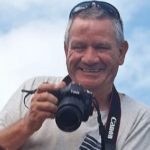


Whether it comes from his professional training over the years or it was a natural gift of birth, Grant Dixon has an uncanny ability to weigh things up. As we sat in a large open area overlooking the Auckland waterfront recently, I wondered if it was possible that a person of such succinct abilities could tell me why so many people had still to discover the benefits of a whole food plant-based diet.
Funnily enough, a question along similar lines had arisen with his podiatrist the previous day. For Grant, 68, food and feet have an intrinsic connection, and although he didn’t voice it quite this way, the logic of it probably works something like this.
If you don’t eat, you won’t move your feet. But it comes with a caveat: what you eat seriously affects how well you will be able to move your feet.
The fact was the podiatrist hadn’t heard about the benefits of a whole food plant-based diet. For Grant it was an ideal opportunity to explain and, of course, there is nothing a movie maker likes more than a captive audience.
These days, Grant is an independent film producer some of the time. He also enjoys singing in a choir and runs up to l5 kms a week. He loves family. He and wife Sharon have been married for 42 years and together they have 5 children, and 11 grandchildren.
A love for film
But film was his first love and dates back to his teenage years. As a young adult, he trained as an electronics technician for the New Zealand Broadcasting Corporation (NZBC), which eventually became TVNZ. He later became a technical director and presentation director. He started making some five-minute programme fillers, and on the basis of that, he got a job with the NZ National Film unit as a film director producer.
After making a few documentaries and some children’s programmes, he went out on his own and made documentaries for TVNZ, TV3 and some corporate videos.

A lucky escape
This story has a sequel that no one could have imagined when it was originally written. Just before it went to print in Spring 2020, Grant almost died. He would have, except for the fact that the medical event he suffered occurred in a very public setting, and the just the right people were near to help him. Check the link for part two of this article at the end of this story.
“That work dried up after about 10 years, so I went back and got my Masters of Communications at Victoria University. I then moved up to Auckland and worked as an events manager for three or four years, and after, to the Employers and Manufacturers Association (EMA) and worked as a conference producer for another three or four years.”
Now, he’s semi-retired but has been making some documentaries, the most notable of which as far as the whole food plant-based (WFPB) community is concerned being, The Big FAT Lie.
It wasn’t until he experienced a major medical event that he started to research food and health seriously, and he recalls doing a search on cheese in the earliest days of the Internet.
“I remember doing a search with a question like how healthy is cheese? I used to eat a lot of cheese and I enjoyed cheese. I went through the internet looking for this information and I got story after story saying cheese is good for you. It’s full of good nutrients, its healthy and it’s an important part of your diet. I found nothing else. Nothing saying there was anything possibly bad about it.
A magic formula?
“So, in my naivety at the time, I thought there must be some magic formula inside the cheese that turns the fat into something that’s good for you. Of course, I was totally wrong, and all the articles I was reading were just propaganda from the dairy industry. Twenty years later, the penny dropped, but it took 20 years for it to come around.”
But taking cheese out of his life wasn’t the cure for all his ills.
“I’ve always had high blood pressure. I’ve still got high blood pressure. I’m one of the 20 per cent of people who do not benefit from diet with their blood pressure, so I still take blood pressure pills, unfortunately.
“I’ve always had that nagging feeling that, because of my high blood pressure, it puts me at risk of heart disease. Also, there’s a lot of family history. My dad died of a stroke, and my oldest brother died just before his 60th birthday of a heart attack. It’s in the family. My sister died of cancer as well.
“But I’ve always been active. I’ve always run three to five kilometres a week. I now run 15kms a week. I’ve upped that somewhat since I changed my diet.”
Apart from one incident when he was about 28, Grant says his health had always been reasonably good.
“But I was overweight, my face was fat, I had a pot like most men have got these days and I couldn’t get rid of it despite the exercise. I exercised, but I was still overweight. Not grossly overweight but 10kgs or so overweight, nevertheless. That’s where I started.
“The funny thing about it is that people now think I look unhealthily thin. What they don’t realise is that this is the natural way, the normal way of looking. The way I look is the way we all should look. It’s not that I am looking unhealthily thin; it’s that you are looking unhealthily overweight.”

TV reality show
If it were a TV reality show, the wedding suit challenge would be a critical test that most men would fail miserably these days.
“I can now fit my wedding suit. I got married at 26, but for most of my life, I couldn’t do that. It’s only since I changed my diet that I have been able to do that. But my health was always ok. I played rugby as a kid, played a bit of touch.”
But he was aware of becoming overweight as time moved on.
“I can remember one of my sisters-in-law making a comment once, I was probably in my early 30s, that all the fathers in the group, and there was probably about three or four of us, were all overweight. All had tummies. It was true; we were all overweight. That’s because of the food we ate.
“We accept it as the norm, and I would go so far as to say that a certain amount of obesity is now the norm. It’s not just overweightness; it’s obesity. That’s really scary when you think about what that means.”
Thinking back on people he knew when he was young, he said it was uncommon to see much obesity about.
“My mum was overweight, but she would have been unusual, I think. Then, maybe three out of four people would have been of average weight and then the odd person was overweight but now, it’s the other way around. Three out of four are overweight.
“I’ve always been aware that fruit and vegetables are healthy. That’s been a mantra since I was a child. I’ve always known that. I remember at my wedding my dad, in his speech, said don’t forget the greens, and I thought it was very funny.
Greens in a sea of fat
“That was an in-joke between me and him. I’d always go up to my mother and say make sure there are some greens with my meal because greens are healthy. I hadn’t realised that the sea of fat that was actually in the same meal was the problem. The greens were certainly important, but it was also important not to have the fat.
“It’s always been a big concern of mine to have enough fruit and vegetables, so I’ve always been very health-focused, but I was ignorant. We were all a little bit overweight but not grossly overweight like we are now. It’s definitely got worse, a lot worse.”
Thinking back on whether he might have had any heart issues, Grant says he recalls going to the doctor with chest pain in his late 20s.
“They did all the tests, but they just brushed it off as part of life and explained it as getting a bit anxious because I was selling the car at the time. Looking back, that was probably my first heart attack – at 28.”
But can people have heart attacks like that and just pass over it?
“Oh, I’m sure it happens. I mean, I was too young for a heart attack, so they just discounted it.”
Does that happen with stroke? “Possibly. Apparently, people have strokes all the time. We’re all having mini-strokes, so apparently, when you get to my age, you’ve had dozens of them. Scary thought, isn’t it?”
Grant today
Part II: The article above has a sequel Grant certainly never expected, and it shocked everyone close to him. Check it out here.