


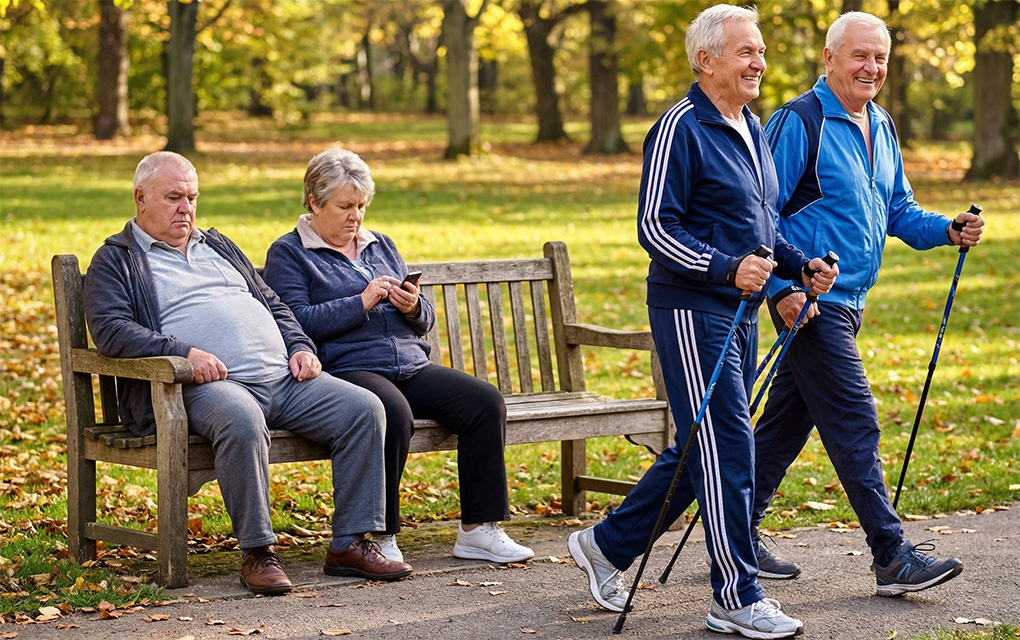

For decades, scientists have told us that exercise is good for the brain. Now, a new study from University College London adds a compelling twist: as we become fitter, our brains respond even more powerfully to a single session of exercise. In other words, fitness doesn’t just make movement easier—it makes movement more effective for the brain.
But alongside this encouraging discovery comes a sobering global reality. A second major study, released almost simultaneously, shows that despite two decades of national policies aimed at increasing physical activity, the world has made virtually no progress. One in three adults still fails to meet even the minimum recommended levels of movement.
Together, these two studies reveal a paradox at the heart of modern health: the science of exercise is more exciting than ever, yet our collective behaviour remains stubbornly unchanged.
Brains respond quickly
The UCL study, published in Brain Research, followed 30 inactive adults through a 12‑week cycling programme. Participants trained three times a week, gradually improving their aerobic fitness. At the beginning, and again at six and twelve weeks, researchers measured:
- VO₂max (a gold‑standard measure of aerobic fitness)
- Levels of brain‑derived neurotrophic factor (BDNF) before and after exercise
- Cognitive performance
- Brain activity in the prefrontal cortex
BDNF is often described as “fertiliser for the brain.” It supports the growth of new neurons, strengthens synapses, and helps maintain the health of existing brain cells. Higher BDNF levels are associated with better learning, sharper thinking, and improved emotional regulation.
The key finding was striking: as participants became fitter, their brains released significantly more BDNF in response to a single 15‑minute bout of vigorous exercise. Baseline BDNF didn’t change, but the exercise‑induced spike grew larger over time.
This means the brain becomes more responsive to movement as fitness improves—an elegant feedback loop where effort amplifies benefit.
The study also found that higher BDNF levels were linked to changes in prefrontal‑cortex activity during tasks involving attention and inhibition. These are the executive functions that help us stay focused, regulate emotions, and resist impulses—skills that shape everything from productivity to mental wellbeing.
Lead author Dr Flaminia Ronca summarised the excitement:
“If we become fitter, our brains benefit even more from a single session of exercise, and this can change in only six weeks.”
It reinforces a familiar message: small, consistent steps can create meaningful physiological change. The brain is not a passive passenger—it adapts, strengthens, and responds to the way we live.
The global picture
Yet the second study, led by UTHealth Houston and published in Nature Health, shows that this science isn’t translating into population‑level change.
Researchers analysed 20 years of global physical‑activity policy and behaviour. Their findings were blunt:
- 92% of countries now have at least one physical‑activity policy.
- 35% have a dedicated national strategy.
- But physical activity levels have barely changed since 2012.
- One in three adults still does not meet WHO’s recommended 150 minutes of moderate activity per week.
Despite more policies, more plans, and more awareness campaigns, the world is not moving more.
Lead researcher Dr Andrea Ramirez Varela noted that physical activity “has really not increased since 2012,” despite the appearance of progress. The problem, she argues, is not a lack of intention but a lack of effective implementation.
The study identifies several systemic barriers:
- Physical activity is still treated as a health issue, rather than a multisector priority involving transport, education, and urban planning.
- There is no shared global understanding of what success looks like.
- Leadership and advocacy are weak, especially compared with tobacco control or alcohol regulation.
- Environments remain movement‑unfriendly, with cities designed for cars, not people.
A comparison with tobacco control is telling. Thirty years ago, smoking was far less regulated. Today, it is tightly controlled through taxation, advertising restrictions, packaging laws, and public‑space protections. Physical activity, by contrast, has no equivalent global movement pushing for structural change.
The result is a world where the science is strong, but the systems are weak.
Knowing isn’t doing
The contrast between these two studies highlights a fundamental truth: individual behaviour is shaped by environment far more than by knowledge.
People don’t avoid exercise because they don’t know it’s good for them. They avoid it because:
- Their neighbourhood lacks safe footpaths or cycle lanes.
- Their workdays are dominated by screens and long commutes.
- Their schools cut physical education to make room for academic testing.
- Their communities lack green spaces, lighting, or accessible recreation.
- Their daily routines are built around convenience, not movement.
The UCL study shows what the human body is capable of. The global policy study shows what society is failing to support.
This is not a story of personal failure. It’s a story of structural design.
Blueprint for change
When viewed together, the studies offer a powerful roadmap for improving public health. An informed initiative could look something like this:
1. Make movement easier, not harder
Cities that prioritise walking, cycling, and public transport see higher activity levels. Infrastructure is destiny.
2. Build physical literacy from childhood
Daily physical education, active play, and movement‑rich classrooms help children develop lifelong habits—and healthier brains.
3. Integrate movement into healthcare
Lifestyle‑medicine approaches, including exercise prescriptions, can help clinicians support patients in practical, personalised ways.
4. Create community‑based programmes that meet people where they are
Local walking groups, culturally tailored initiatives, and free or low‑cost activities reduce barriers and build social connections.
5. Shift the narrative from “exercise” to “active living”
Movement doesn’t have to mean workouts. It can mean gardening, dancing, walking the dog, cycling to the shops, or playing with grandchildren.
The UCL study shows that even 15 minutes of movement can spark meaningful brain changes. The challenge is ensuring people have the opportunity, safety, and support to make those 15 minutes happen.