


by Peter Barclay
When the US Department of Health and Human Services (HHS) and the US Department of Agriculture (USDA) released the Dietary Guidelines for Americans 2025–2030 on January 7, HHS described them as “the most significant reset of federal nutrition policy in decades.” They were certainly right about that!
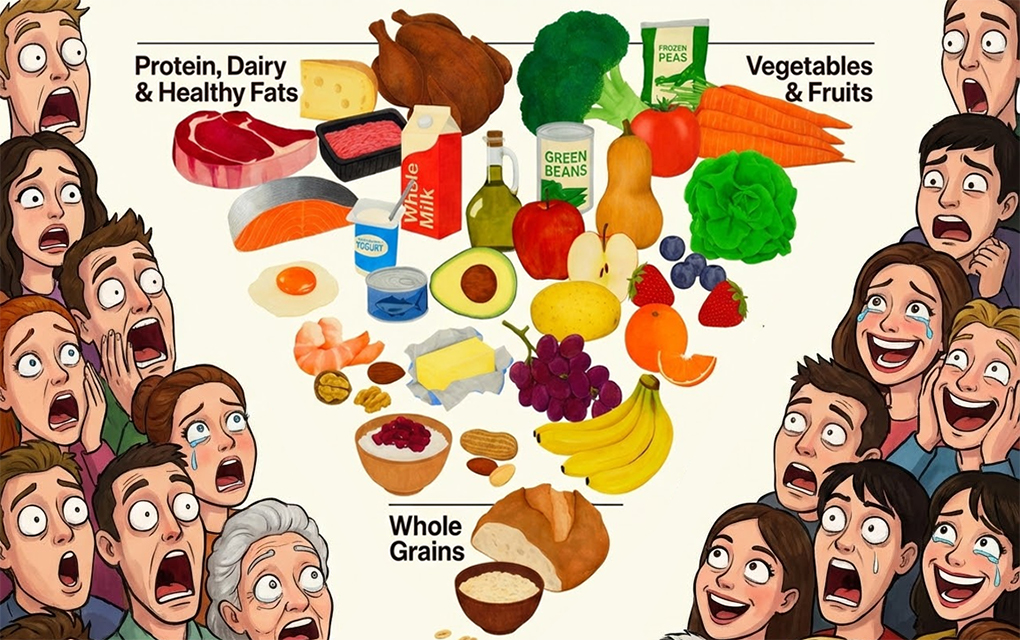
The new guidelines do deliver one emphatic message that WFPB followers can relate to: “Eat real food.” They prioritise whole, minimally processed foods, which we definitely favour, but the protein (double the previous recommendation) is far too high and dairy – at 3 servings a day – is an absolutely head-scratching anathema. Vegetables, fruits, healthy fats, and whole grains (now positioned at the bottom of a new food pyramid) are all still present, but the fibre issue seems to have gone AWOL.
Americans are also urged to dramatically reduce their intake of highly processed foods, refined carbohydrates, added sugars, and artificial additives. The big question is: has this new set of guidelines moved the health dial forward or set it back?
For me, one of the initial and more surprising personal reactions came from NZ’s Evidence Based Eating committee member, Grant Dixon. He sees them as a “giant leap forward”, especially regarding processed foods.
Broadly, some health organisations, clinicians, and food advocates have welcomed the shift; others—both within the US and internationally—have raised concerns about scientific transparency, industry influence, and the environmental implications of the new recommendations.
Because the US guidelines have such an extensive reach, I wanted to explore a wide spectrum of the global reaction: the praise, the criticism, and the deeper questions they ignite.
The guidelines introduce several major changes:
- There’s a strong emphasis on “high-quality” protein, recommending 1.2 to 1.6 g per kg of body weight per day—a significant increase from previous editions. By this, I can only assume that Americans aren’t getting enough of it already. Healio.
- Endorsement of full‑fat dairy and regular red meat consumption, reversing decades of more cautious federal messaging. Baking Business.
- A redesigned “flipped” food pyramid, placing meat, dairy, vegetables, fruits, and healthy fats at the top, and whole grains at the bottom. Baking Business.
- There’s a clear directive to avoid highly processed foods, defined as items made primarily from refined sugars, grains, starches, oils, or containing industrial additives Covington & Burling LLP.
- A strict limit on added sugars: no more than 10 g in a single meal Yahoo.
Several US medical organisations have welcomed the guidelines’ emphasis on nutrient-dense, minimally processed foods.
The American Medical Association praised the recommendations for steering Americans away from “highly processed foods, excess sodium and sugar-sweetened beverages that fuel heart disease, diabetes, obesity, and other chronic illnesses,” Healio.
The American Academy of Paediatrics highlighted the guidelines’ strong focus on child‑nutrition, noting alignment with evidence-based recommendations on breastfeeding, sugar limits, and caffeine avoidance, Healio.
The Physicians Committee for Responsible Medicine (PCRM)—a long-time critic of federal nutrition policy—surprisingly supported several elements, stating the guidelines “are right to limit cholesterol-raising saturated (‘bad’) fat” and applauding the promotion of plant-based foods and reduced alcohol intake. But their ‘support’ is far from unequivocal, see further below. Healio.
Protein intake
FDA Commissioner Martin Makary argued that previous guidelines underestimated protein needs, saying: “The old guidelines had such a low protein recommendation that we are increasing that by 50% to 100%.” Supporters say this shift aligns with emerging research on metabolic health, muscle preservation, and healthy ageing.
HHS Secretary Robert F. Kennedy Jr. said the guidelines “return us to the basics” and will “Make America Healthy Again” by prioritising whole, nutrient-dense foods over processed alternatives, HHS.gov.
And, of course, Keto advocates are squealing with delight.
One of that movement’s leading NZ protagonists, Prof Grant Schofield, of AUT, says the new guidelines are “a huge change in the right direction from the debacle that has been the low-fat ultra-processed food-oriented guidelines of the last 50 years. Finally, we are heading in a more sensible direction, one we have been writing, researching and advocating for most of the last two decades. Hey, still haven’t quite got there in saturated fats, and some see no place for whole grains. Nevertheless, I hope you’ll agree, the new food pyramid is a huge and better change.”
Highly controversial
Despite the praise, though, the guidelines have sparked a storm of controversy—particularly around the scientific process and the political context of their release.
The American Society for Nutrition(ASN) issued a strongly worded statement supporting the overall dietary pattern but warning that the development process “risks undermining public trust in nutrition science.” ConsumerAffairs.
Their concern centres on the government’s decision to introduce a new document—the Scientific Foundation for the Dietary Guidelines—which diverged from the recommendations of the independent Dietary Guidelines Advisory Committee (DGAC) released near the end of last year.
The ASN noted:
- The new scientific foundation lacked transparency around its methods and timelines.
- It diverged from the National Academies’ standards designed to ensure scientific integrity.
- It created “confusion” by running parallel to the DGAC’s own evidence review. ConsumerAffairs.
It emphasised that, “For decades, the DGAC’s scientific report has served as the backbone of the Dietary Guidelines.” ConsumerAffairs
PCRM weighs in
The most forceful rebuke has come from PCRM, which—despite supporting some recommendations— immediately filed a formal petition calling for the guidelines to be withdrawn.
PCRM notes that eight of the nine authors of the scientific foundation report had undisclosed financial ties to beef, dairy, and processed‑food industry groups, including the National Cattlemen’s Beef Association and General Mills vegconomist.
“The ‘cholesterol cartel’ has insidiously manipulated federal diet guidelines. Industry’s pernicious promotion of beef, pork, milk, and cheese is the reason so many Americans are sick today,” PCRM’s Dr Neal Barnard told vegconomist. vegconomist
The petition argues that the process violated the Federal Advisory Committee Act, which requires advisory bodies to operate independently of special interests. This legal challenge echoes a successful PCRM lawsuit from 2000, raising the stakes for federal nutrition policy.
The UK’s Dr Shireen Kassam of Plant Based Health Professionals drew breath and rolled her eyes when she read the latest report. She had this to say on Substack:
“The Scientific Report of the 2025 Dietary Guidelines Advisory Committee did not disappoint and left us hopeful that plant-rich dietary patterns would be at the forefront of the update. Their recommendations included prioritising plant sources of protein, encouraging people to eat less red and processed meat and recommended legumes to be placed within the protein section (where they should have always been!)
Then came the Trump administration, and Robert F. Kennedy Jr. was appointed as the Secretary of Health and Human Services, and sadly, nutrition guidance has veered off course ever since. One reason cited for dismissing the recommendations of the then DGAC was because of the emphasis on health equity. Since when is this a bad; to consider all people, including different ethnicities and indigenous people?
The Scientific Foundation for the Dietary Guidelines for Americans, 2025–2030 states, “The Biden Administration described ‘health equity’ as the ‘central lens‘ for the DGAC’s work, and the term appeared more than 170 times in the DGAC Report. Embedding an equity framework within a document intended to provide unbiased scientific assessment risks allowing existing policy challenges to shape scientific conclusions.”
Dr Kassam continues:
“The guidance is accompanied by a 90 page scientific report and a 418 page Appendix. But we have to confess to not having read these documents fully. We just could not face it when we saw that Ty Beal, PhD, a well-known proponent of meat and dairy consumption, had reviewed the evidence on vegan diets and written that, ‘Most plant sources of protein do not contain all essential amino acids in high enough quantities to meet requirements without being combined with complementary plant proteins or animal-source foods.’ BIG eye-roll! In addition, processed meats and processed meat alternatives have been considered together as if they represent one entity. Neither are considered to cause health harms. How can that be when processed meat is classified as a group 1 carcinogen by the WHO?”
Grain industry backlash
The guidelines’ demotion of grain-based foods—particularly refined grains—has alarmed grain producers worldwide.
The Grain Foods Foundation warned that the guidelines “de-emphasise grains overall” and ignore the role of enriched grain foods in delivering folate, iron, and B vitamins at low cost. Baking Business.
The new pyramid places whole grains at the very bottom, recommending just 2–4 servings per day, compared with 6–11 servings in the original 1992 food pyramid. Baking Business.
Industry groups argue that this shift:
- Undermines decades of public‑health messaging
- Could reduce access to affordable staple foods
- Overlooks the nutritional value of fortified grain products
The WFPB position
If there were a prize for clearly explaining the WFPB standpoint in all this, I think it belongs to G-Bomb creator, Dr Joel Fuhrman. I don’t always see eye-to-eye with Joel and differ significantly from him on supplementation, but on this matter, I think he’s nailed it.
Environmental concerns
Global nutrition and environmental organisations have criticised the guidelines for omitting sustainability considerations—an area where many countries have moved forward.
ProVeg International noted that the guidelines “omit well‑documented risks associated with excessive meat and dairy consumption” and ignore the DGAC’s own findings on environmental impacts.
Anna‑Lena Klapp of ProVeg stated: “The overconsumption of animal‑sourced foods and intensive animal agriculture contribute to the major global challenges that humanity is currently facing, including climate change, biodiversity loss, and public health.”
Countries such as Germany, Brazil, and Canada have integrated environmental sustainability into their dietary guidelines. Critics argue the US has now moved in the opposite direction.
Red meat & full-fat dairy
Many nutrition scientists worry that endorsing red meat and full-fat dairy contradicts long-standing evidence linking high saturated fat intake to cardiovascular disease.
Tufts University nutrition expert Fang Fang Zhang noted that placing whole grains at the bottom of the pyramid “does not support messaging about promoting whole grains” and risks confusing the public.
International heart‑health organisations have echoed these concerns, warning that the guidelines may increase chronic disease risk if interpreted as a green light for high‑saturated‑fat diets.
Food, politics and power
The worldwide reaction reveals a deeper tension:
- Are dietary guidelines purely scientific documents?
- Or are they inevitably shaped by politics, industry, and cultural values?
Supporters see the guidelines as a long‑overdue correction—an overdue embrace of saturated fats and a rejection of the ultra-processed food environment that has fuelled chronic disease.
Critics see them as a politically driven shift that downplays environmental concerns, elevates animal-based foods, and bypasses established scientific processes.
Both perspectives highlight the enormous influence US dietary policy has—not just domestically, but globally.
Ostensibly, when you look at them in the wider context of current American politics, perhaps they make perfect sense. How could anyone expect to see a set of guidelines that fight climate change from an administration that denies it even exists? Science is out; ideology and self-interest rule.
Generally, though, for Whole Food Living readers in New Zealand, Australia and beyond, the new US guidelines offer both inspiration and caution.
Their strong stance on whole, minimally processed foods aligns with global movements toward real‑food nutrition. Their emphasis on reducing refined carbohydrates, added sugars, and industrial additives is consistent with evidence-based public‑health messaging and resonates with the WFPB community.
But the controversy surrounding transparency, industry influence, and environmental omissions reminds us that nutrition policy is never just about nutrition.
As the global conversation continues, one thing is clear: the release of the 2025–2030 US Dietary Guidelines has reignited a worldwide debate about what healthy eating should look like—and who gets to decide.
More viewpoints
Dr Scott Stoll, Plantrician Project
Professor Luigi Fontana, University of Sydney
Dr Gemma Newman, UK, Seismic Change in Dietary Guidance
Professor Boyd Swinburn, University of Auckland, Health Coalition Aotearoa
Medpage Today: Experts say it’s full of errors
Viva Longevity!
Dr Brooke Goldner MD