
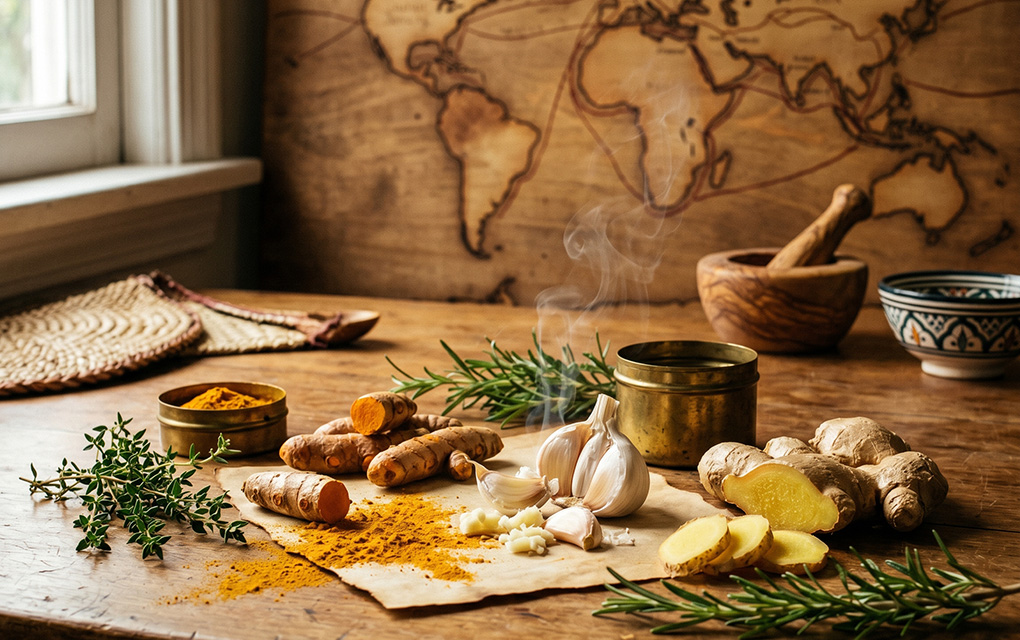

Walk into any kitchen—Auckland, Ahmedabad, Accra, or Abu Dhabi—and you’ll find the same quiet magic waiting in jars and bunches. Turmeric dusting the air like golden pollen. Garlic releases its sharp perfume the moment a knife breaks its skin. Ginger is warming the fingertips. Rosemary and thyme whisper resinous notes that feel both ancient and familiar.
Herbs and spices are the world’s first functional foods. Long before nutrition science could name a molecule or map a metabolic pathway, humans instinctively reached for roots, leaves, seeds, and bark to heal, protect, flavour, preserve, and connect. They were medicine, currency, status symbols, and cultural signatures. They travelled continents, shaped empires, and stitched together trade routes that carried not just goods, but stories, rituals, and identities.
Today, modern science is finally catching up to what our ancestors already knew: herbs and spices are molecular powerhouses. Their vibrant colours, bold aromas, and distinctive flavours come from bioactive compounds—curcumin, allicin, gingerols, rosmarinic acid—that support immunity, calm inflammation, and help the body maintain balance in a world that often pulls it off-centre.
This is the alchemy of herbs and spices: where culture meets chemistry, and flavour becomes a form of nourishment.
This is the ninth in our fortnightly Healthy Food Series. The series consists of 12 features exploring the science, culture and shared joy of natural eating … The previous article in this series covered ‘The Value of Legumes‘ – the world’s most democratic food.
The molecular magic: How herbs and spices heal
Curcumin: The golden guardian
Turmeric’s deep ochre hue comes from curcumin, a polyphenol with potent anti‑inflammatory and antioxidant properties. Curcumin works by modulating inflammatory pathways—particularly NF‑κB, a molecular switch that controls the body’s inflammatory response. When NF‑κB is chronically activated (as it often is in modern lifestyles), inflammation becomes a slow burn beneath the surface. Curcumin helps dial that flame down.
It also supports immune resilience by enhancing the activity of immune cells like macrophages and T‑cells. Paired with black pepper—whose piperine boosts curcumin absorption by up to 2000%—turmeric becomes a daily ritual of protection.
Across cultures, turmeric has always been more than a spice. In India, it’s a symbol of purity and prosperity. In Southeast Asia, it colours curries and healing broths. In the Pacific, it appears in traditional tonics. Everywhere it goes, it brings warmth, colour, and a sense of grounding.
Allicin: The sharp‑edged defender
Crush a clove of garlic, and you unleash allicin, a sulphur‑rich compound responsible for garlic’s unmistakable aroma and its impressive medicinal profile. Allicin forms only when garlic is chopped or crushed—an elegant example of nature’s chemistry in motion.
Allicin acts as a natural antimicrobial, antiviral, and antifungal agent. It supports cardiovascular health by helping relax blood vessels and reduce oxidative stress. It also enhances immune vigilance, making garlic a quiet but powerful ally during seasonal shifts.
Garlic’s cultural story is equally rich. Ancient Egyptians fed it to labourers building the pyramids for strength and endurance. Mediterranean cuisines treat it as a foundational flavour. In East Asia, it’s a symbol of vitality. In New Zealand and Australia, it’s woven into modern plant‑based cooking with ease, adding depth to soups, stir‑fries, and dressings.
Gingerols: The warming warriors
Fresh ginger contains gingerols, spicy‑sweet compounds that give ginger its heat and its healing power. Gingerols help reduce inflammation by inhibiting COX‑2 enzymes—similar to how some anti‑inflammatory medications work, but without the side effects. They also support digestion, soothe nausea, and enhance circulation.
When ginger is dried or cooked, gingerols convert into shogaols, which are even more potent. This is why a slow‑simmered ginger tea feels different from a fresh ginger shot—they’re related, but not the same.
Ginger’s cultural footprint spans continents. In China, it’s a symbol of yang energy—warming, stimulating, balancing. In the Caribbean, ginger is a cornerstone of both cuisine and herbal medicine. In the Middle East, it flavours spiced teas and celebratory dishes. Everywhere, it brings comfort and vitality.
Rosmarinic acid: The herbal shield
Found in rosemary, basil, oregano, sage, and thyme, rosmarinic acid is a polyphenol with strong antioxidant and anti‑inflammatory effects. It helps neutralise free radicals, supports respiratory health, and may even help modulate allergic responses.
Rosmarinic acid also plays a role in cognitive support. Rosemary, in particular, has been associated with improved memory and mental clarity—hence the old saying, “Where rosemary flourishes, the woman rules.”
Mediterranean cultures have long understood rosemary’s power. It was burned in ancient temples, infused into oils, and used to preserve food before refrigeration existed. Today, its piney aroma still evokes a sense of clarity and connection to the land.
The spice routes: How flavour moved the world
Long before globalisation, the world was already connected—by spices.
The ancient highways of flavour
The Spice Routes were not a single road but a vast network of land and sea pathways linking Asia, Africa, the Middle East, and Europe. Cinnamon from Sri Lanka, pepper from India, cloves from the Moluccas, and nutmeg from Banda travelled thousands of kilometres, carried by traders who understood that flavour was as valuable as gold.
These routes shaped empires, sparked exploration, and influenced cuisines across continents. They also facilitated the exchange of ideas, languages, and cultural practices. A dish in Morocco might carry echoes of India. A stew in Greece might whisper of Persia. A curry in Malaysia might reflect centuries of migration and trade.
Indigenous herbs: Local knowledge, global wisdom
While the Spice Routes connected distant lands, indigenous communities cultivated their own herbal traditions—deeply local, deeply wise.
- Māori rongoā in New Zealand uses kawakawa, kūmarahou, and horopito for healing, each with its own bioactive profile and cultural significance.
- First Nations communities in Australia use lemon myrtle, wattleseed, and pepperberry—flavours now celebrated globally.
- Native American traditions rely on sage, cedar, and sweetgrass for both medicinal and ceremonial purposes.
- African herbalism draws on baobab, moringa, hibiscus, and grains of paradise—plants rich in antioxidants and cultural meaning.
These herbs are not just ingredients; they are carriers of identity, memory, and relationship to land.
The global language of flavour
Every culture has its own flavour grammar—its own way of combining herbs and spices to express place, history, and emotion.
- India speaks in turmeric, cumin, coriander, and cardamom.
- Mexico speaks in oregano, cinnamon, and chilli.
- Italy speaks in basil, rosemary, and thyme.
- Morocco speaks in saffron, ginger, and ras el hanout.
- The Pacific speaks in ginger, turmeric, and native herbs.
Flavour becomes a form of storytelling. A curry tells of migration. A broth tells of seasons. A spice blend tells of trade winds and ancient hands grinding seeds in stone mortars.
Why herbs and spices matter now more than ever
In a world where chronic inflammation is linked to many modern health challenges—heart disease, metabolic disorders, autoimmune conditions—herbs and spices offer a simple, accessible way to support the body’s natural balance.
They are concentrated sources of polyphenols, antioxidants, and anti‑inflammatory compounds. They enhance digestion, support immunity, and help regulate metabolic pathways. They make plant‑based meals vibrant, satisfying, and deeply nourishing.
But they also do something more subtle: they connect us. To our ancestors. To our landscapes. To each other. To the sensory joy of cooking and eating.
A sensory invitation: Bringing the alchemy home
You don’t need a spice merchant’s chest to harness this magic. Start with a few simple rituals:
- Bloom your spices in a dry pan to release their essential oils.
- Crush garlic and let it rest for 10 minutes to maximise allicin formation.
- Pair turmeric with black pepper for better absorption.
- Use fresh herbs generously—they’re nutrient‑dense and aromatic.
- Explore indigenous herbs from your region to honour local knowledge.
- Build flavour layers: aromatics first, spices next, herbs last.
Each step is a small act of care—for your body, your senses, and the long lineage of cooks who came before you.
The alchemy lives on
Herbs and spices are more than ingredients. They are chemistry and culture, memory and medicine, flavour and function. They remind us that nourishment is not just about nutrients—it’s about connection, ritual, and the stories we carry in our kitchens.
When you sprinkle cinnamon, crush garlic, grate ginger, or strip rosemary leaves from their stems, you’re participating in a global, ancient, ongoing conversation. One that spans continents and centuries. One that speaks of healing, resilience, and the shared human desire to make food not just fuel, but meaning. Take the time to stop and think about what you are putting into your food and how it is nourishing you from the inside out.
This is the alchemy of herbs and spices. And it’s alive every time you cook.