



By Peter Barclay, Editor, Whole Food Living
There are moments in public health when you can feel the country pivot — when the evidence is so overwhelming, the human cost so stark, and the economic burden so undeniable that the only reasonable response is bold, structural action. Last week was not one of those moments.
Health NZ’s new National Diabetes Roadmap 2026, to be overseen by endocrinologist Sir Jim Mann, arrived with the usual fanfare: solemn press releases, earnest quotes about “commitment” and “wellbeing,” and a reassuring promise that this time — this time — we’re finally getting serious about diabetes.
But as Professor Boyd Swinburn bluntly put it in a LinkedIn post, the plan is “prevention policy‑free.” Swinburn is an internationally recognised expert on population nutrition and health policy. When he comments on documents such as this, his viewpoint must be considered.
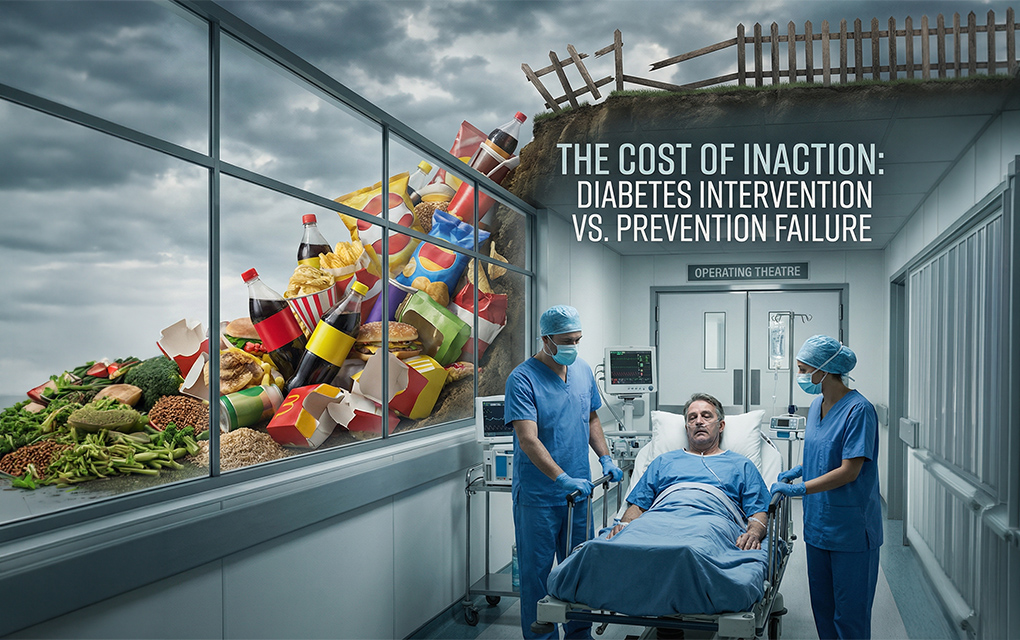
In a way, what we’re seeing here is a ‘clash’ of two titans. Both hold eminent respect in their fields, but on this one, I think Swinburn is right. The Roadmap represents nothing more than a glossy ambulance parked at the bottom of a cliff we built ourselves.
The numbers tell the story here, and it’s not pretty.
The baseline review released alongside the Roadmap is a sobering read. Diabetes now consumes $2.1 billion of Health NZ’s annual budget — 8.15% of all Vote Health funding. And if nothing changes, that figure will balloon to $3.9–$4.8 billion by 2040.
Diabetes makes everything worse
Twelve per cent of all hospital discharges involve someone with diabetes, but those same patients consume 21% of all bed days — because diabetes makes everything worse, from heart disease to infections to amputations.
And the inequity is staggering. Māori, Pacific, and Indian communities carry the heaviest burden, with prevalence rates two to four times higher than other groups. Counties Manukau now sits at a jaw‑dropping 105 cases per 1,000 people for Māori and 146 per 1,000 for Pacific peoples.
These are not numbers. These are lives. These are whānau. These are preventable tragedies.
The Roadmap’s fatal flaw is that it pretends the fire started yesterday.
It talks about “slowing progression,” “improving care,” and “equitable access to bariatric surgery.” All worthy. All necessary. All downstream.
But where is the upstream action?
Where is the fence at the top of the cliff?
Swinburn’s frustration is palpable — and justified. The government has once again sidestepped internationally proven policies that actually reduce obesity and diabetes:
- A serious sugary drinks levy
- Banning junk‑food marketing to children
- Mandatory front‑of‑pack warning labels
- Properly funded school lunches for all kids
These aren’t radical ideas. They’re standard practice in countries that take public health seriously. Norway, Mexico, Chile, the UK — half the world has already moved!
Meanwhile, our government is still clinging to the tired, failed strategy of “working with industry to reduce sugar in drinks.” As Swinburn notes, this approach has been proven to be a total failure.
How did we get here?
If you want to understand the diabetes crisis, you don’t start in a hospital ward. You start in the supermarket aisle.
A new analysis published last week shows that New Zealand’s imports of ultra‑processed foods (UPFs) have exploded from 16 kg per person in 1990 to 104 kg in 2023. UPFs now make up 22% of all food imports, and around 70% of packaged foods in our supermarkets.
These products — engineered for overconsumption, stripped of nutrients, and aggressively marketed — are directly linked to obesity, type 2 diabetes, heart disease, kidney disease, and depression.
And let’s be honest: this didn’t happen by accident.
Over the past 40 years, we replaced scratch cooking with industrial convenience. We outsourced our kitchens to multinational corporations. We lost our personal connection to food at the exact moment we needed it most. Back then, the ‘best’ nutrition advice many of us got was from Popeye, who told us to eat spinach. Look at the outcome now.
The Roadmap pretends this history doesn’t exist.
Yes, the document acknowledges obesity as a driver of diabetes — then promptly avoids every policy that would meaningfully reduce it. Instead, it leans heavily on clinical interventions: bariatric surgery, foot care, weight‑management guidelines, and the possibility of a diabetes register.
Important? Yes.
Sufficient? Absolutely not.
Food system problem
We cannot treat our way out of a food‑system problem. But what does prevention actually look like?
Well, Swinburn’s list is far from theoretical. These policies work. They have been implemented, studied, refined, and shown to shift national health profiles. But here’s the part that frustrates me most: we already know lifestyle change works at the individual level, too.
I’ve seen it.
You’ve seen it.
Thousands of New Zealanders living a whole‑food, plant‑based lifestyle have seen it. I personally know — as do many in our Whole Food Living community — that you can radically alter your type 2 diabetes profile within weeks by changing what’s on your plate.
Not through gimmicks.
Not through deprivation.
Not through expensive supplements.
Through real food. Whole food. Food that looks like it came from the earth, not a factory.
If individuals can achieve this in their own kitchens, imagine what could be done at a population level with supportive national policy in place.
The blind spot
The Roadmap claims to “strengthen the approach to prevention,” but the only prevention measure it names is a vague commitment to “improving food policies.” That’s not a plan. That’s a placeholder.
Prevention is not a vibe.
Prevention is not a paragraph.
Prevention is a suite of policies that reshape the environment in which people make choices.
Right now, our environment is engineered for diabetes.
And the Roadmap leaves that environment untouched.
I admire Sir Jim Mann’s determination. His decades of work have saved countless lives, and his optimism is genuine. But optimism without prevention is just wishful thinking.
An uncomfortable truth
If we want to turn the tide on diabetes, we must confront an uncomfortable truth:
New Zealand’s food system is making us sick, and our government still refuses to regulate it.
We don’t need more ambulances.
We need fences.
We need courage.
We need leadership that values public health over industry comfort.
Until then, the Roadmap is just that — a map with no road.