


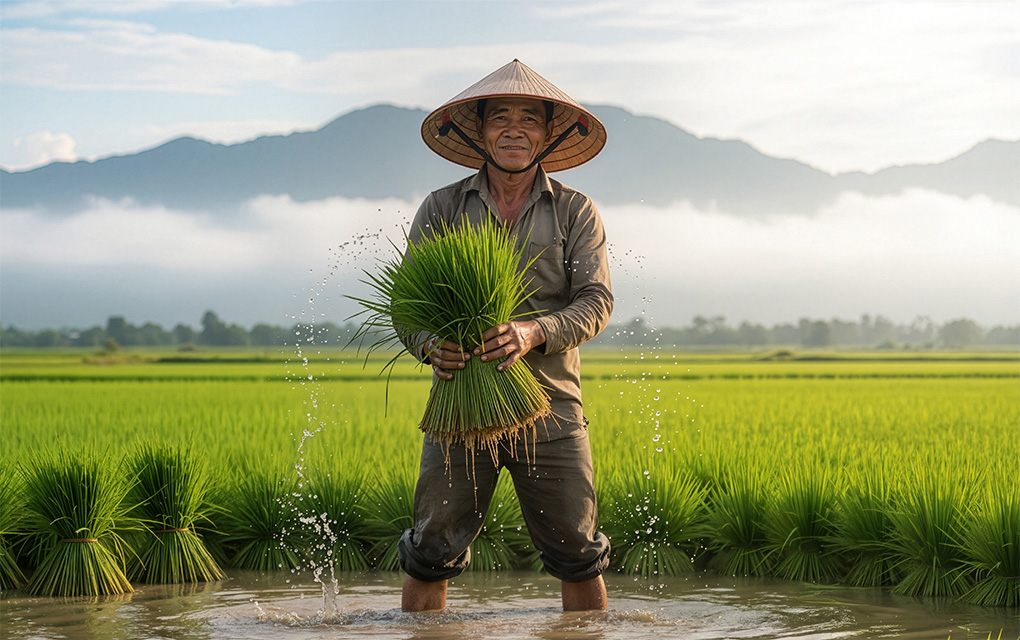

Rice may soon grow more food with far less fertiliser, thanks to a newly identified “master regulator” gene that helps plants stay productive even when nitrogen is scarce. For a world grappling with climate change, rising fertiliser costs, and the urgent need to feed billions sustainably, this discovery offers a rare combination of scientific elegance and practical promise.
Researchers from the University of Oxford, Nanjing Agricultural University, and the Chinese Academy of Sciences have pinpointed a gene in rice—WRINKLED1a—that acts as a central switchboard for how the plant allocates energy between roots and shoots when nitrogen is limited.
Plants typically respond to low nitrogen by diverting resources into root growth to forage for nutrients. While this is adaptive in the wild, it comes at a cost: fewer resources for shoots and grain production. Until now, the molecular mechanism behind this trade-off has been a mystery.
The new study, published in Science, shows that WRINKLED1a helps rice maintain both root and shoot growth even under nitrogen stress. Plants with a stronger version of the gene avoid the usual “more roots, fewer shoots” compromise and keep producing grain at higher levels.
Remarkable results
The research team screened more than 3,000 rice cultivars to identify a naturally stronger allele of WRINKLED1a. When this improved version was bred into rice plants, the results were remarkable:
- 23.7% higher yields under low nitrogen fertiliser (120 kg/ha)
- 19.9% higher yields even under high fertiliser input (300 kg/ha)
- More stable root-to-shoot ratios across changing nitrogen conditions
In field trials across Hainan and Anhui provinces, the enhanced plants consistently outperformed standard varieties. For farmers, this could mean maintaining or increasing yields while using significantly less fertiliser—a major economic and environmental win.
Dr Zhe Ji of the University of Oxford described the results as “extraordinary,” noting how clearly the improved gene boosted yields in real-world conditions.
Rice feeds more than half the world’s population, yet its production is increasingly vulnerable. Every 1°C rise during the growing season can reduce yields by more than 8%, and nitrogen fertiliser—one of the biggest costs for rice farmers—contributes heavily to greenhouse gas emissions, water pollution, and soil degradation.
A gene that helps rice thrive with less nitrogen could:
- Reduce reliance on synthetic fertilisers
- Lower production costs for farmers
- Cut agricultural emissions
- Improve resilience in a warming climate
- Support food security for billions
Ripple effects
The research highlights how deeply interconnected soil health, plant biology, and sustainable food systems truly are. It also reinforces a core principle of lifestyle medicine and ecological nutrition: when we work with nature’s own regulatory systems, the benefits ripple outward—from the microscopic to the planetary.
WRINKLED1a plays different roles in different parts of the plant:
- In shoots, it activates NGR5, a gene that promotes branching and supports grain production.
- In roots, it boosts nitrogen uptake and prevents the formation of a protein complex that normally suppresses auxin, the hormone that drives root growth.
- Crucially, it does this in a tissue-specific way—fine-tuning growth rather than triggering a one-size-fits-all response.
This precision is what makes WRINKLED1a such a powerful target for crop improvement.
Next steps
Lead author Dr Shan Li notes that the next step is to explore whether similar genes in wheat, maize, and other staple crops can be harnessed in the same way. If so, this discovery could mark the beginning of a new generation of climate-smart crops that maintain yields while reducing environmental impact.
For countries like New Zealand—where farmers face increasing pressure to reduce nitrogen runoff—such innovations could help bridge the gap between productivity and sustainability.
This research underscores a broader shift in global agriculture: moving away from heavy chemical inputs and toward crops that are naturally efficient, resilient, and aligned with ecological principles.
It’s a reminder that the future of food may depend as much on molecular biology as on farming practices—and that the most powerful solutions often come from understanding how plants already manage their own resources.