



by Peter Barclay
Chronic disease doesn’t emerge in a vacuum. It doesn’t simply “happen” because individuals make poor choices or lack willpower. Increasingly, global research shows that chronic disease patterns mirror the fingerprints of powerful industries whose products drive harm — and whose internal documents reveal deliberate strategies to shape public behaviour, scientific understanding, and political regulation.
In late March, The New England Journal of Medicine published a paper on Corporate Vectors of Chronic Disease, which highlights a truth public health researchers have been piecing together for decades: when harmful product industries are left to shape the food, marketing, and policy environments, the result is predictable — rising rates of preventable disease.
For Whole Food Living, the article (authored by the Consortium of the Centre to End Corporate Harm at the University of California) isn’t just a story about corporate misconduct. It’s a story about how environments are engineered, how confusion is manufactured, and ultimately how whole‑food, plant‑based living becomes a form of resistance — a way to reclaim autonomy in a system designed to nudge us toward illness.
Internal industry documents — often released through litigation, whistle‑blowers, or public‑records requests — provide a rare window into how harmful‑product industries operate behind closed doors. They show patterns that repeat across sectors: tobacco, alcohol, ultra‑processed foods, sugar, fossil fuels, and even pharmaceuticals.
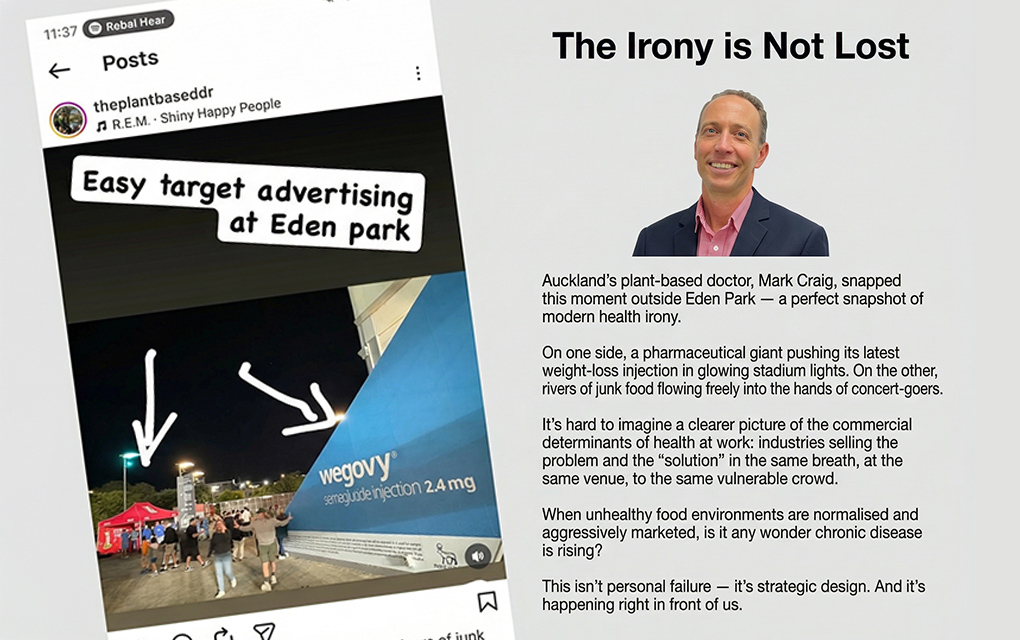
Across these industries, the documents reveal five recurring strategies.
1. Engineering for maximum consumption
One of the most consistent themes revealed in the paper is intentional product design aimed at increasing consumption, even when it harms health.
- Tobacco documents show deliberate manipulation of nicotine levels to maximise addiction.
- Ultra‑processed food companies use “bliss point” engineering — precise combinations of sugar, fat, and salt that override satiety signals.
- Sugary‑drink manufacturers have internal memos acknowledging that their products drive metabolic disease, yet continue to target heavy users.
These industries don’t rely on chance. They rely on biology — specifically, exploiting reward pathways to keep people coming back.
The value of whole food, plant‑based eating is that it disrupts this cycle by shifting the palate back toward natural flavours, fibre‑rich foods, and genuine satiety. It’s not just healthier; it’s de‑engineered.
2. Shaping science, protecting profits
Internal documents repeatedly show industries funding research designed not to discover truth, but to create doubt.
The sugar industry famously paid researchers in the 1960s to downplay sugar’s role in heart disease and shift blame to dietary fat. Tobacco companies funded decades of “controversy” over whether smoking caused cancer. Fossil‑fuel companies privately acknowledged climate impacts while publicly questioning the science.
Ultra‑processed food companies now use similar tactics:
- Funding studies that compare their products to even worse alternatives
- Sponsoring nutrition conferences
- Creating front groups that appear independent
- Funding “energy balance” research that blames obesity on inactivity rather than diet
The goal is always the same: manufacture uncertainty, delay regulation, and keep consumers confused.
For Whole Food Living readers and other WFPB followers, the antidote is simple: independent, peer‑reviewed research, not industry‑funded narratives.
3. Targeting the vulnerable
Internal documents show that harmful‑product industries identify and target communities with the highest potential for profit — often those already facing structural disadvantage. Examples include:
- Tobacco companies targeting Māori and Pasifika communities in Aotearoa with menthol products and culturally tailored advertising
- Sugary‑drink companies saturating low‑income neighbourhoods with billboards and price promotions
- Fast‑food chains clustering around schools, sports clubs, and transport hubs
- Alcohol companies sponsoring youth‑adjacent events and sports teams
These strategies aren’t accidental. They’re calculated.
A whole‑food, plant‑based lifestyle becomes a form of community protection — a way to build resilience against environments designed to exploit vulnerability.
4. Influencing policy
Internal documents reveal extensive political strategies:
- Lobbying against taxes on harmful products
- Funding political campaigns
- Drafting legislation for policymakers
- Creating “astroturf” groups that appear grassroots
- Pressuring governments to adopt voluntary guidelines instead of enforceable regulations
In New Zealand, we see echoes of this in debates over sugar taxes, front‑of‑pack labelling, and supermarket regulation. The supermarket duopoly itself — with its control over pricing, placement, and promotions — is a structural vector of chronic disease.
When policy is shaped by industry rather than public health, the food environment becomes an obstacle course.
5. Normalising Through Culture
Perhaps the most insidious strategy is cultural engineering. Internal documents show industries working to embed their products into everyday life:
- Alcohol as the centrepiece of socialising
- Fast food as a reward or family treat … and even worth going to Hell for, according to a New Zealand-based pizza chain.
- Sugary drinks as symbols of youth, freedom, or sport
- Ultra‑processed snacks as “fuel” for busy lifestyles
Marketing isn’t just about selling products. It’s about shaping identity.
Whole‑food living challenges this by offering a different cultural narrative — one centred on nourishment, connection, and genuine wellbeing.
A counter-strategy
When you understand the strategies harmful‑product industries use, whole food living becomes more than a dietary choice. It becomes a structural counter‑move. Here’s how.
1. It removes you from the reengineered food system
Whole foods aren’t designed in a lab. They don’t rely on addictive combinations of sugar, fat, and salt. They don’t override satiety signals. They don’t require marketing budgets. They simply nourish.
By choosing whole foods, you opt out of the engineered consumption cycle.
2. It reduces exposure to industry‑driven disease vectors
Ultra‑processed foods are now linked to:
- Cardiovascular disease
- Type 2 diabetes
- Depression
- Obesity
- Certain cancers
- All‑cause mortality
These associations persist even when controlling for calories, exercise, and socioeconomic status. A whole‑food, plant‑based diet dramatically reduces exposure to these risk vectors — not through restriction, but through abundance.
3. It rebuilds biological resilience
Fibre, phytonutrients, antioxidants, and plant‑based proteins support:
- Gut microbiome diversity
- Immune regulation
- Metabolic flexibility
- Reduced inflammation
- Improved vascular function
These are the very systems undermined by harmful‑product industries.
Whole‑food living restores what the corporate food environment erodes.
4. It strengthens cultural autonomy
When communities reclaim food traditions — gardening, cooking, sharing meals, supporting local growers — they weaken the influence of industries that profit from disconnection.
In Aotearoa, this aligns with kaupapa Māori approaches to hauora, where food is relational rather than transactional.
5. It cuts through manufactured confusion
Whole‑food living is refreshingly simple:
- Eat plants
- Eat them close to their natural form
- Eat a variety
- Let fibre and colour guide you
No marketing spin. No engineered bliss points. No industry‑funded “balance” narratives. Just clarity.

Reclaiming agency
The NEJM piece underscores a critical truth: chronic disease is not an individual failure. It is the predictable outcome of environments shaped by industries whose profits depend on consumption patterns that harm health.
Internal documents make this undeniable. But they also illuminate a path forward.
Whole‑food, plant‑based living is not just a personal health choice. It is a structural counter‑strategy — one that reduces exposure to harmful products, strengthens biological resilience, and builds community autonomy.
It is a way of stepping out of the system that profits from illness and stepping into one that cultivates wellbeing. And in a world where chronic disease is rising, that shift is both radical and necessary.