


by Catherine Barclay
It’s often said that a move toward whole, plant-rich eating can make you feel more energised, clearer in the head and simply more alive, but honestly, Peter and I can’t say we immediately experienced this. I believe we both felt better initially because we knew we were doing something good for ourselves, but we took it too slowly. Then something ‘magical’ happened.
For me, I suddenly realised that the sharp, short first-step pain when I got out of bed each morning was completely gone. I can’t remember how long I’d had it, but it was quite a while. It was consistently there and very annoying.

This is the fourth in our fortnightly Healthy Food Series. The series consists of 12 features exploring the science, culture and shared joy of natural eating … The previous article in this series covered ‘Nitric oxide pathways‘ – How greens help your blood vessels breathe.
I wanted to know more about this, so we caught up with our plant-based doctor somewhere between his early-morning silent rave at the Port of Auckland and his next cycle ride. Was I imagining this?
“Ah, yes”, he said, “that’s Plantar Fasciitis”.
“You mean it’s got a name?” Probably a silly question, since he’d already said what it was, but why was it gone?
“Hmm, not sure if there are any studies on whether a plant-based diet actually gets rid of it, but it is an inflammatory reaction, and plant-based eating certainly reduces inflammation.”
By this point, Peter’s blood tests had significantly changed for the better, and between the two of us, we were losing our dependence on oil. Our taste buds had altered, our curiosity kept increasing, and with that, I’d like to introduce you to the marvels of mitochondria because I know what has happened to us has occurred at a cellular level.
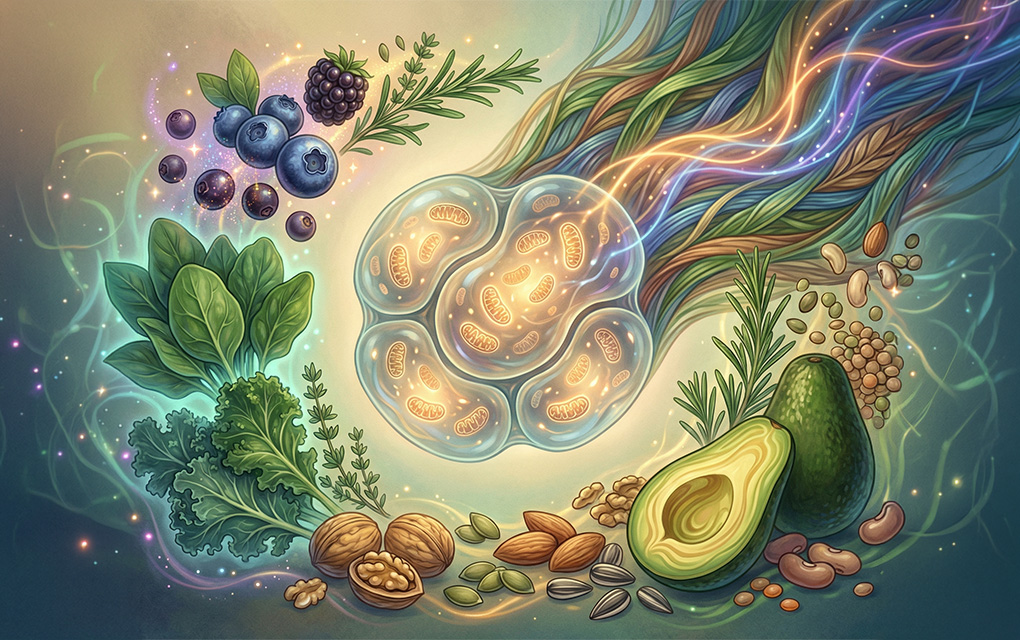
Mitochondria are tiny biological powerhouses responsible for turning the food we eat into usable energy. These organelles are constantly at work, converting carbohydrates, fats, and even some amino acids into ATP, the molecule that fuels everything from muscle contraction to brain signalling.
When mitochondria are running smoothly, energy feels steady and reliable. When they’re under strain, everything from fatigue to inflammation to slower recovery can follow.
The good news is that mitochondria respond remarkably well to the foods we eat. Whole foods – especially plants – provide the raw materials, protective compounds, and metabolic signals that help mitochondria function at their best. In other words, the way we eat can literally energise us from within.
This article explores how whole foods support mitochondrial efficiency, why this matters for everyday wellbeing, and how simple dietary shifts can help your cells thrive.
The mitochondria – Whole food connection
Mitochondria aren’t just passive engines. They’re dynamic, responsive, and deeply influenced by their environment. They sense nutrient availability, oxidative stress, inflammation, and even microbial signals from the gut.
Whole foods—rich in polyphenols, minerals, healthy fats, and diverse fibres—provide the ideal conditions for mitochondria to flourish. Ultra‑processed foods, on the other hand, tend to do the opposite: they increase oxidative stress, reduce nutrient density, and disrupt the gut–cell communication that mitochondria rely on.
Let’s break down the key ways whole foods support mitochondrial health.
Polyphenols: Cellular bodyguards for mitochondria
Polyphenols are natural plant compounds found in berries, herbs, spices, teas, cocoa, and colourful fruits and vegetables. They’re often celebrated for their antioxidant properties, but their real magic lies in how they modulate cellular signalling.
Inside mitochondria, energy production naturally generates reactive oxygen species. In small amounts, reactive oxygen species are normal and even helpful. But when they accumulate—due to stress, poor diet, or inflammation—they can damage mitochondrial membranes, enzymes, and DNA.
Polyphenols help by:
- Reducing oxidative stress inside mitochondria
- Supporting mitochondrial biogenesis, the creation of new mitochondria
- Improving mitochondrial membrane integrity
- Enhancing cellular resilience to stress
Blueberries, rosemary, turmeric, green tea, and dark leafy greens are particularly rich sources. These foods don’t just “fight free radicals”—they help mitochondria operate in a cleaner, more efficient way.
This is one reason people often feel a noticeable lift when they increase their intake of colourful plant foods. It’s not just nutrients; it’s cellular optimisation.
Healthy fats: Clean-burning fuel for energy production
While carbohydrates are the body’s quickest source of energy, fats—especially whole‑food fats—are an incredibly efficient and stable fuel for mitochondria.
Healthy fats from nuts, seeds, avocados, and olives provide:
- Steady, slow‑burning energy
- Essential fatty acids that support mitochondrial membranes
- Anti‑inflammatory compounds that reduce metabolic stress
- Improved metabolic flexibility, allowing the body to switch between fuel sources more easily
Unlike the damaged fats found in processed foods, whole‑food fats come packaged with antioxidants, fibre, and minerals that support metabolic balance.
Walnuts, flaxseeds, chia seeds, and hemp seeds are especially beneficial because they contain ALA, a plant‑based omega‑3 that supports mitochondrial structure and function.
Avocados, meanwhile, offer monounsaturated fats that help stabilise energy levels throughout the day.
When mitochondria have access to clean, unprocessed fats, they produce ATP more efficiently and with fewer metabolic by‑products.
Magnesium: The unsung hero of ATP production
If ATP is the body’s energy currency, magnesium is the mint that prints it. Every molecule of ATP must bind to magnesium to become biologically active. Without adequate magnesium, energy production slows, muscles fatigue more easily, and metabolic processes become less efficient.
Magnesium is abundant in:
- Leafy greens (spinach, silverbeet, kale)
- Legumes (lentils, chickpeas, black beans)
- Nuts and seeds
- Whole grains
- Cacao
These foods provide magnesium in its most bioavailable form, alongside other minerals and phytonutrients that support mitochondrial enzymes.
Modern diets—especially those high in processed foods—tend to be low in magnesium. This is one reason people often experience improved energy, sleep, and muscle recovery when they shift toward whole foods. They’re finally giving their mitochondria the minerals they need to do their job.
Plant diversity: Feeding the microbiome, supporting the mitochondria
It may seem surprising, but your gut microbes have a direct influence on mitochondrial function. The microbiome produces metabolites—especially short‑chain fatty acids (SCFAs)—that communicate with mitochondria throughout the body.
SCFAs such as butyrate, acetate, and propionate:
- Reduce inflammation
- Improve insulin sensitivity
- Support mitochondrial biogenesis
- Enhance cellular energy production
- Influence appetite and metabolic balance
These SCFAs are produced when gut bacteria ferment dietary fibre, particularly from legumes, oats, apples, onions, garlic, and leafy greens.
A diverse plant‑rich diet leads to a diverse microbiome, which in turn sends healthier, more balanced signals to mitochondria. This gut–cell communication is one of the most powerful ways whole foods support long‑term energy and metabolic health.
Why mitochondrial efficiency matters for everyday life
When mitochondria are functioning well, the effects ripple outward into nearly every aspect of wellbeing. People often describe it as feeling “lighter,” “clearer,” or “more themselves.”
Here’s what efficient mitochondria support:
Steadier energy levels
Instead of the peaks and crashes associated with processed foods, whole‑food‑fuelled mitochondria provide a more stable supply of ATP.
Better metabolic health
Efficient mitochondria help regulate blood sugar, reduce inflammation, and support healthy weight balance.
Improved recovery
Muscles repair faster, oxidative stress decreases, and the body bounces back more easily from physical or emotional strain.
Sharper cognitive function
The brain is one of the most energy‑hungry organs. When mitochondria are thriving, mental clarity and focus often improve.
Enhanced resilience
Healthy mitochondria help cells respond to stress, toxins, and inflammation more effectively.
This is why people transitioning to a whole‑food, plant‑forward lifestyle often report feeling more vibrant. It’s not just psychological—it’s cellular.
Practical ways to support your mitochondria every day
You don’t need supplements or complicated protocols. Whole foods do the heavy lifting. Here are simple, everyday strategies:
1. Eat the rainbow
Aim for a variety of colourful fruits and vegetables to maximise polyphenol intake.
2. Include healthy fats daily
A handful of nuts, a spoonful of seeds, or half an avocado can make a meaningful difference.
3. Prioritise magnesium-rich foods
Think leafy greens, legumes, whole grains, and cacao.
4. Boost plant diversity
Try to include 20–30 different plant foods each week. Even herbs count.
5. Choose whole over processed
Minimise (but preferably exclude) refined oils, sugars, and additives that increase oxidative stress.
6. Support your microbiome
Include prebiotic fibres (onions, garlic, leeks, oats) and fermented foods (sauerkraut, kimchi, miso).
7. Stay hydrated
Water is essential for mitochondrial enzyme function and nutrient transport.
These habits don’t just support energy—they support long‑term metabolic and cellular health.
The bigger picture: whole foods as cellular communication
One of the most fascinating aspects of mitochondrial science is the idea that food is not just fuel—it’s information. Whole foods contain thousands of compounds that communicate with our cells, influencing everything from gene expression to inflammation to energy production.
When we eat whole foods, we’re sending mitochondria a message of abundance, balance, and resilience. When we eat ultra‑processed foods, the message is one of stress, scarcity, and imbalance.
This is why the shift toward whole foods can feel so transformative. It’s not just about nutrients—it’s about restoring harmony at the cellular level.
Energising the body from the inside out
Mitochondria may be microscopic, but their impact on our wellbeing is enormous. By supporting these tiny powerhouses with whole, plant‑rich foods, we nourish the very foundation of our energy, metabolism, and vitality.
Polyphenols protect them. Healthy fats fuel them. Minerals like magnesium enable them. And plant diversity—through the microbiome—helps regulate their function.
When mitochondria thrive, we thrive.
And that’s the quiet, powerful truth behind the renewed energy so many people feel when they embrace whole‑food living.
If you’re looking for a way to feel more energised, grounded, and clear from the inside out, start with your plate. Your mitochondria are listening.