

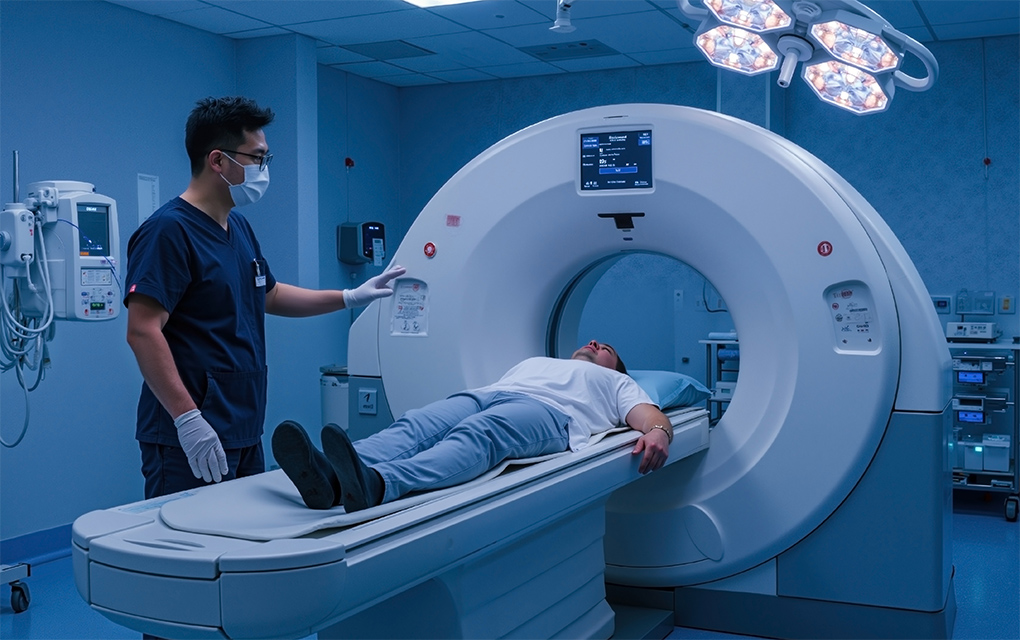

For decades, cardiac CT scans have been the workhorse of modern cardiology—quick, non‑invasive, and reliable for spotting clogged arteries. But new research from Kumamoto University suggests these scans may soon do something far more powerful: reveal hidden heart damage long before symptoms appear, giving clinicians a chance to intervene earlier and more precisely than ever.
In a study of more than 1,200 patients, researchers found that a standard CT scan—when enhanced with a brief “delayed phase”—can detect subtle, widespread injury to the heart muscle that typically goes unnoticed.
And when two specific markers from this enhanced scan are combined, they become a remarkably accurate predictor of who is most likely to face heart failure, hospitalisation, or even premature death in the years ahead.
Seeing what’s hidden
Traditional CT scans focus on the coronary arteries, searching for blockages that restrict blood flow. But the Kumamoto team, led by Professors Yasuhiro Izumiya and Kenichi Tsujita, wanted to know whether the same scan could also reveal deeper, more diffuse forms of heart injury.
Their approach centred on two markers:
- Late Iodine Enhancement (LIE) — highlights localised scarring in the heart muscle
- Extracellular Volume (ECV) — detects subtle, widespread tissue damage that often precedes more serious disease
Individually, each marker offers a glimpse into the heart’s structural health. Together, they create what the researchers describe as a “synergistic” picture—one that captures both the visible and the invisible.
Patients showing abnormalities in both LIE and ECV were significantly more likely to experience unplanned hospitalisations or death during the 26-month follow-up period. In other words, the scan didn’t just show what had already happened to the heart—it forecasted what was likely to happen next.
A potential shift
This matters because the current gold standard for detecting subtle heart muscle damage is cardiac MRI—an excellent tool, but expensive, time‑consuming, and not widely available. CT scans, by contrast, are fast, accessible, and already part of routine cardiac care.
If a single CT scan can reliably identify high‑risk patients, it could transform how clinicians triage care:
- Earlier intervention for people who appear healthy but carry hidden risk
- More targeted treatment for those with early signs of heart muscle injury
- Reduced reliance on MRI, freeing up resources for complex cases
- Better long‑term monitoring, especially for patients with diabetes, hypertension, or chronic inflammation—conditions known to quietly damage the heart over time
For Whole Food Living readers, this research underscores a broader truth: heart disease is not always loud. It doesn’t always announce itself with chest pain or dramatic symptoms. Sometimes the earliest signs are microscopic: changes in tissue structure, shifts in cellular space, tiny scars accumulating over years.
Prevention-focused living
Lifestyle medicine has long emphasised the importance of catching disease early, ideally before it becomes symptomatic. This study adds a new layer to that philosophy: technology that can detect risk even before traditional tests raise alarms.
For individuals already committed to whole‑food nutrition, movement, stress reduction, and sound sleep routines, this kind of imaging could offer reassurance—or early warning—without waiting for a crisis.
And for clinicians, it opens the door to a more nuanced understanding of heart health, one that blends structural imaging with lifestyle‑driven prevention.
The bottom line
A routine CT scan may soon become one of the most powerful tools in preventive cardiology. By revealing both visible scars and subtle, diffuse damage, it offers a clearer picture of who is at risk—and a chance to act before heart failure takes hold.
As the researchers put it, combining LIE and ECV allows doctors to detect “potential heart damage that might otherwise be missed”. For a condition as widespread and deadly as heart disease, that’s not just a technical breakthrough; it’s a lifeline.